Nomenclature of Ionic compounds, Molecular Compounds, Binary and Oxy-acids, and Intro to the Mole
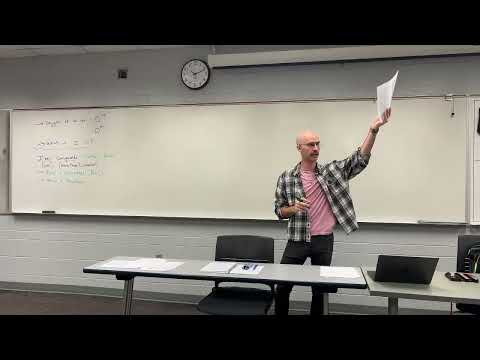 Watch on YouTube →
Overview
John Flood Chemistry reviews ionic-compound formulas and names, including polyatomic ions, transition-metal charges, empirical ratios, and hydrated salts, then teaches binary molecular-compound and acid nomenclature. The lecture concludes with the mole as 6.022 × 10²³ entities and uses molar mass to connect particle counts with measurable grams, while preparing students for a roughly 50-question, two-hour unit test.
Key takeaways
- Ionic formulas must be electrically neutral and reduced to the lowest whole-number ratio; balancing Cu²⁺ with SO₄²⁻ gives CuSO₄, not Cu₂(SO₄)₂.
- A Roman numeral in a name such as iron(III) oxide identifies the transition metal’s charge; Fe₂O₃ contains two Fe³⁺ ions and three O²⁻ ions.
- Parentheses group a polyatomic ion only when a subscript applies to multiple copies, as in (NH₄)₂S; a single sulfate unit is written SO₄ without parentheses.
- Binary molecular prefixes report atom counts directly, while ionic formulas rely on charge balance; SF₆ is sulfur hexafluoride and NO₂ is nitrogen dioxide.
- Acid names reveal their source: binary acids use hydro- and -ic acid, while oxyacids convert -ate to -ic and -ite to -ous, as in HCl versus HClO₃.
- One mole always contains 6.022 × 10²³ entities, but its mass depends on the substance; H₂CO₃ has a molar mass of approximately 62.03 g/mol.
Chapters
0:00
Unit 1–2 Test Preparation and Course Logistics
- John Flood Chemistry slows down to clarify material before moving into Unit 3, prioritizing readiness for the first major assignment.
- The practice test approximates the unit test’s format: roughly 50 questions and two hours, with lockdown browser as the main difference.
- Students are reminded that the drop deadline is the last chance to withdraw and receive a refund.
2:20
Periodic-Table Families and Oxygen’s −2 Ion
- Oxygen is a Group 6A nonmetal two columns from the noble gases, so it typically gains two electrons to form O²⁻.
- The class distinguishes oxygen’s ionic charge from the written order of charge notation; either −2 or 2− communicates the charge.
- Iodine belongs to the halogen family, and recognizing family names becomes easier through repeated practice.
5:45
Ionic Compounds: Metal–Nonmetal Pairing and Naming Order
- A compound contains more than one element; an ionic compound consists of oppositely charged ions from different elements.
- Sodium chloride illustrates the standard metal-first, nonmetal-second order in both formula and name.
- The anion name changes its ending, as chlorine becomes chloride, while the cation is named first.
8:05
Copper(II) Sulfate and Empirical Ionic Formulas
- Copper sulfate combines Cu²⁺ with sulfate, SO₄²⁻; the Roman numeral in copper(II) identifies copper’s charge, not the number of copper atoms.
- Crisscrossing the charges might initially suggest Cu₂(SO₄)₂, but ionic formulas must be reduced to the lowest whole-number ratio: CuSO₄.
- Treat sulfate as one polyatomic unit rather than separating its sulfur and oxygen atoms when balancing an ionic formula.
10:40
Polyatomic Ions with Nonmetals: Ammonium Sulfide
- A polyatomic ion contains multiple atoms but acts as a single charged unit; ammonium is NH₄⁺ and sulfide is S²⁻.
- Two ammonium ions are needed to balance one sulfide ion, giving ammonium sulfide the formula (NH₄)₂S.
- Parentheses preserve the integrity of a polyatomic ion when a subscript applies to the entire ion.
16:20
Combining Two Polyatomic Ions and Using Parentheses
- Ionic compounds can pair a polyatomic cation with a polyatomic anion, as in ammonium cyanide, NH₄CN.
- Hydronium carbonate balances H₃O⁺ against CO₃²⁻ to form (H₃O)₂CO₃; omit parentheses around a polyatomic ion when only one is present.
- The class discusses that charge-balanced combinations need not all be common or familiar compounds.
20:45
Oxyanion Families, Oxygen Counts, and Study Practice
- Within an oxyanion family, an -ate ion has more oxygens than its corresponding -ite ion; the suffix indicates a relative difference, not an exact count.
- The per- and hypo- prefixes are highlighted for the chlorine oxyanion family, while charges must be learned separately from oxygen-count patterns.
- John recommends flashcards plus practice writing formulas and names, including handwritten deliberate-practice problems.
24:00
Ionic Nomenclature Practice and Variable-Charge Metals
- Students practice deriving formulas by balancing ion charges to the lowest whole-number ratio, then naming the resulting compounds.
- Transition-metal charges generally cannot be predicted from periodic-table position; copper can commonly form Cu⁺ or Cu²⁺.
- A Roman numeral is required for a metal with multiple common charges, and it specifies the metal’s charge rather than its atom count.
32:00
Hydrates, Monatomic Ions, and Formula-Writing Conventions
- Hydrate names such as pentahydrate indicate water associated with an ionic crystal; the water is written after a dot with a coefficient.
- For example, five waters are represented as ·5H₂O, not as an H₂O subscript or as part of a newly combined molecular formula.
- Use parentheses for repeated polyatomic ions, not for monatomic ions such as Na⁺ or O²⁻.
39:35
Correcting Chlorate Charges and Working Backward from Formulas
- John corrects a handout error: perchlorate, chlorate, chlorite, and hypochlorite each carry a −1 charge; the bromate and iodate analogues do too.
- The table’s column relating oxygen atoms and charge is not a dependable way to infer ion charge; identify each ion and its charge separately.
- For a transition-metal oxide such as zinc oxide, use known oxide charge and zinc’s usual +2 charge to write ZnO.
46:00
Salt Meaning, Hydrated Crystals, and Iron(III) Oxide
- In chemistry, a salt means an ionic compound, not only table salt; hydrated salts contain water molecules in their crystal lattice.
- The formula Fe₂O₃ has two Fe³⁺ ions balancing three O²⁻ ions, so its name is iron(III) oxide.
- The Roman numeral identifies iron’s +3 charge, not the subscript 2 that counts iron ions in the empirical formula.
53:30
Hydrate Formula Practice and Zinc Oxide Charge Reasoning
- Cobalt(I) nitrate pentahydrate is represented as CoNO₃·5H₂O: Co⁺ and NO₃⁻ balance one-to-one, with five waters shown after the dot.
- For reverse naming, use the formula’s subscripts and known ion charges to determine a variable-charge metal’s Roman numeral.
- Zinc is treated as Zn²⁺ and oxide as O²⁻, making zinc oxide’s simplest formula ZnO.
59:30
Molecular Compounds Versus Ionic Lattices
- Ionic solids such as sodium chloride form extended lattices and are reported using empirical formulas rather than discrete molecule counts.
- Molecules are discrete units, so a molecular formula preserves the actual atom ratio within each molecule; octane is C₈H₁₈, even though its empirical formula is C₄H₉.
- H₂ and O₂ are molecules but not compounds because each contains only one element.
1:03:00
Binary Molecular Names and Prefix Rules
- Binary molecular compounds contain two nonmetals that share electrons rather than forming cations and anions.
- The less electronegative element is named first; as a practical periodic-table guide, it is generally farther left or down than the second element.
- Use Greek prefixes to specify atom counts; omit mono- for the first element but include a prefix for the second.
1:09:10
Molecular Prefix Examples: SF₆, PI₃, and COCl₄
- SF₆ is sulfur hexafluoride: no mono- is used for the single first-element sulfur, while six fluorines require hexa-.
- PI₃ is phosphorus triiodide, and NO₂ is nitrogen dioxide; the second element’s ending changes to -ide.
- Prefix spelling can contract adjacent vowels, as in monoxide rather than monooxide, but triiodide retains the doubled i.
1:13:05
Binary Acids: Hydro- Naming for Hydrogen and a Nonmetal
- Binary acids contain hydrogen and one other element; their names use hydro- plus the nonmetal root and -ic acid.
- HF is hydrofluoric acid, while HCl is hydrochloric acid; analogous halogen examples include hydrobromic and hydroiodic acid.
- H₂S is hydrosulfuric acid in the binary-acid naming system; binary means two elements, not necessarily two atoms.
1:22:00
Molecular Prefixes and Binary-Acid Naming Boundaries
- The -ide ending in a molecular-compound name identifies the second element but does not mean that the atom has a negative ionic charge.
- Prefixes in names such as sulfur hexafluoride state atom counts directly, unlike ionic formulas, whose ratios come from charge balance.
- John contrasts binary acids such as H₂S with oxyacids to show why the presence or absence of oxygen changes the naming system.
1:27:30
Oxyacid Rules: -ate to -ic and -ite to -ous
- Oxyacids contain hydrogen and a polyatomic oxyanion; unlike binary acids, their names do not begin with hydro-.
- An -ate ion becomes an -ic acid, as carbonate produces carbonic acid; an -ite ion becomes an -ous acid.
- Prefixes such as hypo- remain in the acid name, as hypobromite becomes hypobromous acid.
1:33:30
Carbonic, Hypobromous, and Sulfuric Acid Examples
- H₂CO₃ contains carbonate, CO₃²⁻, and is named carbonic acid; carbonic acid forms when CO₂ reacts with water.
- HBrO contains hypobromite, BrO⁻, and is named hypobromous acid, retaining hypo- while changing -ite to -ous.
- H₂SO₄ is sulfuric acid because sulfate becomes an -ic acid; H₂S instead uses the binary name hydrosulfuric acid.
1:39:00
Hydrochloric, Chloric, Nitric, and Nitrous Acids
- HCl is hydrochloric acid, while chloric acid is an oxyacid derived from chlorate; the prefix hydro- distinguishes the binary acid.
- Chlorate is ClO₃⁻, so chloric acid is HClO₃; hypochlorite, ClO⁻, yields hypochlorous acid.
- Nitric acid HNO₃ comes from nitrate, NO₃⁻, while nitrous acid HNO₂ comes from nitrite, NO₂⁻.
1:44:30
Peroxyacid Naming and Per- Prefixes
- The per- prefix marks an oxyanion with more oxygen than its -ate counterpart, as periodate has more oxygen than iodate.
- Periodate is IO₄⁻, so its oxyacid is HIO₄, named periodic acid.
- Students practice moving from acid names back to formulas by identifying the parent oxyanion and balancing its charge with hydrogen.
1:49:00
The Mole as a Counting Unit
- A mole is a counting unit like a dozen, but one mole represents 6.022 × 10²³ entities.
- The counted entities can be atoms, molecules, ions, or even everyday objects; one mole of carbon contains 6.022 × 10²³ carbon atoms.
- One mole of carbon has a mass of about 12.01 g, connecting the mole to molar mass.
1:52:00
Molar Mass Connects Grams to Particle Counts
- Molar mass is the mass of one mole, expressed in g/mol; carbon’s molar mass is approximately 12.01 g/mol, matching its periodic-table atomic mass numerically.
- Calculate a compound’s molar mass by multiplying each element’s atomic mass by its subscript and summing; H₂CO₃ is about 62.03 g/mol.
- A mole has a fixed number of entities, not a fixed mass: one mole of oxygen atoms weighs more than one mole of carbon atoms.
Summary, takeaways, and chapters were generated by AI from the video's transcript and may contain errors. The video belongs to its creator, John Flood Chemistry.