Neutrinos: The ghost particle that could explain why you exist | with Kirsty Duffy
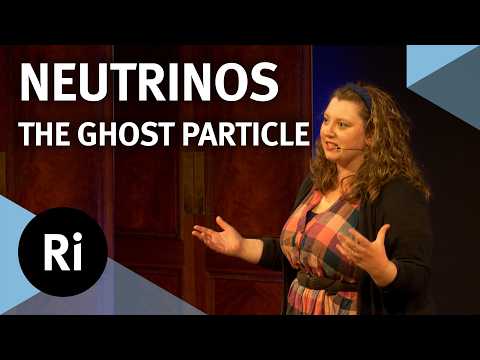 Watch on YouTube →
Overview
Kirsty Duffy, a particle physicist, explains neutrinos, the most abundant matter particles in the universe, which interact very rarely. She details their discovery, the "solar neutrino problem" resolved by neutrino oscillation (changing between electron, muon, and tau flavors), and how this phenomenon proves neutrinos have mass, challenging the Standard Model. Duffy highlights ongoing research, particularly the DUNE experiment, aiming to determine if neutrino and anti-neutrino oscillations differ, which could explain the universe's matter-antimatter asymmetry and why we exist.
Key takeaways
- Neutrinos are the most abundant matter particles in the universe, yet they interact so rarely they are called 'ghost particles'.
- Neutrino oscillation, the phenomenon where neutrinos change between electron, muon, and tau flavors, proves they possess mass, a discovery that necessitates extensions to the Standard Model of particle physics.
- The DUNE experiment, a massive underground detector in South Dakota, is designed to precisely measure neutrino oscillations and search for differences between neutrino and anti-neutrino behavior, which could explain the matter-antimatter asymmetry in the universe.
- The discovery of neutrino oscillation is a macroscopic quantum mechanical effect, demonstrating quantum phenomena can manifest over vast distances (hundreds to thousands of kilometers).
- The 'solar neutrino problem' was resolved by understanding that the Sun produces only electron neutrinos, but these transform into other flavors before reaching Earth, explaining the observed deficit in early experiments.
Chapters
0:00
Introduction to Particle Physics and Neutrinos
- Kirsty Duffy, a particle physicist, introduces neutrinos, the focus of her research.
- Particle physics explores fundamental questions: what are we made of, where did everything come from, and why do we exist?
- The Standard Model of particle physics categorizes fundamental particles into quarks, leptons, gauge bosons, and the Higgs boson.
5:40
The Standard Model and Neutrino Flavors
- The Standard Model organizes matter particles into three generations, each a heavier copy of the previous one.
- The three generations include up/down quarks, charm/strange quarks, and top/bottom quarks.
- Leptons include electrons, muons, and taus, each with a corresponding neutrino: electron neutrino, muon neutrino, and tau neutrino.
10:43
Abundance and Sources of Neutrinos
- Neutrinos are the most abundant matter particles, with about a billion neutrinos for every proton, neutron, or electron.
- They stream through us constantly, with ~100 billion passing through a thumbnail each second, mostly from the Sun.
- Neutrinos originate from the Big Bang, supernovae (carrying 99% of the energy), the Sun, Earth's core, nuclear reactors, and even bananas (due to potassium decay).
16:50
The 'Ghost Particle': Neutrino Interaction Properties
- Neutrinos are called 'ghost particles' because they interact extremely rarely, passing through matter almost unimpeded.
- On average, only one or two neutrinos interact with an atom in a human body over a lifetime.
- This low interaction rate is often described as neutrinos being 'small', but technically, fundamental particles are point-like with no intrinsic size.
30:12
Size, Cross-Section, and Fundamental Forces
- In particle physics, 'size' is related to the likelihood of interaction, or cross-sectional area.
- Neutrinos interact only via the weak nuclear force and gravity, the two weakest fundamental forces.
- Compared to an electron, a neutrino is a million times less likely to interact.
35:09
The Solar Neutrino Problem and Neutrino Oscillation
- The Sun produces only electron neutrinos through nuclear fusion.
- Early experiments (like Ray Davis's chlorine-based detector) measured significantly fewer electron neutrinos than predicted, creating the 'solar neutrino problem'.
- The resolution is neutrino oscillation: electron neutrinos change into muon and tau neutrinos as they travel from the Sun to Earth.
44:10
Detecting Neutrinos and Interpreting Data
- Neutrinos themselves are invisible; detection relies on observing charged particles produced when a neutrino interacts with an atom in a detector.
- The type of charged particle produced (electron, muon, tau) indicates the original neutrino flavor.
- The 'beach ball analogy' illustrates how observing only a sliver (like a specific neutrino flavor) can be misleading about the whole object (the neutrino's true nature).
50:01
Mass States vs. Flavor States and Quantum Mechanics
- Neutrinos exist as 'mass states' (nu1, nu2, nu3) which determine how they travel, and 'flavor states' (electron, muon, tau neutrinos) which determine how they interact via the weak force.
- Quantum mechanics dictates that a neutrino can be a mixture of mass states, and its flavor state changes probabilistically as it travels.
- This phenomenon, neutrino oscillation, is a macroscopic quantum effect occurring over hundreds or thousands of kilometers.
Summary, takeaways, and chapters were generated by AI from the video's transcript and may contain errors. The video belongs to its creator, The Royal Institution.