Nepal recovering from impact of flash floods 💻: Learn about the news in English 🗞️
 Watch on YouTube →
Overview
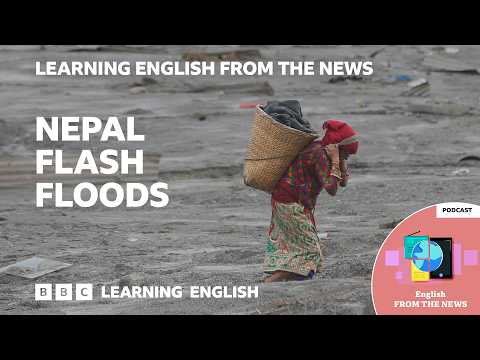
BBC Learning English covers the deadly flash floods on the Nepal–Tibet border, reporting more than 1,000 confirmed deaths, almost 4,000 people missing, and 279 workers rescued from hydropower sites. It explains the suspected Himalayan glacier collapse and teaches headline vocabulary—“over,” “trigger,” “imminent,” and “wipe out”—while describing the ongoing search, cleanup, and uncertainty about rebuilding.
Key takeaways
- The reported Nepal–Tibet border floods left more than 1,000 people confirmed dead and almost 4,000 missing, according to Nepal’s disaster agency.
- Rescuers were working to reach workers trapped in hydropower tunnels, and 279 people had already been rescued from the sites.
- The US Geological Survey identified a glacial collapse in the Himalayas as the cause of the floods, rather than the initially suspected earthquake and landslide.
- A newly formed lake near the Nepal–Tibet border raised concerns about a second flood, although experts said it could drain naturally over time.
- In headline English, trigger means cause something to start, imminent means likely to happen soon, and wipe out means destroy or remove completely.
- Over means finished in the phrase “not over”; it can also appear in “over and done with,” which conveys that something is finished and no longer needs attention.
Chapters
0:00
Nepal Flood Toll and the Meaning of “Over”
- Nepal’s disaster agency reports more than 1,000 confirmed deaths and almost 4,000 people still missing after floods on the Nepal–Tibet border.
- Rescuers are trying to reach workers trapped in hydropower-site tunnels; 279 people had been rescued from the sites.
- In the Sky News headline “clearly not over,” over means finished; the search for survivors and the disaster’s consequences continue.
3:28
Glacier Collapse, a Possible Second Flood, and “Trigger”
- The US Geological Survey attributed the disaster to a glacial collapse, rather than the initially suspected earthquake-triggered landslide.
- China warned that a newly formed lake near the border could cause another flood, while experts said it might drain naturally; imminent means likely to happen soon.
- The Independent uses trigger to mean cause something to start: the glacial collapse triggered the flash floods.
6:06
Flood Cleanup and What “Wipe Out” Means
- As the search for survivors continues, local residents have begun cleaning mud and debris from hospitals and schools.
- Bloomberg’s phrase “landscape wiped out” means the terrain or structures have been completely destroyed or changed, often suddenly.
- Wipe out also describes environmental destruction, such as deforestation eliminating habitats, or mass loss, such as an asteroid wiping out the dinosaurs.
Summary, takeaways, and chapters were generated by AI from the video's transcript and may contain errors. The video belongs to its creator, BBC Learning English.