My Family, Partition and Me: India 1947 - Episode 1
 Watch on YouTube →
Overview
Partition in 1947 created India and Pakistan, displaced around 15 million people and caused more than a million deaths, while breaking apart communities and families across Bengal and Punjab. Through Banita's return to her father's village in Bangladesh, Mandy's discovery of her grandfather Arthur Wise's peace efforts in Calcutta, and Asad's return to Ambala with his grandson Samir, the journeys connect family memories to the violence, flight and acts of solidarity that shaped Partition.
Key takeaways
- Partition displaced around 15 million people and caused more than a million deaths, turning familiar multi-faith communities in Punjab and Bengal into sites of mass flight and violence.
- The Punjab boundary was announced three days after Pakistan became independent, leaving families such as Asad’s uncertain whether their homes would fall in India or Pakistan.
- Bhim Bhowmick’s family survived the Noakhali attacks because Muslim neighbors arranged and operated a boat to help them escape.
- Arthur Wise used his position as a Calcutta councillor and his work with Gandhi’s peace committee to oppose communal violence, while documenting the 1946 riots on film.
- Partition violence crossed religious lines: Hindu, Muslim and Sikh civilians were killed in attacks and reprisals, while ordinary residents also risked their lives to protect neighbors.
Chapters
0:00
Partition’s Legacy: A Border and Families Divided
- The Wagah border ceremony symbolizes the division that did not exist before British India was partitioned in 1947.
- Partition forced about 15 million Muslims, Hindus and Sikhs to flee, while more than a million people died in the violence.
- The series follows British descendants returning to family homes across India, Pakistan and Bangladesh to hear from survivors.
3:07
British Withdrawal and the Contested Division of India
- About 100,000 British colonial officials ruled a population of more than 380 million as independence approached.
- Muslim leaders sought a separate homeland, Pakistan, while many Hindu and Sikh politicians favored a united India.
- The 1947 plan divided Punjab and Bengal; people who had shared languages, food and festivals were abruptly separated by religious and national boundaries.
4:38
Four British Families Begin Tracing Their Partition Histories
- Banita travels to Bangladesh to investigate her father Bhim Bhowmick’s childhood as a Hindu refugee from Bengal.
- Mandy explores her grandfather Arthur Wise’s life in Calcutta, where he had been a businessman and city councillor.
- Asad, who fled Ambala for Pakistan as a Muslim child, returns with his grandson Samir to recount the family’s flight.
- Bhim’s refugee certificate and Asad’s surviving family photographs provide rare documentary links to their former homes.
12:08
Banita Returns to Bhim Bhowmick’s Village in Bangladesh
- Banita uses her father’s refugee certificate to locate Mandari in Noakhali, Bangladesh, the first member of his family to return since Partition.
- Bhim remembers a close-knit village where his father, landowner Germany Mohan Bhowmick, employed local Muslims and hosted Bengali music.
- A longtime local resident recognizes the Bhowmick family and helps Banita visit the house where her father was born.
18:20
The 1946 Noakhali Attacks and the Bhowmick Family’s Escape
- In October 1946, armed Muslim gangs attacked Hindu communities in Noakhali; the program reports up to 5,000 Hindus killed and about 200,000 people displaced.
- Six-year-old Bhim recalls his mother waking the children to flee as attackers approached and smoke rose from nearby homes.
- Banita hears that her family escaped by hiding with nine relatives on a small riverboat, aided by local Muslims who risked their own safety.
21:00
Mandy Finds Arthur Wise’s Home and Political Role in Calcutta
- Mandy locates the former Harrington Street home in Calcutta, where her aunt Pamela remembers a comfortable family life; only the garden remains.
- Arthur Wise served on the Calcutta Municipal Corporation from 1944 to 1948 and urged councillors to resolve religious disputes without violence.
- His family left for Britain after his daughter was attacked and told to “Quit India,” but Arthur stayed to work for peace.
27:00
Asad Revisits His Ambala Home as Punjab’s Border Is Announced
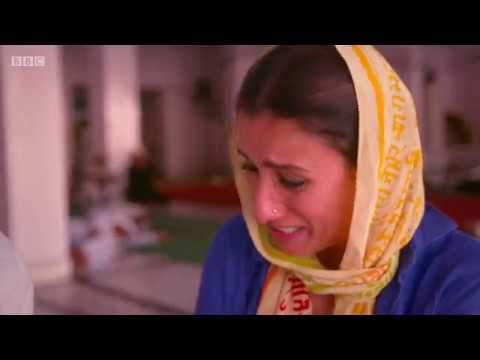
- Asad returns to the house where he was born; it is now in poor condition and used for storage, a shock that leaves him in tears.
- His father, a Muslim League supporter and respected doctor, decided the family had to leave after Ambala was assigned to India.
- Pakistan became independent on 14 August 1947, but the border was not announced until 17 August, leaving residents uncertain about which country would contain their homes.
35:04
Survivors Recall Noakhali and the Great Calcutta Killings
- Banita meets elderly Hindu survivor Raymond Paul, whose memories of Noakhali violence remain vivid decades later.
- Arthur Wise filmed the August 1946 Calcutta riots, later known as the Great Calcutta Killings; more than 5,000 Hindus and Muslims died in less than ten days.
- Childhood witnesses describe bodies in the streets and the murder of a friend’s father, highlighting the human cost of retaliatory violence and British inaction.
44:46
Punjab Refugee Convoys and Attacks on Muslims Fleeing India
- After the Punjab boundary was announced, millions of Hindus, Sikhs and Muslims fled, with refugee columns and crowded trains exposed to attack.
- Records discussed in Ambala describe a convoy of about 15,000 Muslims attacked by a Sikh mob; approximately 4,000 were reportedly killed.
- A separate account describes Muslim passengers attacked on a train leaving Ambala, amid calls for revenge for violence elsewhere.
- Asad’s family survived by leaving by train; the journey helps Samir understand why his grandfather still carries emotional pain.
49:48
Banita Thanks the Muslim Family Who Helped Her Father Escape
- Bhim’s family hid beneath one another in a small boat, leaving their ancestral home and land without knowing where they would go.
- Two local Muslim men concealed the family when the boat was challenged, telling others that Muslim locals were travelling.
- Banita meets the grandson of the man who arranged the boat and thanks the family on her father’s behalf, showing how neighbors crossed religious lines to save lives.
54:19
Arthur Wise and Gandhi’s Calcutta Peace Effort
- Mandy learns that Arthur Wise met Gandhi and joined a peace committee working to reduce Hindu-Muslim violence in Calcutta.
- In August 1947, Gandhi and the committee held a rally attended by hundreds of thousands of Hindus and Muslims; Wise filmed the event before returning to Britain.
- The journey changes Mandy’s view of her grandfather from a comfortable businessman forced to leave into a civic mediator whose peace work deserves recognition.
Summary, takeaways, and chapters were generated by AI from the video's transcript and may contain errors. The video belongs to its creator, Knowledge Lover.