More with continuity; limits with infinity (Calc 1; Lecture 1-5; Fall 26)
 Watch on YouTube →
Overview
Beard Meets Calculus reviews logarithm rules, repeated roots, and graph-based function composition before developing continuity through piecewise functions and continuous-function limit laws. The lecture then introduces the Intermediate Value Theorem and distinguishes horizontal asymptotes, found by studying inputs approaching ±∞, from vertical asymptotes, analyzed through one-sided limits and signs near a denominator zero.
Key takeaways
- For nested limits such as g(f(x)), work from the innermost input outward and preserve one-sided direction: f(x) approaching 4 from below requires the left-hand behavior of f.
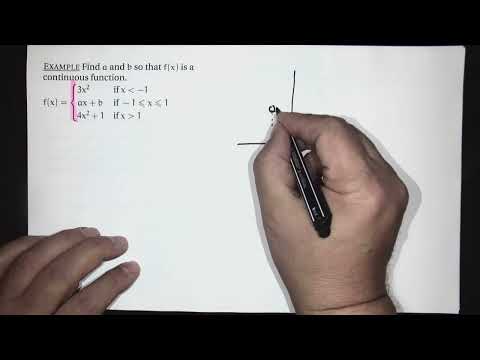
- To make a piecewise function continuous, match the adjoining one-sided limits at every join; for the quadratic-line-quadratic example, the conditions a + b = 5 and −a + b = 3 yield a = 1 and b = 4.
- When a complicated expression is built from continuous functions and its denominator is nonzero, evaluate its limit by direct substitution rather than manipulating every term.
- The Intermediate Value Theorem guarantees every output between the endpoint values of a continuous function, but equal-sign endpoint values do not rule out roots inside the interval.
- For (7e^x + 3)/(1 + e^x), the horizontal asymptotes differ by direction: y = 7 as x → +∞ and y = 3 as x → −∞.
- For an infinite limit at a denominator zero, factor and check signs on both sides; x(x − 1)^2 stays positive near 1, making the example's two-sided limit +∞.
Chapters
0:00
Quickfire Review: Logarithm Rules and a Repeated Root
- The logarithm of (x + 1)^4 divided by e^3(x − 4) separates into 4 ln(x + 1) − 3 − ln(x − 4).
- Factoring x^3 − 2x^2 + x as x(x − 1)^2 reveals roots 0 and 1, with 1 counted twice.
- Beard Meets Calculus encourages trying an answer—even zero or one—rather than avoiding participation.
3:55
Evaluate Nested Limits by Following Function Layers
- For lim as x approaches 3 from below of g(f(x)), first track f(x): the graph shows it equals 2 nearby.
- Then evaluate g(2) to get 1; avoid trying to construct the full composite function from the graphs.
- For lim as x approaches 2 from above of f(g(x)), g(x) approaches 4 from below, so the relevant one-sided behavior of f gives 1.
8:35
Make a Piecewise Function Continuous at Its Join Points
- The function uses 3x^2 for x < −1, ax + b between −1 and 1, and 4x^2 + 1 for x > 1.
- Continuity at x = 1 requires a + b = 5, matching the middle line to the right-hand value of 4(1)^2 + 1.
- Continuity at x = −1 requires −a + b = 3, matching the middle line to 3(−1)^2.
- Solving the two equations gives a = 1 and b = 4; for piecewise functions, check continuity at each join.
20:58
Use Continuity to Evaluate Complicated Limits by Substitution
- Polynomials, e^x, cosine, and arctangent are continuous; logarithm and tangent are continuous where they are defined and away from asymptotes.
- Sums, products, quotients with nonzero denominators, and valid compositions of continuous functions remain continuous.
- The displayed limit as x approaches 2 combines sine, exponential, cosine, a cubic–arctangent product, and a logarithm; continuity makes direct substitution sufficient.
24:55
Intermediate Value Theorem: Continuous Functions Cannot Skip Values
- If f is continuous on an interval, it takes every value between f(a) and f(b) somewhere between a and b.
- For 18x^3 − 63x^2 + 67x − 20, the values at 0 and 1 are −20 and 2, so continuity guarantees a root between 0 and 1.
- The positive endpoint values f(1) = 2 and f(2) = 6 do not rule out a root between 1 and 2; the theorem guarantees intermediate values, not the absence of extra behavior.
30:30
Limits at Infinity and the Strategy for Horizontal Asymptotes
- Infinity is not a number to substitute; limits as x approaches ±∞ describe inputs growing without bound in either direction.
- A horizontal asymptote records a finite output approached as the input tends to positive or negative infinity.
- For an ∞/∞ expression, identify the dominant growth term, factor it from numerator and denominator, and simplify; forms such as ∞ − ∞ may need rewriting as ratios.
34:30
Find Both Horizontal Asymptotes of an Exponential Ratio
- For f(x) = (7e^x + 3)/(1 + e^x), the limit as x approaches +∞ is initially an ∞/∞ form.
- Dividing numerator and denominator by e^x gives (7 + 3/e^x)/(1 + 1/e^x), which approaches 7; y = 7 is the positive-infinity horizontal asymptote.
- As x approaches −∞, e^x approaches 0, so the original ratio approaches 3/1; y = 3 is the negative-infinity horizontal asymptote.
41:10
Vertical Asymptotes: Check One-Sided Behavior and Signs
- A vertical asymptote occurs when the output grows without bound as x approaches a finite input, often when a nonzero numerator is divided by a denominator approaching zero.
- Use one-sided limits because the denominator may approach zero from the positive or negative side, producing opposite signs of infinity.
- To determine the direction of divergence, inspect the sign of the full expression near the denominator zero rather than considering only the numerator.
43:29
Sign Analysis Gives a Two-Sided Limit of Positive Infinity
- For (3x^2 − 7x + 5)/(x^3 − 2x^2 + x), substitution at x = 1 gives a positive numerator, 1, over a zero denominator.
- Factor the denominator as x(x − 1)^2; near 1, x is positive and (x − 1)^2 is positive on both sides.
- The denominator approaches zero through positive values while the numerator stays positive, so the two-sided limit is +∞.
Summary, takeaways, and chapters were generated by AI from the video's transcript and may contain errors. The video belongs to its creator, Beard Meets Calculus.