More practice and review (Calc 1; Lecture 1-12; Fall 26)
 Watch on YouTube →
Overview
Beard Meets Calculus reviews Calc 1 exam skills through algebra warm-ups, product and quotient rules, repeated chain-rule applications, and derivative problems using tables and graphs. The lecture also introduces Gottfried Wilhelm Leibniz’s derivative notation and closes with an exam checklist covering limits, continuity, tangent lines, derivative rules, and motion applications.
Key takeaways
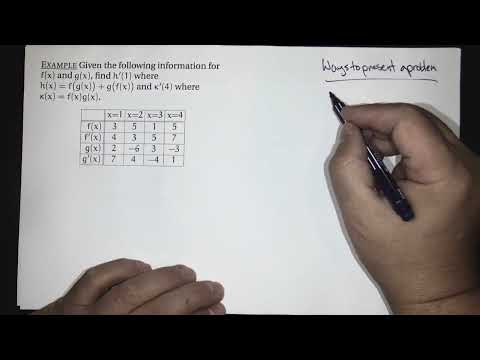
- Differentiate a composition before using a table: for h(x)=f(g(x))+g(f(x)), evaluate nested inputs from the inside outward; the worked table example gives h′(1)=5.
- For the product k(x)=f(x)g(x), use k′=f′g+fg′ before substituting table entries; at x=4 the example evaluates to -16.
- The second derivative of f(g(x)) has two terms: f″(g(x))(g′(x))² and f′(g(x))g″(x), with the latter arising from differentiating the inner derivative.
- The limit definition of the derivative is a high-priority exam skill; the lecture notes that all posted Calc 1 exams in the reviewed history included a limit-definition derivative problem.
- Continuity at a piecewise join requires matching values, while differentiability additionally requires matching derivatives so the graph has no kink.
- In motion applications, position, velocity, and acceleration form a derivative sequence, and answers should include appropriate units.
Chapters
0:00
Fraction Algebra and a Quotient-Rule Derivative
- Quickfire problems review adding fractions and finding common denominators, skills needed when simplifying difference quotients.
- The derivative of fg/(f+g) uses the product rule in the numerator and the quotient rule overall.
- After cancellation, the derivative simplifies to (f²g′ + g²f′)/(f+g)².
4:32
Second Derivatives of a Composition
- For f(g(x)), find the second derivative by differentiating the first-derivative chain-rule expression.
- The result is f″(g(x))(g′(x))² + f′(g(x))g″(x), combining the chain rule and product rule.
- The extra f′(g(x))g″(x) term is easy to miss when differentiating a composition twice.
9:16
Exam-Day Preparation: Pace, Rest, and Checking Work
- Beard Meets Calculus recommends arriving rested, fed, and hydrated rather than sacrificing sleep to last-minute study.
- A steady, systematic pace helps reduce errors that can result from rushing or test anxiety.
- Check work and trust practiced methods instead of letting nerves dictate the pace.
10:52
Chain Rule with Function Tables: Compositions and Products
- For h(x)=f(g(x))+g(f(x)), differentiate first, then use the table from the inside outward to evaluate each function value and derivative.
- The table lookup gives h′(1)=f′(2)g′(1)+g′(3)f′(1)=3·7+(-4)·4=5.
- For k(x)=f(x)g(x), apply the product rule before evaluating; the table values give k′(4)=7·(-3)+5·1=-16.
- Function problems can be presented as explicit formulas, tangent-line information, tables, or graphs.
21:12
Reading Derivatives from a Graph in Chain-Rule Problems
- The vertical evaluation bar means differentiate the expression first and then substitute the specified input.
- For f(x²) at x=2, the chain rule requires 2x·f′(x²); the graph supplies the slope f′(4).
- For f(f(x)), evaluate f′(f(2))·f′(2), using the graph first to find f(2), then the slopes at the relevant inputs.
- A graph’s local line-segment slope gives the derivative on that segment; distinguish the square on the input from a square on the function value.
30:06
Leibniz Notation for a Three-Layer Chain Rule
- Leibniz notation tracks dependencies such as y depending on u, u on v, and v on x, giving dy/dx=(dy/du)(du/dv)(dv/dx).
- For y=e^(cos(x²)), define u=cos(v), v=x², and y=e^u to separate the exponential, cosine, and power layers.
- Multiplying the layer derivatives and substituting back gives e^(cos(x²))·sin(x²)·2x.
- The notation is presented as an alternative way to understand the chain rule, not as a primary exam requirement.
39:01
Exam Review: Rates of Change, Derivative Definition, and Tangents
- Average rate of change is [f(b)-f(a)]/(b-a), the slope of a secant line between two inputs.
- The derivative is the instantaneous rate of change and is defined as a limit of average rates of change.
- Beard Meets Calculus says every posted Calc 1 exam in the reviewed history included a derivative calculated from the limit definition.
- Tangent lines encode both the function’s value and its derivative at a point, and locally approximate the function.
44:54
Limits, Asymptotes, and Continuity Conditions
- When direct substitution gives 0/0, simplify further; use a conjugate for square roots, a common denominator for fractions, and expansion for polynomials.
- The limit sin(θ)/θ as θ approaches zero relies on sin(θ) being close to θ near zero.
- For limits at positive or negative infinity, check both directions; vertical asymptotes commonly arise where a denominator is zero.
- Continuity requires the limit to match the function value; jump discontinuities have unequal one-sided limits, while removable discontinuities involve a hole.
47:45
Differentiability, Derivative Rules, and Motion Applications
- To make a piecewise function differentiable at a join, match both the function values and the derivatives to avoid a kink.
- Memorize the course’s six basic functions and four derivative rules as building blocks for more complex problems.
- In motion problems, differentiating position gives velocity, and differentiating velocity gives acceleration.
- Include units in application answers when requested to receive full credit.
Summary, takeaways, and chapters were generated by AI from the video's transcript and may contain errors. The video belongs to its creator, Beard Meets Calculus.