More on Vesicles, BIO105 Introductory Biology, David Champlin, USM
 Watch on YouTube →
Overview
David Champlin explains how vesicles move proteins, phospholipids, neurotransmitters, and external material through cells. He connects smooth endoplasmic reticulum phospholipid synthesis to vesicle transport, illustrates acetylcholine release and Botox’s effect on vesicle fusion, and describes macrophage phagocytosis followed by lysosomal digestion.
Key takeaways
- The smooth ER synthesizes phospholipids, which vesicles deliver to destinations such as the cell membrane.
- Vesicle membranes enable hydrophobic phospholipids to move through the cell’s hydrophilic, watery environment.
- Neurons release acetylcholine by vesicle fusion; Botox interferes with docking and fusion proteins to block this release and relax muscles.
- Macrophages use phagocytosis to enclose bacteria in vesicles, then lysosomal acidity kills and digests the bacteria.
- Pinocytosis is a form of endocytosis that takes in extracellular fluid and its contents through vesicles.
Chapters
0:00
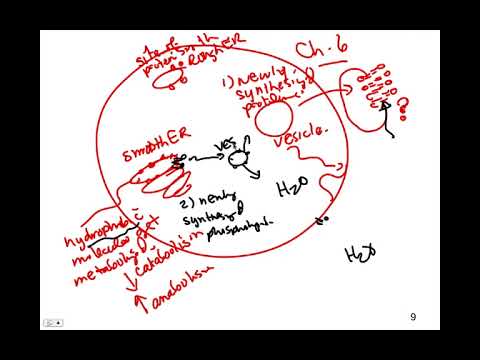
Smooth ER Phospholipids Travel Through Vesicles
- Vesicles have a phospholipid bilayer like the cell membrane and can fuse with it, adding their phospholipids.
- The smooth endoplasmic reticulum synthesizes phospholipids and metabolizes hydrophobic molecules; the rough ER is an important site of protein synthesis.
- Vesicles transport hydrophobic phospholipids through the cell’s watery environment while keeping them associated with membrane.
3:38
Acetylcholine Release, Exocytosis, and Botox
- At a nerve-to-muscle junction, acetylcholine is stored in vesicles and released by exocytosis when a nerve signal stimulates muscle contraction.
- After release, acetylcholine binds receptors on muscle cells and triggers contraction.
- Botox blocks proteins needed for vesicle docking and fusion, preventing acetylcholine release; vesicles also transport newly synthesized proteins and phospholipids.
5:40
Macrophage Phagocytosis and Lysosomal Digestion
- A macrophage, a type of white blood cell, surrounds invading bacteria with its membrane and brings them inside by phagocytosis, a form of endocytosis.
- The bacteria-containing vesicle fuses with a lysosome, whose acidic lumen kills and digests the bacteria; components such as amino acids can be recycled by the macrophage.
- Macrophages can leave blood vessels and crawl through tissue toward infection sites; pinocytosis, or “cell drinking,” brings outside fluid and contents into the cell in vesicles.
Summary, takeaways, and chapters were generated by AI from the video's transcript and may contain errors. The video belongs to its creator, The New Evolution for Everyone.