More limits (Calc 1; Lecture 1-3; Fall 26)
 Watch on YouTube →
Overview
Beard Meets Calculus develops a practical strategy for evaluating limits: substitute first, then use algebraic rewrites—factoring, conjugates, or trigonometric identities—to remove indeterminate 0/0 forms. The lecture proves the squeeze principle and the radians-based limit sin(θ)/θ → 1, then applies that result to limits involving sine.
Key takeaways
- Direct substitution is the first test for a limit: a 0/0 result means the form is indeterminate and requires rewriting, not that the limit equals zero.
- Factor common terms and cancel them only for nearby inputs where the original expression is defined; the simplified expression can then reveal the limit.
- Multiplying by a conjugate converts radical differences into differences of squares, often exposing a factor that cancels the zero-producing denominator term.
- The squeeze principle evaluates t sin(1/t) at zero despite infinitely rapid oscillation, because its magnitude is bounded above by |t|.
- The foundational limit sin θ/θ → 1 depends on measuring θ in radians and supports approximating sin θ by θ for small angles.
- For scaled-angle limits, match the denominator to the sine’s inside expression—for example, rewrite sin(2θ)/θ as 2·sin(2θ)/(2θ)—rather than incorrectly treating sin(2θ) as 2 sin θ.
Chapters
0:00
Quickfire Review: Exponent Rules and Function Substitution
- Combining e^(5t)(e^(4t))^3/e^(-6t) gives e^(23t): multiply exponents in the power, then subtracting a negative adds 6t.
- For f(x) = x² + 4x, evaluating f(2 + h) − f(2) gives h² + 8h.
- The substitution example previews a recurring Calc 1 skill: use parentheses when plugging expressions into a function.
3:09
Evaluating a Difference of Rational Expressions at x = 3
- Substituting x = 3 into both fractions produces nonzero-over-zero expressions, so the difference is indeterminate and needs algebraic simplification.
- Since the fractions share denominator x − 3, combine their numerators as (x² − x) − (9 − x), carefully distributing the minus sign.
- Factor x² − 9 as (x − 3)(x + 3), cancel x − 3 for x near—but not equal to—3, and obtain the limit 6.
7:20
Limit Strategy: Work Through Frustration and Look for Cancellation
- Steve frames frustration as a normal part of learning mathematics and encourages students to keep working until concepts click.
- For a limit that substitutes to 0/0, treat the form as a signal for more work rather than as an answer.
- Useful rewrites include factoring, expanding, multiplying by a conjugate, combining fractions, and applying trigonometric identities.
11:20
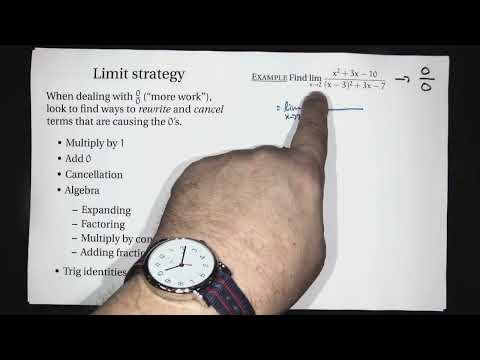
Factoring a 0/0 Limit to Get the Value 7
- For the limit as x approaches 2 of (x² + 3x − 10)/((x − 3)² + 3x − 7), direct substitution gives 0/0.
- The numerator factors as (x − 2)(x + 5); expanding and combining the denominator gives x² − 3x + 2 = (x − 2)(x − 1).
- Cancel the shared x − 2 factor, then substitute x = 2 into (x + 5)/(x − 1) to get 7.
15:45
Using a Conjugate to Evaluate a Radical Limit
- For the limit as t approaches 4 of (t − 4)/(√(t² − 7) − 3), substitution produces 0/0.
- Multiply numerator and denominator by the conjugate √(t² − 7) + 3, preserving the expression by multiplying by an equivalent form of 1.
- The denominator becomes (t² − 7) − 9 = t² − 16 = (t − 4)(t + 4); cancel t − 4 and evaluate to get 6/8 = 3/4.
- Expand only where it helps: leave the numerator’s product intact so its t − 4 factor remains easy to cancel.
22:05
Trig Identity Simplification Gives a Limit of One-Half
- For (1 − cos θ)/sin² θ as θ approaches 0, substitution gives 0/0.
- Use sin² θ = 1 − cos² θ, then factor the denominator as (1 − cos θ)(1 + cos θ).
- Cancel the common factor 1 − cos θ and substitute θ = 0 into 1/(1 + cos θ), yielding 1/2.
- Cancellation applies to shared factors, not visually similar pieces of sums or differences.
26:44
The Squeeze Principle and the Limit of t sin(1/t)
- If g(x) ≤ f(x) ≤ h(x), and g and h approach the same value L as x approaches c, the squeeze principle forces f to approach L too.
- Although sin(1/t) oscillates infinitely often near t = 0, it remains bounded between −1 and 1.
- Multiplying those bounds by the magnitude of t gives −|t| ≤ t sin(1/t) ≤ |t|; both bounds approach 0, so t sin(1/t) approaches 0.
32:17
Unit-Circle Areas Prove sin(θ)/θ Approaches 1
- For 0 < θ < π/2 on the unit circle, compare the areas of an inscribed triangle, a circular sector, and a tangent-based triangle.
- Their areas are respectively (1/2)sin θ, (1/2)θ, and (1/2)tan θ, giving sin θ < θ < tan θ.
- Rearranging yields cos θ < sin θ/θ < 1; the argument uses radians because the sector’s area is θ/2.
- Even symmetry extends the bounds to negative θ near zero; since both outer expressions approach 1, the squeeze principle proves lim(θ→0) sin θ/θ = 1.
40:48
Applying sin(θ)/θ to Limits with Scaled Angles
- The limit sin θ/θ = 1 implies sin θ is approximately θ for small angles, with θ measured in radians.
- For sin(2θ)/θ, either use sin(2θ) = 2 sin θ cos θ or rewrite it as 2·[sin(2θ)/(2θ)]; both methods give 2.
- More generally, sin(u)/u approaches 1 whenever u approaches 0, allowing the inside expression to serve as the matching denominator.
- For sin(9t²)/(t sin(3t)) as t approaches 0, use sin(9t²) ≈ 9t² and sin(3t) ≈ 3t to obtain the limit 3.
Summary, takeaways, and chapters were generated by AI from the video's transcript and may contain errors. The video belongs to its creator, Beard Meets Calculus.