Mon Sep 28, 2026 Lecture (L14) Stewart Section 2.7 Related Rates, Part 2
 Watch on YouTube →
Overview
Barsamian's Math Videos demonstrates a systematic related-rates method for problems modeled by the Pythagorean theorem: define changing quantities, record signed rates, differentiate with respect to time, and evaluate at the specified instant. Examples include a boat being pulled toward a dock and two cars moving on perpendicular roads, showing how derivative signs distinguish approaching from separating and how the distance rate changes with position.
Key takeaways
- For a right-triangle related-rates problem, differentiate a² + b² = c² with respect to time to obtain aa' + bb' = cc'.
- A constant geometric dimension has derivative zero: the boat-pulley height b = 5 feet does not change, so b' = 0.
- Rates require signs that reflect direction: the boat rope shortens at c' = −1 ft/s, and Anne's distance from the intersection decreases at a' = −90 mph.
- A negative c' means two objects are getting closer, while a positive c' means their separation is increasing; the car examples yield −6 mph and 270/13 mph, respectively.
- Calculate the instantaneous distance from the Pythagorean theorem before substituting into a rate formula; the examples use 3-4-5 and 5-12-13 triangles.
Chapters
0:00
Related Rates with the Pythagorean Theorem
- The lecture continues Stewart Section 2.7, connecting related-rates problems to implicit differentiation.
- The examples focus on right triangles and the relationship a² + b² = c².
5:00
Model the Boat, Dock, and Pulling Rope
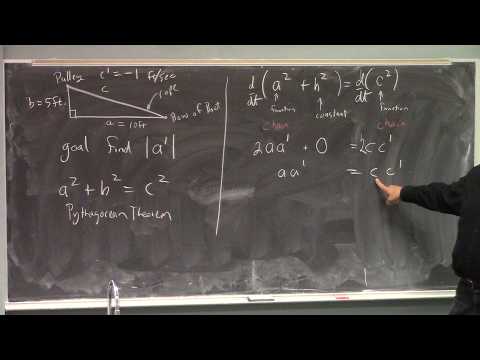
- A rope runs from a boat's bow through a dock pulley positioned 5 feet above the bow.
- Define a as the boat's horizontal distance from the dock, b as the vertical separation, and c as the rope length.
- At the requested instant, a = 10 feet; because the rope is pulled in at 1 foot per second, c' = −1 ft/s.
- The target is the boat's speed, so first find a' and then report its absolute value.
10:50
Differentiate the Boat's Right-Triangle Equation
- Differentiate a² + b² = c² with respect to time to obtain 2aa' + 2bb' = 2cc'.
- Since b = 5 feet is constant, b' = 0; canceling the common factor of 2 gives aa' = cc'.
- At a = 10 and b = 5, the rope length is c = √(10² + 5²) = 5√5 feet.
- Thus a' = −√5/2 ft/s, so the boat approaches the dock at √5/2 ft/s.
18:00
Set Up the Perpendicular-Car Distance Problem
- Anne drives west toward an intersection at 90 mph, while Bob drives north away from it at 60 mph.
- Let a and b be the cars' distances from the intersection and c their separation; their rates are a' = −90 mph and b' = 60 mph.
- The right-triangle model applies to both cases: a² + b² = c², with all three distances changing over time.
- Differentiation gives aa' + bb' = cc', or c' = (aa' + bb')/c.
23:00
Determine Whether Anne and Bob Are Closing the Gap
- When Anne is 3 miles east and Bob is 4 miles north, c = 5 miles and c' = (3·−90 + 4·60)/5 = −6 mph.
- The negative separation rate means the cars are getting closer at 6 mph in the 3-4-5 triangle case.
- When Anne is 5 miles east and Bob is 12 miles north, c = 13 miles and c' = (5·−90 + 12·60)/13 = 270/13 mph.
- The positive separation rate means Bob is getting farther away in the 5-12-13 triangle case; tracking signs is essential.
Summary, takeaways, and chapters were generated by AI from the video's transcript and may contain errors. The video belongs to its creator, Barsamian's Math Videos.