Mon Sep 21, 2026 Lecture (L11) Stewart Sect. 2.4 Product Rule; Quotient Rule
 Watch on YouTube →
Overview
Barsamian's Math Videos teaches the product rule and quotient rule from Stewart Section 2.4, emphasizing that derivatives of products and quotients are not found by differentiating each part independently. Worked examples include √x sin x, rewriting (x² + 4x + 3)/√x using power functions, differentiating 2t/(2 + √t), deriving (tan x)' = sec²x, and setting up a tangent-line and horizontal-tangent exercise for f(x) = 1/(1 + x²).
Key takeaways
- For a product fg, use f′g + fg′; differentiating both factors and multiplying their derivatives is not the product rule.
- Use the simplest valid differentiation method: the sum and constant-multiple rules can avoid unnecessary product-rule steps, and rewriting a quotient as powers can avoid the quotient rule entirely.
- In quotient-rule work, preserve the full denominator v² and do not cancel it against an individual term in the numerator.
- A correct chain of equations needs a clearly named left-hand side and equal signs only between equivalent expressions; parentheses are essential when differentiating a subtracted function.
- Writing tan x as sin x/cos x and applying the quotient rule reduces its derivative to (sin²x + cos²x)/cos²x = sec²x.
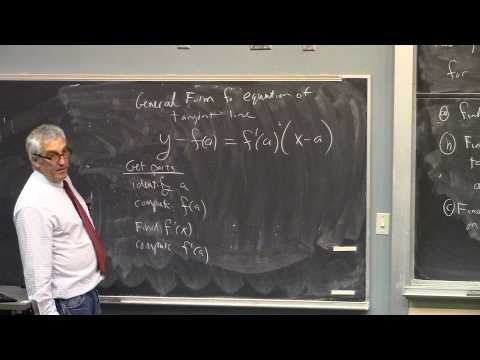
- The tangent-line equation at x = a is y − f(a) = f′(a)(x − a), where f(a) gives the point's y-coordinate and f′(a) gives the tangent slope.
Chapters
0:00
Product Rule: Differentiate One Factor at a Time
- The product rule is (fg)' = f'g + fg': differentiate the first factor and keep the second, then keep the first and differentiate the second.
- For a product such as √x sin x, the rule gives (√x)' sin x + √x cos x.
- Barsamian stresses that the derivative of a product is not the product of the derivatives.
2:20
Product-Rule Example and Writing Equalities Correctly
- The worked √x sin x example uses √x = x^(1/2) to apply the power rule, then combines that result with the derivative of sin x.
- A solution should begin with the expression being differentiated, such as d/dx[√x sin x], so each subsequent line has a meaningful left-hand side.
- Equal signs must connect expressions that are actually equal; a stack of unlabelled expressions is not a valid chain of mathematical statements.
7:22
Frick, Frack, and Wacky Jack: Choosing the Right Rule
- The comparison of three fictional students distinguishes a valid product-rule approach from Frick's invalid attempt to multiply separate derivatives.
- Wacky Jack uses the sum and constant-multiple rules, avoiding unnecessary product-rule work when a simpler rule applies.
- The example warns against treating the derivative of a constant such as 5 as 5; its derivative is 0.
13:17
Quotient Rule Formula and Its Subtraction Order
- For top function u and bottom function v, the quotient rule is (u/v)' = (u'v − uv')/v².
- The numerator order matters: differentiate the top and multiply by the bottom, then subtract the top multiplied by the derivative of the bottom.
- The denominator is the original bottom function squared, not a derivative of the denominator.
15:20
Rewrite (x² + 4x + 3)/√x Before Differentiating
- Rather than use the quotient rule, split (x² + 4x + 3)/√x into x^(3/2) + 4x^(1/2) + 3x^(-1/2).
- Apply the power rule term by term to obtain (3/2)x^(1/2) + 2x^(-1/2) − (3/2)x^(-3/2).
- Write the final result with positive exponents, for example (3/2)√x + 2/√x − 3/(2x√x).
- Label each line accurately: the rewritten expression is still y, while the differentiated expression is y′.
20:57
Quotient Rule Example: 2t/(2 + √t)
- For y = 2t/(2 + √t), the quotient rule gives [2(2 + √t) − 2t(1/(2√t))]/(2 + √t)².
- Simplifying the numerator yields (4 + √t)/(2 + √t)².
- Do not cancel a factor from the denominator with a term inside the numerator; cancellation applies to common factors, not individual terms in a sum.
28:47
Derive the Tangent Derivative Using the Quotient Rule
- Express tan x as sin x/cos x and apply the quotient rule: [cos x·cos x − sin x·(−sin x)]/cos²x.
- Keep parentheses around the derivative of cos x so the negative sign in (cos x)' = −sin x is handled correctly.
- Use sin²x + cos²x = 1 to simplify the result to 1/cos²x = sec²x.
36:41
Paired Practice: Tangent Lines and Horizontal Tangents
- Students work in pairs on f(x) = 1/(1 + x²), first finding f′(x).
- The exercise asks for the tangent-line equation at x = −1 and the x-coordinates of all points with horizontal tangents.
- Use the point-slope tangent formula y − f(a) = f′(a)(x − a), identifying the point (a, f(a)) and slope f′(a).
Summary, takeaways, and chapters were generated by AI from the video's transcript and may contain errors. The video belongs to its creator, Barsamian's Math Videos.