Mon Sep 14, 2026 Lecture (L09) Stewart Sect. 2.3 Basic Differentiation Formulas, Part 1
 Watch on YouTube →
Overview
Barsamian's Math Videos introduces Stewart Section 2.3's basic differentiation rules, connecting constant and linear functions to tangent-line slopes before developing the power rule, sum and constant-multiple rules, and sine and cosine derivatives. Worked examples show how to rewrite radicals and reciprocals as powers, preserve valid derivative notation, and use the rules to find a tangent line; the lecture also reminds students that Friday's first exam includes both derivative rules and the limit definition.
Key takeaways
- A constant function has derivative 0 because every tangent line to its horizontal graph has slope 0; for f(x)=x, the constant tangent slope 1 gives f′(x)=1.
- The power rule d/dx[x^p]=p x^(p−1) handles positive, negative, and fractional exponents after an expression is rewritten as a power of x.
- For 1/x^5, rewrite as x^−5 before differentiating to obtain −5/x^6; differentiating a reciprocal does not mean taking the reciprocal of the original function's derivative.
- Valid derivative work preserves the function being differentiated on the left side of an equation and retains d/dx when rewriting an expression before differentiation.
- The sum and constant-multiple rules reduce polynomial differentiation to term-by-term calculations; x^2−2x−3 differentiates to 2x−2.
- For f(x)=4cos x at x=π/6, the point is (π/6, 2√3), the tangent slope is −2, and the tangent line is y=−2x+π/3+2√3.
Chapters
0:00
Exam Scope and Derivative Notation: d/dx Is the Operator
- The Friday first exam will include both derivatives found using the limit definition and derivatives found with Section 2.3 shortcut rules.
- The derivative operator is d/dx; its output notation depends on the function, so the derivative of g(x) is written d/dx[g(x)] or g′(x), not dy/dx.
- The limit definition introduced previously is the limit as h approaches 0 of [f(x+h) − f(x)]/h.
5:20
Constant Function Rule: A Horizontal Graph Has Zero Slope
- If f(x)=c for a constant c, then f′(x)=0, equivalently d/dx[c]=0.
- Every tangent line to the horizontal graph y=c has slope 0, so the derivative graph is the horizontal line y=0.
- The rule follows from the derivative definition, but the lecture motivates it by matching tangent slopes to derivative values.
11:48
Derivative of x: The Line y=x Has Slope 1 Everywhere
- For f(x)=x, every tangent line has slope 1, giving f′(x)=1 and d/dx[x]=1.
- The graph-based interpretation treats each slope on y=x as a y-value on the derivative graph, producing the constant graph y=1.
- The result can also be derived from the power rule by setting the exponent p=1.
16:40
Power Rule: Bring Down p and Reduce the Exponent
- For a power function x^p with a real constant exponent p, the rule is d/dx[x^p]=p x^(p−1).
- The lecture presents the full power rule, while noting that textbook proofs for more complicated cases rely on techniques developed in later sections.
- For x^5, keep the derivative expression unchanged on the left and calculate 5x^4 on the right.
21:00
Power-Rule Notation: Keep Each Equation Valid
- When applying the rule, do not alter the expression being differentiated on the left; change the exponent only in the result on the right.
- Writing d/dx[x^5] = 5x^4 is valid, whereas changing the left side to d/dx[x^4] during the calculation changes the problem.
- The lecture recommends writing intermediate steps rather than doing exponent arithmetic mentally, to avoid errors such as mishandling negative exponents.
23:09
Reciprocal Powers: Differentiate 1/x⁵ as x⁻⁵
- Rewrite 1/x^5 as x^−5 before using the power rule; the derivative is −5x^−6, or −5/x^6.
- A one-line solution must retain d/dx while rewriting: d/dx[1/x^5] = d/dx[x^−5] = −5/x^6.
- The derivative of 1/f(x) is not 1/f′(x); here, −5/x^6 is not the reciprocal of the derivative of x^5.
30:45
Radicals as Powers: Differentiate 1/√x
- Rewrite 1/√x as x^−1/2 so the power rule applies with p=−1/2.
- The derivative is (−1/2)x^−3/2, simplified without a negative exponent to −1/(2x^(3/2)).
- This matches the result from Friday's longer limit-definition calculation and illustrates why rewriting expressions and showing small steps matters.
37:12
Sum and Constant-Multiple Rules: Differentiate a Polynomial Term by Term
- The derivative of af(x)+bg(x) is af′(x)+bg′(x): constants factor through the derivative, and sums split into separate derivatives.
- For x^2−2x−3, differentiate each term: 2x−2+0, giving 2x−2.
- The result agrees with the earlier derivative found from the limit definition for the same function.
43:43
Sine and Cosine Derivatives: Compare Slopes with Their Graphs
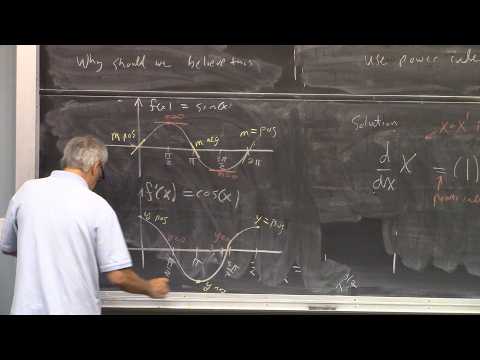
- The basic trigonometric rules are d/dx[sin x]=cos x and d/dx[cos x]=−sin x.
- For sin x, horizontal tangents at x=π/2 and x=3π/2 correspond to cosine values of 0 at those same inputs.
- The signs of the sine graph's tangent slopes align with cosine's positive and negative values, providing a graphical check of the rule.
48:07
Tangent Line to 4 cos x at x=π/6
- For f(x)=4cos x at a=π/6, the point of tangency has y-value f(a)=4cos(π/6)=2√3.
- Using the constant-multiple and cosine rules gives f′(x)=−4sin x, so the tangent slope is f′(π/6)=−2.
- Point-slope form gives y−2√3=−2(x−π/6), or y=−2x+π/3+2√3; the announced normal-line example was not completed.
Summary, takeaways, and chapters were generated by AI from the video's transcript and may contain errors. The video belongs to its creator, Barsamian's Math Videos.