Mon Oct 5, 2026 Lecture (L16) Stewart Sections 3.1 Exponential Functions, 3.2 Inverse Functions
 Watch on YouTube →
Overview
The lecture focuses on the calculus-relevant ideas in Stewart Sections 3.1 and 3.2: Euler’s number e, exponential-function behavior and limits, inverse-function structure, and the derivative of an inverse. Numerical estimates motivate the limit definition of e, while graphs and one-sided limits illustrate exponential growth and decay; inverse functions are then connected to reflected graphs, cancellation identities, and reciprocal tangent slopes.
Key takeaways
- Euler’s number is defined by lim as x approaches 0 of (1 + x)^(1/x), and numerical evaluations near x = 0 approach approximately 2.718.
- For every exponential function b^x with b > 1, the domain is all real numbers, the range is positive real numbers, the graph passes through (0, 1), and y = 0 is a left-end horizontal asymptote.
- The function e^(cot x) has left-hand limit 0 and right-hand limit positive infinity at x = π, so its two-sided limit there does not exist.
- An inverse function exchanges the domain and range of its original function, swaps point coordinates, and has a graph reflected across y = x.
- The inverse derivative formula is (f^(-1))'(x) = 1 / f'(f^(-1)(x)); the reciprocal reflects the relationship between tangent slopes on graphs mirrored across y = x.
Chapters
0:00
Why Sections 3.1 and 3.2 Emphasize Calculus Concepts
- Sections 3.1 and 3.2 include substantial precalculus review: exponent rules, logarithms, exponential graphs, and inverse functions.
- The lecture prioritizes the calculus ideas embedded in those sections rather than reteaching all of the review material.
- Students are reminded that the assigned homework still draws on the full range of precalculus topics.
2:47
Powers Greater Than One and the Limit That Defines e
- For any base b greater than 1, b raised to increasingly large powers grows without bound; for example, 2^p tends to infinity.
- By contrast, 1^p remains 1 for every exponent p.
- The expression (1 + x)^(1/x) as x approaches 0 combines a base approaching 1 with an exponent growing large, so its limit is not immediately obvious.
5:17
Why (1 + x)^(1/x) Has an Indeterminate-Looking Trend
- As positive x approaches 0, the base 1 + x approaches 1 from above while the exponent 1/x increases without bound.
- The competing effects make it unclear whether the expression approaches 1, infinity, or another value.
- A numerical table is used to investigate the trend before stating the limit as a mathematical fact.
8:33
Numerical Estimates Approach Euler’s Number
- The lecture evaluates (1 + x)^(1/x) at x = 0.1, 0.01, 0.001, and 0.0001.
- The displayed estimates approach approximately 2.718 as x gets closer to 0.
- The calculations provide evidence that the limit exists and is finite, while the lecture notes that the table itself is not a proof.
15:16
Euler’s Number e and Its Limit Definition
- The limit lim as x approaches 0 of (1 + x)^(1/x) defines the irrational constant e.
- Euler’s number is approximately 2.718 and cannot be expressed as a ratio of integers or as a terminating or repeating decimal.
- The limit expression is important because it recurs throughout mathematics and the sciences.
18:07
Comparing the Graphs of 2^x, e^x, and 3^x
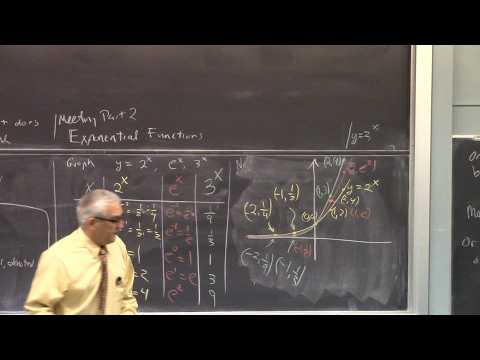
- A value table for 2^x, e^x, and 3^x uses x = -2, -1, 0, 1, and 2.
- For 2^x, the listed outputs are 1/4, 1/2, 1, 2, and 4; for 3^x, they are 1/9, 1/3, 1, 3, and 9.
- Because 2 < e < 3, the graph of e^x lies between 2^x and 3^x at positive x, with corresponding reversed ordering for negative x.
23:26
Shared Domain, Range, Growth, and Asymptote of b^x
- For any exponential function b^x with b > 1, the domain is all real numbers and the range is y > 0.
- Every graph passes through (0, 1), since b^0 = 1, and is increasing: x1 < x2 implies b^x1 < b^x2.
- As x approaches negative infinity, b^x approaches 0, giving the horizontal asymptote y = 0; as x approaches positive infinity, b^x grows without bound.
- The lecture also notes that tangent lines to these exponential graphs have positive slopes.
30:47
One-Sided Limits of e^(cot x) at x = π
- Using cot x = cos x / sin x, the lecture examines e^(cot x) as x approaches π from either side.
- From the left, cos x approaches -1 while sin x is positive and approaches 0, so cot x tends to negative infinity and e^(cot x) approaches 0.
- From the right, sin x is negative and approaches 0, so cot x tends to positive infinity and e^(cot x) grows without bound.
- Since the one-sided limits differ, the two-sided limit at π does not exist; the graph repeats its behavior every interval of length π.
43:24
Inverse Functions Swap Inputs, Outputs, and Graph Coordinates
- If a one-to-one function f has domain A and range B, its inverse f^(-1) has domain B and range A.
- The defining relationship f(a) = b corresponds to f^(-1)(b) = a, and the cancellation identities are f^(-1)(f(a)) = a and f(f^(-1)(b)) = b.
- A point (a, b) on f corresponds to (b, a) on f^(-1), so their graphs reflect across y = x.
50:10
Deriving the Derivative Formula for an Inverse
- For a one-to-one differentiable function, the lecture presents (f^(-1))'(x) = 1 / f'(f^(-1)(x)).
- The reciprocal comes from the reflected tangent lines: swapping horizontal and vertical changes a slope Δy/Δx to its reciprocal Δx/Δy.
- The derivative of f is evaluated at f^(-1)(x), the corresponding input on the original function’s graph.
- The formula is flagged as conceptually difficult, with practice scheduled for the following recitation.
Summary, takeaways, and chapters were generated by AI from the video's transcript and may contain errors. The video belongs to its creator, Barsamian's Math Videos.