Mon Aug 31, 2026 Lecture (L04) Stewart Sect. 1.6 Limits Involving Infinity Part 1: Infinite Limits
 Watch on YouTube →
Overview
Barsamian's Math Videos introduces Stewart Section 1.6 by extending ordinary real-valued limits to describe functions whose values grow without bound near a finite x-value. Through 1/x², cotangent near π, a rational function near 4, and a piecewise absolute-value example near 0, the lecture develops one-sided infinite limits and vertical asymptotes while emphasizing that infinity is shorthand for a trend—not a number—and cannot be used in arithmetic.
Key takeaways
- The notation lim(x→a) f(x)=+∞ means function values can exceed any chosen positive bound when x is sufficiently close to the finite input a; it does not mean the limit equals a real number.
- A vertical asymptote x=a is identified by one-sided unbounded behavior, and the left and right limits can have different signs.
- For cot(x)=cos(x)/sin(x) near π, the numerator stays near −1 while the denominator changes sign across π, producing −∞ from the left and +∞ from the right.
- A two-sided limit can fail because its one-sided limits disagree, as with cot(x) at π and the corrected rational function (x−2)(x−1)/(x−4) at 4.
- Never infer an infinite limit by calculating 1/0 or −1/0; determine the sign and unbounded trend of nearby function values instead.
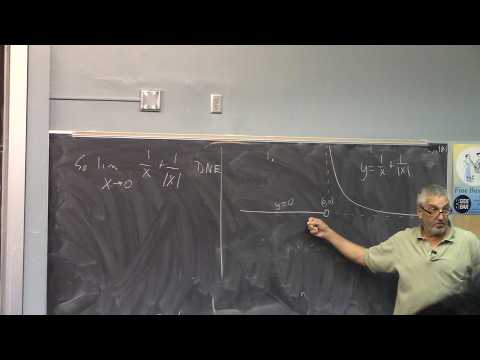
- For expressions involving |x|, use its piecewise definition on each side: 1/x+1/|x| equals 0 for x<0 and 2/x for x>0, so its one-sided limits at 0 are 0 and +∞.
Chapters
0:00
Course Website, Office Hours, and the First Quiz
- Barsamian directs students to the public course webpage linked from Canvas for course information, office location, and office hours.
- Regular office hours are Tuesday, Wednesday, and Thursday from 2–4 p.m.; one session is to be made up later in the week.
- The upcoming Wednesday quiz has three problems, and Section 1.6 is not included; the instructor says it will be tested the following week.
3:00
Why 1/x² Has No Ordinary Real-Valued Limit at Zero
- For x approaching 0 through positive values, 1/x² grows from 1 at x=1 to 4 at x=1/2, 100 at x=0.1, and 1,000,000 at x=0.001.
- Under the Section 1.3 definition, a limit must approach a real number, so lim(x→0) 1/x² does not exist as an ordinary finite limit.
- The graph has no finite destination point (0,L); instead, its y-values grow positively without bound.
6:30
Distinguishing Infinite Behavior from the Earlier Limit Laws
- The limit laws from Sections 1.3–1.4 describe limits that exist as real numbers, not a quotient whose numerator approaches 1 and denominator approaches 0.
- As x approaches 0 in 1/x², the x-values approach a finite input while the y-values become arbitrarily large and positive.
- The lecture treats this behavior as a reason to expand the definition of limit rather than apply ordinary quotient arithmetic.
9:00
The Meaning of an Infinite Limit and the Symbol ∞
- The notation lim(x→a) f(x)=∞ means f(x) can be made arbitrarily large and positive by taking x sufficiently close to a, with x≠a.
- Infinity is not a real number or a graph point such as (0,∞); it is shorthand for an unbounded trend in function values.
- With this Section 1.6 convention, lim(x→0) 1/x² is described as +∞, even though it is not a finite real-valued limit.
14:00
One-Sided Infinite Limits Define Vertical Asymptotes
- Infinite behavior can be positive or negative and can occur from the left or the right of a finite input a.
- A vertical asymptote is a vertical line x=a associated with at least one one-sided limit growing to +∞ or −∞.
- The lecture distinguishes Section 1.6 infinite limits, where x approaches a finite number, from a later topic involving x approaching infinity.
17:20
Preparing the Cotangent Example with Sine and Cosine
- To analyze lim(x→π) cot(x), Barsamian rewrites cot(x) as cos(x)/sin(x).
- The argument relies on familiar sine and cosine graphs: cos(x) approaches −1 near π, while sin(x) approaches 0.
- Rather than depend on a calculator or memorize the cotangent graph, the method tracks the signs and relative sizes of numerator and denominator.
22:00
Cotangent Approaches −∞ from the Left and +∞ from the Right
- For x→π⁻, cos(x) is near −1 and sin(x) is positive but close to 0, so cos(x)/sin(x) becomes arbitrarily large in magnitude and negative: the limit is −∞.
- For x→π⁺, cos(x) remains near −1 while sin(x) is negative and close to 0, making the quotient arbitrarily large and positive: the limit is +∞.
- The cotangent graph therefore has a vertical asymptote at x=π, but lim(x→π) cot(x) does not exist because the one-sided limits differ.
30:10
Why Limits Cannot Be Evaluated by Dividing by Zero
- The lecture rejects replacing a limiting quotient with expressions such as −1/0 or treating 1/0 as infinity; those are not valid arithmetic operations.
- A correct infinite-limit result comes from analyzing values near the input, including their signs—not from substituting the input and dividing by zero.
- A shortcut that happens to produce the right result for 1/x² is still invalid if it can give the wrong signs or answer for other limits.
35:20
A Rational Function Near 4 Has Opposite One-Sided Limits
- The worked example is analyzed using the corrected numerator x²−3x+2=(x−2)(x−1), whose value at x=4 is 6; the board initially shows a minus sign before the instructor changes it to plus.
- As x→4⁻, the numerator stays near 6 and x−4 is negative and near 0, so the quotient tends to −∞.
- As x→4⁺, the numerator stays near 6 and x−4 is positive and near 0, so the quotient tends to +∞; consequently, the two-sided limit does not exist.
43:00
Piecewise Absolute Value Produces Different Behavior at Zero
- The correct piecewise definition is |x|=x for x≥0 and |x|=−x for x<0; the formula used depends on which side of 0 x approaches from.
- For x<0, 1/x+1/|x|=1/x−1/x=0, so the left-hand limit at 0 is 0.
- For x>0, 1/x+1/|x|=2/x, which tends to +∞ as x→0⁺; the two-sided limit therefore does not exist.
- The graph is y=0 on the negative side and rises without bound on the positive side, combining a finite left-hand approach with a vertical-asymptote trend.
Summary, takeaways, and chapters were generated by AI from the video's transcript and may contain errors. The video belongs to its creator, Barsamian's Math Videos.