Mon Aug 24, 2026 Lecture (L01) Stewart Section 1.3 (Limits)
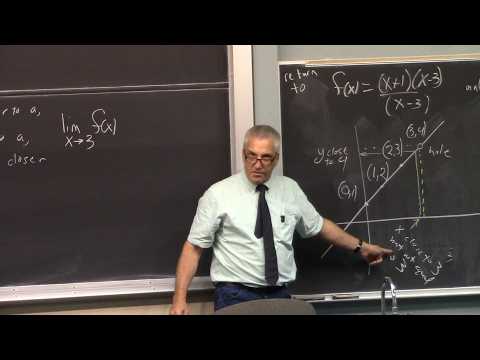 Watch on YouTube →
Overview
Mark Barsamian introduces Math 2301 course systems and study expectations, then develops limits through cancellation, function domains, and graph behavior. Using f(x)=((x+1)(x−3))/(x−3) and g(x)=x+1, he shows that functions can differ at x=3 while sharing a limit of 4, then illustrates how one-sided limits and the function’s value specify separate graph features.
Key takeaways
- Canceling a common factor can simplify an expression only where the original denominator is nonzero; for f(x)=((x+1)(x−3))/(x−3), x=3 remains excluded.
- A function’s limit and its value at the input are different questions: f can be undefined at x=3 while its limit there is 4.
- The functions f(x)=((x+1)(x−3))/(x−3) and g(x)=x+1 differ at x=3 but have the same limit, 4, as x approaches 3.
- One-sided limits describe different approaches: a right-hand limit of 4 and left-hand limit of 2 correspond to distinct graph behavior near x=3.
- For a graph with specified limits and f(3), plot the approach locations separately from the function’s actual value; the example uses (3,4), (3,2), and (3,5).
- Barsamian recommends written problem-solving alongside WebAssign because online answer checking does not replace the written mathematical communication required on quizzes and exams.
Chapters
0:00
Math 2301 Setup: Keep Course Handouts and Exam Work Together
- Mark Barsamian recommends keeping all three-hole-punched Math 2301 handouts, quizzes, and exams in one notebook.
- Later exams and the final may reuse questions from earlier quizzes and exams, making old course materials useful for review.
- Attendance is required, and the common final for all Math 2301 sections is scheduled for Thursday, December 10.
6:15
Canvas, WebAssign, D301, and How Course Grades Are Tracked
- Canvas links to WebAssign homework and course scores; Barsamian’s public Math 2301 webpage contains policies, calendars, handouts, recitation details, and lecture videos.
- The Stewart calculus exercises form the course’s central content; Barsamian recommends solving problems on paper before checking answers in WebAssign because quizzes and exams are written.
- The one-credit Math D301 Learning Laboratory for Calculus offers weekly, just-in-time algebra review; a diagnostic test later in class helps identify students who may benefit.
- Students can track accumulated points and their projected percentage and letter grade using the course’s grade-calculation worksheet.
12:10
Cancellation, 0/0, and Why Function Domains Matter
- Barsamian emphasizes that 0/0 is undefined, so canceling a common factor does not make an expression defined where its denominator is zero.
- For f(x)=((x+1)(x−3))/(x−3), cancellation gives x+1 only when x≠3; at x=3, f is undefined.
- The function g(x)=x+1 is defined at x=3, so f and g are not the same function even though their values match at inputs other than 3.
18:10
Limit Notation: Values Near an Input, Not Necessarily At It
- Barsamian introduces lim as x approaches a of f(x)=L, with a and L initially described as real numbers.
- A limit means that as x gets closer to a—but remains unequal to a—the values of f(x) get closer to L.
- This definition focuses on nearby behavior rather than requiring the function to have a value at x=a.
22:10
The Hole at (3,4): Different Functions Can Share a Limit
- The graph of g(x)=x+1 is a straight line through (0,1), (1,2), (2,3), and (3,4).
- The graph of f matches that line except for a hole at (3,4), because f is undefined at x=3.
- Both lim as x approaches 3 of f(x) and lim as x approaches 3 of g(x) equal 4, although f(3) does not exist and g(3)=4.
27:10
One-Sided Limits and Function Values Set Separate Graph Conditions
- For the sketching example, the right-hand limit at x=3 is 4, the left-hand limit is 2, and f(3)=5.
- The right-hand limit describes the graph approaching (3,4) from the right; the left-hand limit describes it approaching (3,2) from the left.
- The condition f(3)=5 requires a filled point at (3,5), distinct from the locations indicated by the two limits.
- Barsamian recommends labeling important coordinates such as (3,4), (3,2), and (3,5) instead of spending time making a precisely scaled axis.
32:10
Read Stewart Section 1.3 and Use the Algebra Diagnostic
- Barsamian encourages students to build the skill of reading mathematics by working through Stewart Section 1.3 and its examples, including Examples 1, 3, and 4.
- He prioritizes lecture time for material not already illustrated in the textbook and says quizzes and exams will each include at least one book-example problem.
- The algebra diagnostic is worth 10 points but does not count toward the course grade; students scoring 7 or less are strongly encouraged to take Math D301.
Summary, takeaways, and chapters were generated by AI from the video's transcript and may contain errors. The video belongs to its creator, Barsamian's Math Videos.