Misexpression of Genes, BIO105 Introductory Biology, David Champlin, USM
 Watch on YouTube →
Overview
David Champlin explains how a gene’s promoter and transcription unit can be rearranged to change where a gene is expressed, using a PDGF-related skin cancer example. He contrasts accidental misexpression with an engineered mouse reporter that fuses a germline-cell promoter to jellyfish GFP, then previews how exons, coding regions, transcription factors, and RNA polymerase contribute to gene expression.
Key takeaways
- A translocation can place a gene under different regulatory control; in the example, PDGF is produced in skin rather than bone-marrow megakaryocytes.
- Ectopic PDGF can promote cell-cycle activity after it is secreted and binds the PDGF receptor.
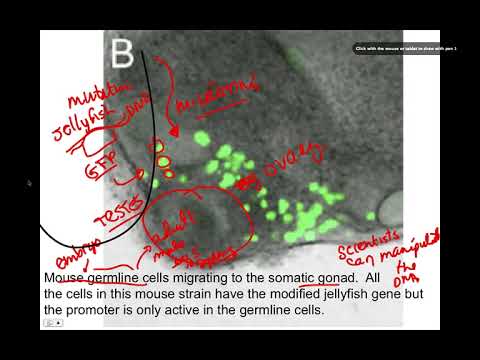
- A promoter–reporter fusion can reveal where a gene’s regulatory sequence is active: a mouse germline promoter drives jellyfish GFP in germline cells.
- The reporter strategy provides a visible way to follow germline-cell migration toward developing ovaries or testes.
- Introns are removed during RNA processing, whereas exons remain in mature RNA; protein-coding regions specify amino acids.
- Transcription factors acting at promoters regulate gene activation, and RNA polymerase synthesizes the corresponding RNA.
Chapters
0:00
PDGF Misexpression After a Gene Translocation
- A gene has a transcription unit and a promoter; Champlin distinguishes proximal and distal promoter regions.
- A translocation joins parts of two genes, causing PDGF to be expressed in skin cells instead of its usual megakaryocytes in bone marrow.
- The resulting PDGF protein is secreted from skin cells, binds the PDGF receptor, and stimulates the cell cycle.
- The transcription unit can contain exons and introns; introns are removed from RNA while exons remain in mature RNA.
3:02
Using a Germline Promoter and Jellyfish GFP to Track Mouse Cells
- Mouse germline cells migrate through the embryo to developing ovaries or testes, where they contribute to eggs or sperm.
- Researchers fused a mouse germline-cell promoter to the jellyfish gene for green fluorescent protein (GFP).
- The engineered DNA is present in mouse cells, but the promoter activates GFP in germline cells, making those cells glow green.
- Unlike the accidental PDGF translocation, this deliberate DNA manipulation uses misexpression as a marker for studying cell migration.
6:20
From Coding Regions to Transcriptional Control
- In protein-coding genes, the coding region lies within the transcription unit and specifies an amino-acid sequence assembled at the ribosome.
- Champlin describes DNA as a linear sequence of letters whose arrangement carries biological information.
- Transcription factors bind promoter regions to activate genes, while RNA polymerase synthesizes RNA from the transcription unit.
- The lecture previews later topics: protein synthesis in Chapter 17 and gene regulation in Chapter 18.
Summary, takeaways, and chapters were generated by AI from the video's transcript and may contain errors. The video belongs to its creator, The New Evolution for Everyone.