Meiosis, BIO105 Introductory Biology, David Champlin, USM
 Watch on YouTube →
Overview
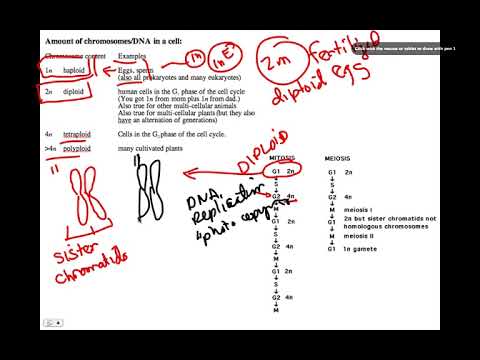
David Champlin explains meiosis as the process that reduces diploid cells to haploid sperm or eggs, contrasting its two divisions with mitosis. He reviews human chromosome sets, distinguishes homologous chromosomes from sister chromatids, and highlights the absence of an S phase between meiosis I and II, the timing of chromatid separation, and genetic recombination.
Key takeaways
- Human diploid cells carry two 23-chromosome sets, one inherited from each parent; sperm and eggs carry one set.
- Sister chromatids are identical copies produced by DNA replication, whereas homologous chromosomes carry the same genes but may contain different variants.
- Meiosis has one DNA-replication phase followed by two divisions, and there is no S phase between meiosis I and meiosis II.
- Meiosis I separates homologous chromosomes while keeping sister chromatids together; meiosis II then separates the sister chromatids.
- Crossing over in meiosis I exchanges chromosome segments between homologs, mixing maternal and paternal genetic information.
- DNA replication doubles a cell's DNA content but does not make a diploid cell tetraploid; the chromosome-set number and DNA amount are distinct measures.
Chapters
0:00
Mitosis, Meiosis, and Human Diploid Chromosome Sets
- Champlin distinguishes bacterial fission from eukaryotic cell division: mitosis serves most body-cell division, while meiosis produces sperm and eggs.
- A human haploid genome contains 23 chromosomes: 22 autosomes and one sex chromosome; most body cells have one set from each parent, or 2n.
- Fertilization combines haploid sperm and egg sets to restore a diploid chromosome complement.
3:00
DNA Replication, Sister Chromatids, and Homologous Chromosomes
- During S phase, each chromosome is copied into two identical sister chromatids, illustrated with chromosome 11.
- Maternal and paternal versions of chromosome 11 are homologs: they carry the same genes but can have different gene variants.
- Mitosis separates sister chromatids so each daughter cell receives a copy; DNA replication doubles DNA content, but does not itself change a cell's ploidy.
6:00
Meiosis I, Meiosis II, and Crossing Over
- Meiosis begins after one S phase and includes two cell divisions, with no additional S phase between meiosis I and meiosis II.
- In meiosis I, homologous chromosomes separate while sister chromatids remain together; in meiosis II, sister chromatids separate.
- During meiosis I, homologous chromosomes can undergo recombination, or crossing over, exchanging segments and producing chromosomes with a mixture of maternal and paternal genetic information.
- Champlin describes crossing over as random and rare, while noting that exchanges can occur at multiple points along long chromosomes.
Summary, takeaways, and chapters were generated by AI from the video's transcript and may contain errors. The video belongs to its creator, The New Evolution for Everyone.