Medieval German Easterplays 8: Perspectives. The Wienhausen Easter Play
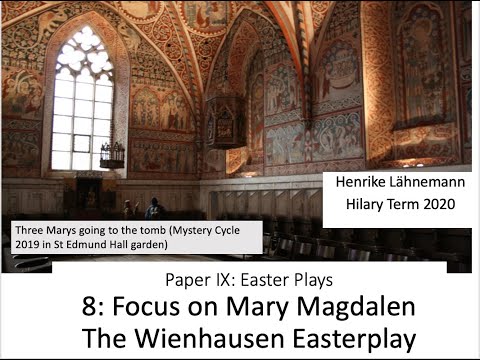 Watch on YouTube →
Overview
Henrike Lähnemann uses the Wienhausen Easter Play—a small role booklet for Mary Magdalene—to compare the Innsbruck and Muri Easter Plays and show how medieval drama depended on performance setting, liturgy, and community. The booklet preserves Latin music alongside Low German dialogue, while its performance in a Cistercian nuns’ choir demonstrates that these plays were adaptable, open texts rather than fixed literary works.
Key takeaways
- The Wienhausen Easter Play survives as a compact role booklet for Mary Magdalene, found under the nuns’ choir floorboards in 1952 and probably dating from the 14th or 15th century.
- Wienhausen offers unusually rich performance evidence: the convent’s nuns’ gallery, tomb imagery, Holy Sepulchre, and surviving costume fragments connect the script to a specific religious community.
- The play preserves Latin music and the sequence Victimae paschali laudes alongside Low German translations, showing how liturgical material could be made theatrically and linguistically accessible.
- Medieval staging did not require a permanent theater: Nuremberg streets and Newcastle guild processions illustrate how town landmarks, wagons, and communal routes could become performance spaces.
- Shared lines between the Wienhausen and Innsbruck plays show that medieval Easter-play scenes could circulate and be reshaped, rather than belonging to one fixed text.
- The practical manuscripts are valuable precisely because they are not polished literary editions: their linguistic variation and performance cues preserve traces of oral adaptation and communal use.
Chapters
0:00
Wienhausen as a Performance-Based Comparison for Innsbruck and Muri
- Lähnemann introduces the Wienhausen Easter Play because its performer, audience, and setting can be identified more clearly than those of the fragmentary Innsbruck and Muri evidence.
- The surviving Wienhausen manuscript is a small parchment booklet containing Mary Magdalene’s role.
- Its scenes include the visit to the tomb, the encounter with Christ as gardener, and an episode with Thomas.
5:49
Shared Easter-Play Scenes and Contrasting Stage Requirements
- The Wienhausen play shares lines with the Innsbruck play, evidence that scenes could circulate and be adapted across performances.
- The Innsbruck play calls for multiple locations, including the temple, tomb, Limbo, and a merchant’s house.
- The Muri play has fewer stage directions and concentrates action around Pilate, linking a vendor’s license payment to the bribe paid to the guards.
10:35
Sacred Geography, Nuremberg, and Processional Performance
- Medieval towns could serve as a map of Jerusalem: Nuremberg’s Pilatushaus and a nearby hill were associated with pilgrimage routes and sacred sites.
- A churchyard tomb or a well could become a biblical location, making performance possible beyond a purpose-built playhouse.
- English guild plays offer another model: Newcastle guilds kept props by town-wall towers and performed on wagons along a processional route.
17:29
The Wienhausen Role Booklet and Its Musical Text
- The booklet was found beneath the nuns’ choir floorboards when they were lifted in 1952; its parchment leaves measure about 11 by 9 centimeters.
- Its date is uncertain, though related objects from Wienhausen generally belong to the 14th or 15th century.
- Unlike the surviving Innsbruck and Muri texts, the booklet preserves Latin sections and music as well as German material.
22:04
Mary Magdalene, the Easter Sequence, and the Sacred Tomb
- The play expands liturgical material such as the Easter sequence Victimae paschali laudes into dramatic exchange between Mary Magdalene and the apostles.
- The nuns’ gallery included imagery of the Three Marys at the tomb, with inscriptions echoing lines used in Easter plays.
- A Wienhausen Holy Sepulchre could conceal and reveal Christ; its head and side wounds also held relics and the consecrated host, connecting performance with Eucharistic devotion.
30:57
The Lost Role Booklet and Its Material Performance Context
- The surviving booklet likely belonged to the nun playing Mary Magdalene, who may have dropped it in the choir.
- Wienhausen also preserves an angel’s Easter garment, once displayed over Christ’s tomb, with a Low German Passion Play text reused as backing.
- Writing implements found beneath the floorboards add evidence of the material culture surrounding the convent’s performances.
35:20
Mary Magdalene’s Role and the Nuns’ Dramatic Reenactment
- The role begins with a tomb scene; a marginal addition supplies a brief Thomas episode before the play’s final sequence.
- In the concluding scene, Mary Magdalene performs Victimae paschali laudes while the other nuns take the parts of the apostles.
- The antiphonal arrangement lets performers step forward to deliver lines and respond to one another within the nuns’ choir.
38:27
Latin Chant, Low German Translation, and Linguistic Variation
- The play makes the Latin sequence accessible by translating its parts into rhyming Low German couplets, often through Mary Magdalene’s account to the apostles.
- Its language includes Low German forms alongside occasional High German alternatives, consistent with oral transmission and adaptation.
- Four lines shared with the Innsbruck play may reflect a common High German model, though Lähnemann notes that stock phrasing or coincidence remain possible.
44:34
Easter Plays as Open Texts Rather Than Fixed Works
- Lähnemann characterizes the plays as performance-based, open texts—more like evolving collections of material than stable literary entities.
- Their practical scripts preserve direct evidence of medieval actors, community life, and the interaction of Latin liturgy with vernacular drama.
- The lecture closes by inviting students to compare different stagings of a medieval play at a 25 April event.
Summary, takeaways, and chapters were generated by AI from the video's transcript and may contain errors. The video belongs to its creator, Henrike Lähnemann.