Medieval German Easterplays 7: Muri Easter Play Fragment IV-VI
 Watch on YouTube →
Overview
The Muri Easter Play’s surviving fragments combine comic marketplace scenes with the Easter drama of Christ’s descent into hell and the visitation of the tomb. Comparing the Muri and Innsbruck plays with Latin liturgy shows how vernacular paraphrase expands theological ideas, helps reconstruct damaged text, and makes a performance script accessible to its audience.
Key takeaways
- The Muri Easter Play adapts Psalm 24’s “Who is this King of Glory?” into a staged contest between Lucifer and Jesus, then expands Jesus’s answer into an explanation of redemption.
- Latin liturgical cues can recover not only the source of a scene but also help reconstruct German wording lost from damaged manuscript leaves.
- The Muri manuscript’s marginal performer name Antonius and abrupt scene transitions point to a practical performance script, not merely a text prepared for scholarly study.
- The play’s repeated language connects Christ’s promised descent into hell with its fulfillment, reinforcing the redemption narrative through a clear prediction–action–completion sequence.
- Mary Magdalene’s confession functions like a congregation’s response after liturgical readings, making her a model for how the audience should interpret the resurrection.
- Muri and Innsbruck draw on the same Latin foundations, but Muri uses fewer characters, less comic banter, and a more prominent Mary Magdalene as resurrection witness.
Chapters
0:00
The Muri Peddler’s Luxury Goods and Comic Social World
- The peddler, identified with the Latin term institor, sells fashionable goods such as small belt bags, belts, and decorated hats.
- The bags are described as a southern German diminutive, linking the vocabulary to the play’s Swiss or southern German origins.
- A comparison with the Codex Manesse image of Dietmar von Aist places the peddler’s wares in a broader medieval culture of fashion, courtship, and luxury.
5:30
Lucifer’s Psalm Challenge and Jesus as King of Glory
- The Muri text marks Jesus’s entrance in the margin but omits staging directions, so the Innsbruck Easter Play helps suggest how the scene may have unfolded.
- The dialogue adapts the processional Psalm 24, including the question “Who is this King of Glory?”, for a dramatic exchange between Lucifer and Jesus.
- Jesus’s answer expands the Latin text into a theological explanation of his divine identity and his purpose in destroying hell.
10:30
Christ Rescues His Creatures and Expounds Redemption
- The phrase “creatures of his hand” presents humanity as God’s handiwork and connects Christ’s act of rescue to the image of the Lord’s strong arm.
- Wolfram von Eschenbach’s Willehalm uses related language when the Christianized princess Gyburc pleads for the lives of pagan relatives.
- The play reinforces liberation from hell, death, and sin through repeated phrases and expanded vernacular explanation.
13:00
Latin Easter Sequence as a Guide to Missing Muri Text
- A marginal cue for the Easter sequence signals a sung interlude without writing out the full passage, relying on performers’ knowledge of the liturgy.
- Latin source wording can help reconstruct missing German lines where manuscript leaves were damaged at the binding.
- The German text translates the Latin’s core meaning and then amplifies it to clarify context and complete the rhyme.
18:00
Mary Magdalene’s Purchase and the Play’s Money Economy
- A sharp transition introduces the peddler being asked for aromatic substances and containers needed for the tomb visit.
- A marginal name, Antonius, appears to identify the performer playing Mary Magdalene, showing that the manuscript was prepared for a particular performance.
- Money and exchange recur in the play: the peddler sells goods, while Pilate also seeks funds to pay guards and manage the tomb’s security.
22:00
The Three Marys, the Tomb, and Actor Doubling
- The tomb scene evokes a heavy, flat tomb cover that must be lifted, comparable to medieval stone tombs rather than a rounded rock.
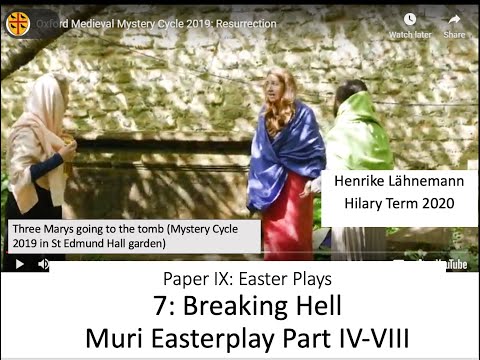
- A University College London staging at Saint Edmund Hall used one actor for both Jesus and the angel, a doubling that may fit the Muri script’s marginal cues.
- The exchange at the tomb draws on the Latin “Whom do you seek?” tradition and places Mary Magdalene’s response within the visitation scene.
25:45
Reading the Visitation Scene as a Performance Text
- The passage is read aloud with musical pauses, foregrounding the Muri fragments as a script intended for performance rather than a polished library edition.
- Marginal performer names and abrupt transitions offer practical clues about casting and scene changes even where stage directions are absent.
- The surviving text’s rhyme and repetition remain audible features of the dramatic reading.
37:30
Mary Magdalene’s Creed and the Muri–Innsbruck Comparison
- The epilogue repeats Jesus’s earlier promises and redemption language, making the sequence of prediction, action, and fulfillment a teaching device.
- Compared with the Innsbruck Easter Play, Muri uses fewer characters and concentrates comedy in the peddler and, to a lesser extent, Pilate.
- Mary Magdalene becomes the central witness whose confession models the congregation’s response to Gospel readings, paralleling liturgical readings followed by communal profession of belief.
Summary, takeaways, and chapters were generated by AI from the video's transcript and may contain errors. The video belongs to its creator, Henrike Lähnemann.