Medieval German Easterplays 5: Visiting the Tomb in the Innsbruck Easterplay
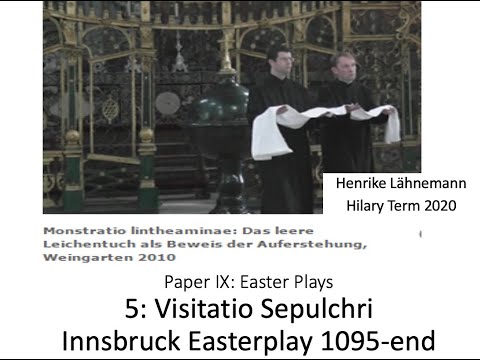 Watch on YouTube →
Overview
Henrike Lähnemann traces the Innsbruck Easterplay’s tomb visit from biblical accounts and early Easter liturgy to a vernacular medieval drama, showing how the encounter of the three Marys, the angels, and the risen Christ became a model for theatrical action. Close readings of the Latin sequence Victimae paschali laudes, the play’s staging and costumes, and its comic yet devotional epilogue reveal how the performance joins salvation teaching to worship and practical support for poor students.
Key takeaways
- The Easterplay’s tomb scene grew from the Quem quaeritis liturgical exchange, turning the angel’s commands to come, see, and tell into a dramatic model of Christian witness.
- In church performance, the altar of the Holy Cross could stand for Christ’s tomb, while the consecrated bread and wine made the reenactment materially connected to the Eucharist.
- Victimae paschali laudes, an eleventh-century sequence, expands the biblical story into a dialogue in which the apostles question Mary Magdalene about what she saw.
- The Innsbruck play localizes biblical imagery in German: a tomb lid is lifted rather than a stone rolled away, making the scene legible in a familiar setting.
- The epilogue combines spiritual teaching with practical fundraising: audiences are asked to feed student performers in return for an invitation to imagine Christ’s heavenly feast.
Chapters
0:00
The Tomb Visit as the Easterplay’s Dramatic Core
- The encounter at Christ’s tomb anchors the Easterplay cycle in biblical accounts and early Easter liturgy.
- Lähnemann traces how liturgical amplification and later German vernacular versions developed into dramatic action.
- Humor remains secondary, though the Innsbruck play lets the risen Jesus gently tease Mary Magdalene.
3:00
From the Empty-Tomb Image to the Quem Quaeritis Trope
- An Italian ivory carving from the fourth or fifth century depicts the empty tomb, an early visual focus for the resurrection story.
- The Quem quaeritis exchange expands the biblical account into dialogue: the women ask about the stone, and the angel announces that Christ has risen.
- The angel’s commands to come, see, and tell make the tomb scene a call to witness and spread the news.
5:20
How Church Liturgy Staged the Visit to the Sepulchre
- During the Easter service, three clergy members could dress as the women and emerge from the sacristy after readings and music.
- Three boys carrying lights accompanied them as they sang the Latin exchange at the altar of the Holy Cross.
- The altar represented Christ’s tomb, while the consecrated bread and wine connected the reenactment to belief in Christ’s body.
8:20
Victimae Paschali Laudes Turns Mary Magdalene into a Witness
- The eleventh-century sequence Victimae paschali laudes develops the implied biblical exchange into a conversation between Mary Magdalene and the apostles.
- Peter and John ask, Dic nobis, Maria, quid vidisti?—“Tell us, Mary, what did you see?”—and Mary answers in the first person.
- The sequence’s question-and-answer form helped congregations participate in the Easter liturgy and supplied material for dramatic performance.
11:50
Innsbruck’s Vernacular Translation and Purposeful Repetition
- The German version adapts the tomb imagery to local experience: instead of rolling away a stone, characters describe lifting a tomb lid.
- Mary Magdalene repeats lines of lament four times, emphasizing the play’s message of redemption rather than merely filling out the text.
- The play keeps Latin liturgical material while translating and explaining it in German for its audience.
16:00
Mary Magdalene, the Gardener, and Medieval Stage Props
- In the Noli me tangere scene, Mary mistakes the risen Jesus for a gardener before recognizing him.
- A prayer-book illustration from the convent of Medingen shows Mary’s ointment jar, Jesus’s wounds, and his resurrection banner.
- A surviving statue from Wienhausen illustrates how interchangeable banners, wings, and garments could furnish Easter scenes.
21:00
Costumes, Doubting Thomas, and the Easter Sequence
- Performance instructions assign Jesus to a devout priest and roles such as Mary Magdalene and John to young men.
- A red chasuble, paper crowns, a cross, and a banner distinguish sacred characters and signal their roles.
- After Mary reports the resurrection, Thomas doubts her; the play draws on the liturgical Trisagion before Jesus appears to him.
- Mary and the apostles sing portions of Victimae paschali laudes, whose repeated structures shape the dramatic exchange.
27:00
Singing Victimae Paschali Laudes as Congregational Drama
- Lähnemann rehearses the sequence’s call-and-response pattern, with clergy singing and the congregation answering.
- The tune associated with Victimae paschali laudes was used in Easter worship from the fourteenth century.
- The performance demonstrates how a Latin liturgical song could become both a dramatic script and a shared act of worship.
41:30
The Epilogue’s Appeal: A Heavenly Feast and Food for Students
- The ending shifts from salvation history to a practical appeal for food and drink for the performers.
- Poor students training in the Latin grammar school could serve as supporting actors and depend on the performance’s meal collection.
- The request links feeding the students at an earthly feast with Christ’s invitation to a heavenly feast.
- The actors move between representing Christ and appearing as hungry clergy, making the fundraising appeal part of the drama.
Summary, takeaways, and chapters were generated by AI from the video's transcript and may contain errors. The video belongs to its creator, Henrike Lähnemann.