Medieval German Easterplays 4: Merchants versus Marys (ii) in the Innsbruck Easterplay
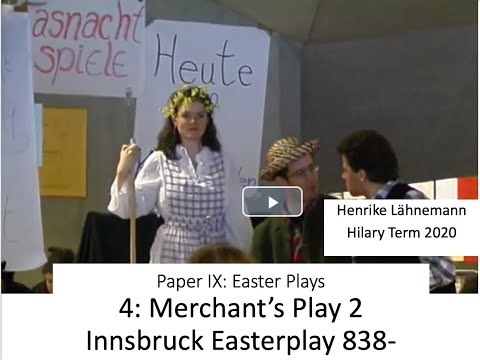 Watch on YouTube →
Overview
Henrike Lähnemann examines how the Innsbruck Easterplay sets the Three Marys’ sacred visit to the tomb against comic scenes with a merchant, his servants, and his wife. Close attention to insults, sexual innuendo, pseudo-Latin, food jokes, and performance ambiguity shows how the play moves between liturgical seriousness and comedy; Lähnemann also considers how a modern translation could restore the force of its dated jokes.
Key takeaways
- The Innsbruck Easterplay derives much of its comedy from abrupt shifts between elevated literary or liturgical language and ordinary market speech.
- Medieval insults and jokes are difficult to translate literally because their force depends on lost cultural context, performance, and improvisation.
- Rubin’s mock Latin and parodied church phrases bring the merchant comedy into contact with the Marys’ liturgical material, gradually joining the play’s comic and sacred strands.
- Lähnemann recommends translating obsolete jokes by recreating their effect and sharpness for modern audiences, rather than insisting on uncertain literal meanings.
- The Easterplay’s sacred narrative grows out of the Easter sequence “Victimae paschali laudes” and the liturgical dialogue asking Mary Magdalene what she saw.
Chapters
0:00
Merchant Comedy, the Three Marys, and Medieval Stock Characters
- Lähnemann frames the merchant’s comic play as a counterpoint to the Three Marys’ approach to Christ’s tomb.
- The merchant’s wife recalls unruly women in medieval farce: she answers back and threatens to beat her husband with a stick.
- Recurring clown-like servants may have been recognizable stock characters, identified by costume or exaggerated features such as a large nose or feet.
5:00
Insults, Thuringian Dialect, and Sexual Innuendo
- The insult involving dog excrement recurs in the soldiers’ taunts, but its precise medieval force is difficult to recover without contemporary context.
- An adjective ending unlike standard German appears repeatedly and helps researchers associate the source play with Thuringia.
- Sexual innuendo and references to unappealing animal leftovers turn the merchant’s market talk into deliberately low comedy.
10:00
Pseudo-Latin, Mock Scholarship, and the Merchant’s Remedies
- Invented, impressive-sounding words parody people who use scholarly language without understanding it, much like “hocus-pocus.”
- The phrase “hocus-pocus” is linked to the Eucharistic words “hoc est corpus meum,” showing how sacred Latin could become comic material.
- The merchant’s rhyme shifts from the elevated language of a dawn song to mundane talk about carrying a sack and selling dubious performance-enhancing remedies.
14:00
Uncertain Stage Directions and Comedy at the Edge of Offense
- Because the text gives few stage directions, it is unclear whether references to old women mean extra market characters or insults aimed at the Three Marys already onstage.
- Lähnemann favors interpreting unclear words through dramatic context, while acknowledging that no definitive reading may survive.
- The comedy works near the boundary of blasphemy and offense; improvisation, gestures, and delivery could shift the joke’s target and intensity.
18:00
From Comic Ingredients to Serious Latin Recitation
- The merchant’s concoctions mix possible ingredients with deliberately absurd or invented ones, echoing impossible materials such as moonlight.
- A sudden switch into Latin changes the register from comic speech to serious recitation, including a reference to the shepherd being struck down.
- The contrast between the merchant’s pseudo-learned language and Latin recitation makes shifts in tone a central theatrical device.
23:00
Bladder-Stone Doctors, Goose Milk, and Liturgical Parody
- A medical term is connected to bladder-stone cutting, a procedure associated with traveling doctors, and to examining urine in a glass vial.
- The absurd command to milk geese plays on the impossibility of the task and on the idea of a mythical creature that supplies everything.
- The merchant’s comic song begins to overlap with the Marys’ liturgical singing, as Rubin praises his master in a German-Latin mixture that parodies genuine church phrases.
30:00
Translating Dead Jokes and Restoring Their Comic Force
- The Marys sing biblical names and lines alongside the merchant’s song, bringing the previously separate sacred and comic strands into closer contact.
- Unclear or nonsensical words may have been intended primarily for sound and comic effect, rather than to convey a recoverable literal meaning.
- Lähnemann argues that an effective modern translation should find fresh jokes and insults with comparable sharpness, rather than reproduce obsolete wording literally.
35:00
The Merchant and His Wife: Public Conflict and Courtesy
- A manuscript illustration from 1425 contrasts virtuous study and religious listening with foolish behavior, including an older man pursuing a young woman.
- The play’s merchant-and-wife quarrel draws servants into a near-stage fight, turning household conflict into public spectacle.
- The discussion of courtliness complicates the scene: beating one’s wife in public is presented as socially improper, while the insults expose competing ideas of respectable behavior.
45:00
Dramatic Reading and the Liturgical Origins of the Easterplay
- A dramatic reading occupies the final section, putting the merchants-versus-Marys material into performance rather than treating it only as written text.
- The next section will focus on the play’s oldest layer, developed from Easter liturgy and the sequence “Victimae paschali laudes.”
- The chant’s question “Dic nobis, Maria, quid vidisti in via?”—“Tell us, Mary, what did you see on the way?”—introduces Mary Magdalene’s encounter with the risen Christ.
Summary, takeaways, and chapters were generated by AI from the video's transcript and may contain errors. The video belongs to its creator, Henrike Lähnemann.