Medieval German Easterplays 2: Harrowing of Hell in the Innsbruck Easterplay
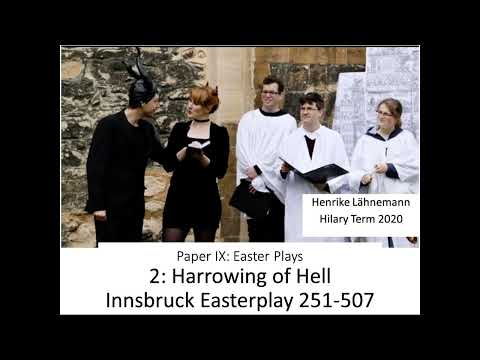 Watch on YouTube →
Overview
Henrike Lähnemann explains how the Innsbruck Easter Play stages Christ’s Harrowing of Hell as a dramatic and theological bridge between burial and Resurrection, drawing on the Apostles’ Creed, Psalm 24, and Latin Easter sequences. She connects the play’s Latin chants, German dialogue, stage movement, and comic episodes to medieval ideas about redemption, pride, social hierarchy, and the audience’s own conduct.
Key takeaways
- The Harrowing of Hell is a later dramatic expansion of the Apostles’ Creed’s statement that Christ descended into Hell, rather than an episode narrated in detail in the Bible.
- Psalm 24 and the sequence Cum rex gloriae give the Innsbruck Easter Play a call-and-response structure that turns liturgical words into a staged confrontation at Hell’s gates.
- The play makes Latin liturgy accessible by pairing chant with physical action and German translation or repetition, so audiences can follow its meaning without understanding every Latin phrase.
- Leaving one soul in Hell after Adam, Eve, and the other dead are freed dramatizes medieval disputes about whether redemption depends on human action or comes through unconditional grace.
- Lucifer’s fall links pride to the Fall of Adam and Eve, while the subsequent procession of social ranks uses the Dance of Death tradition to invite satire of local society.
- The play’s engagement with its audience extends beyond theology: possible audience participation and jokes about bread and beer measures connect staged moral judgment to civic life.
Chapters
0:00
The Innsbruck Easter Play Moves from Resurrection to Hell
- The Harrowing of Hell follows the play’s scenes at Pilate’s house, the guards, and Christ’s Resurrection.
- The Resurrection itself is brief; the drama focuses on how different groups respond to it.
- The cycle moves upward from Hell toward Christ’s Ascension in the next play.
3:00
The Apostles’ Creed Supplies the Harrowing’s Theological Premise
- The descent into Hell has no direct biblical narrative describing the event; it expands the Creed’s phrase that Christ “descended into hell.”
- Early Christians used the episode to bridge the burial and Resurrection and explore their theological consequences.
- Christ’s victory is presented as reaching the dead of the past as well as people living now and in the future.
7:00
Easter Sequences and the Bodleian Manuscripts
- The sequence Victimae paschali laudes is associated with the later Mary Magdalene and empty-tomb scenes.
- The Harrowing draws on the sequence Cum rex gloriae, quoted in the Innsbruck Easter Play.
- A late-15th-century Cistercian convent handbook in the Bodleian Library records how a provost and nuns could imaginatively enact Easter through sung liturgy.
- Manuscript images show Christ with his wounds and the Hellmouth, whose toothed form can help identify northern German artistic traditions.
10:30
Psalm 24 Shapes the Procession to Hell’s Gates
- Psalm 24’s call to lift the gates and its question, “Who is this King of Glory?”, provide the dramatic pattern for the encounter with Hell.
- The psalm’s alternating question and answer echo a processional performance, with a cantor and a responding group.
- The Vulgate’s reading of “princes” influences the Middle High German wording, while the King James Bible and Handel’s Messiah reflect a reading closer to the Hebrew text.
14:00
Procession, Latin Chant, and the Voices of the Dead
- In the staging, Christ and the angels move left to right toward Hell, while medieval stage convention associates the opposite direction with villains.
- Angels sing Cum rex gloriae as they approach the Hellmouth, turning liturgical chant into both music and stage direction.
- The Latin names the forefathers and saints awaiting redemption, from Adam to John the Baptist.
- The play breaks a sequence normally sung continuously by clergy into separate dramatic parts, including Adam’s plea.
18:00
Adam’s Musical Plea and the Gates of Hell
- The chant uses rising and falling melodic patterns to convey the dead’s longing, darkness, and hope for release.
- Adam raises his hands to Christ, while a long melisma stretches the musical expression of the souls’ desire.
- Lucifer confronts the approaching King of Glory at the Hellmouth, and the angels’ replies echo the psalm’s repeated question-and-answer structure.
- The German dialogue translates or restates much of the Latin, helping audiences follow the liturgical material through performance.
24:00
Christ Frees the Dead but Leaves One Soul Behind
- Christ’s biblical language and Adam’s welcome connect the Latin sequence to German dialogue; Adam frames the news as good news, or Gospel.
- Adam, Eve, and the other souls are released, but one soul remains in Hell.
- The remaining soul makes redemption’s limits a live theological question: is grace unconditional, or must a person do something to receive it?
- A play about the wise and foolish virgins similarly depicts intercession by Mary and the saints failing to save the condemned.
28:50
Lucifer’s Fall Explains the Link Between Pride and Human Sin
- An interlude presents Lucifer as a former angel who falls after aspiring to a place above God.
- The flames of Lucifer’s fall are portrayed as descending onto Adam and Eve, linking the angel’s pride to humanity’s Fall.
- A Nuremberg clerk, Johannes Förster, illustrates Lucifer’s transformation by darkening his face, hair, and one arm.
- The episode recalls the earlier use of the same actor as Lucifer and the serpent in the Creation and Fall play.
31:40
Lucifer’s Review of Society Echoes the Dance of Death
- After the redeemed souls leave, Lucifer’s empty Hellmouth is refilled with representatives of different social ranks.
- The procession recalls the Dance of Death, moving through figures such as the pope, cardinal, bishop, and monk.
- The sequence offered scope for local satire, including references to current events and people in the town.
- Lähnemann points to the influential Dance of Death in Lübeck and a surviving medieval example at Berlin’s Marienkirche.
35:10
Reading the Latin Sequence as a Dramatic Performance
- Lähnemann stops the detailed grammatical walkthrough and recites rather than sings the long sequence to keep the session manageable.
- The performance section demonstrates how the liturgical passage could be delivered as spoken or sung drama rather than treated only as a written text.
- The play’s Latin and German components work together: action and translation help communicate material even when audiences do not understand every Latin word.
47:00
Audience Participation, Market Measures, and the Next Play
- The staging may have blurred the boundary between performers and spectators by drawing people from the audience into the action.
- The closing discussion connects social satire to everyday standards, including the correct size of bread rolls and the measure of beer.
- Examples from Freiburg’s Münster show how civic stone measures let people check bread and other goods.
- The next session will examine the merchants’ play and the Three Marys, whose comic and tragic scenes form a linked sequence.
Summary, takeaways, and chapters were generated by AI from the video's transcript and may contain errors. The video belongs to its creator, Henrike Lähnemann.