Medieval German Easterplays 1: Introduction, Innsbruck Easterplay 1-250
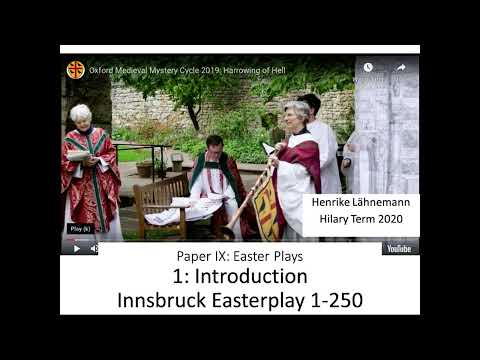 Watch on YouTube →
Overview
Henrike Lähnemann introduces the Innsbruck Easter Play as an early, performable manuscript text rather than a complete modern-style script, using its 1391 copy, staging cues, dialect, and liturgical elements to explain how the play worked. Close reading of lines 1–250 shows how processions, repeated calls, comic scenes, Latin chants, and audience movement build dramatic structure; the lecture ends with a read-through of the passage.
Key takeaways
- The Innsbruck Easter Play manuscript was completed in 1391, making it an unusually early witness to German vernacular drama; its Thuringian language and Austrian copying context point to a text that traveled between regions.
- The manuscript functions as a director’s prompt copy: it preserves practical cues while leaving Latin chants to be supplied from church liturgical books.
- Medieval staging depended on loca and processions, and audience members could move between the tomb and Pilate’s house as the action changed location.
- The manuscript’s mixed dialect and inconsistent spelling require readers to distinguish scribal conventions from normalized Middle High German forms.
- Repeated calls, musical interludes, and redundant phrasing serve practical dramatic purposes: they hold audience attention, emphasize the message, and allow movement between stations.
- The opening juxtaposes liturgical Latin with comic scenes, including an invented pseudo-Hebrew song that reflects the play’s anti-Jewish conventions.
Chapters
0:00
Course Plan and the Innsbruck Easter Play’s Prologue
- Lähnemann frames the opening passage around the play’s precursor, or expositor, who introduces the action and bridges parts of salvation history.
- A planned April 25 performance was seeking a support cast; Leslie Smith had taken the precursor’s role in an earlier production.
- The course plan allocates five lectures to the complete Innsbruck Easter Play, two to fragments of the Muri Easter Play, and a final week to other German traditions, especially Low German.
2:35
The 1391 Manuscript and Its Thuringian-Austrian History
- The manuscript was completed in 1391, unusually early for surviving vernacular drama compared with English mystery plays that entered the written record in the 15th century.
- Its language points to a Thuringian origin, while the copy was used in Austria; Lähnemann suggests the text may have been composed earlier in the 14th century and carried between regions.
- Italian paper provides material evidence of the cross-European movement of texts and manuscripts.
6:02
A Director’s Copy, Not a Complete Acting Script
- The text uses a two-column business-register format that could be practical for a director prompting actors.
- It records cues actors needed rather than every element of a modern script; Latin material was omitted because performers could learn it from liturgical sources.
- Other medieval playbooks could preserve only one performer’s role—for example, a Mary Magdalene part—rather than the full play.
9:17
Loca, Processions, and the Moving Audience
- The play is organized around loca, or distinct playing places, rather than Aristotle’s unified time and place.
- The audience could move between locations such as the tomb and Pilate’s house as the action shifted.
- Actors were positioned before the Easter Play began, following the preceding Assumption of Mary play; the actor playing Jesus could process through the crowd to his first location.
13:02
Reading the Play’s Unstandardized Middle High German
- The manuscript combines Thuringian forms with features introduced by an Austrian scribe, so its spelling does not follow a consistent system.
- Readers must accommodate conventions such as interchangeable v and u, inconsistently marked umlauts, and variable spellings of sounds represented by modern z or tz.
- Lähnemann contrasts the manuscript’s spellings with normalized Middle High German editions, which reflect later editorial choices.
19:08
Repetition, Liturgical Inserts, and Dramatic Pacing
- The precursor uses repeated calls and formulaic language to make key instructions register with a large, potentially unruly audience.
- Repetition and redundancy create suspense and emphasis onstage, even where repeated lines might seem tedious in a written poem.
- Latin chants are reconstructed from liturgical sources rather than copied into the manuscript; music also gives the audience time to reflect and move between playing locations.
22:54
Mock Hebrew, Biblical Latin, and Medieval Stage Comedy
- The opening includes an invented song designed to sound Hebrew to non-speakers, using pseudo-Hebrew forms and comic sounds.
- Lähnemann identifies this scene as part of the play’s anti-Jewish conventions, while distinguishing its fabricated song from the actual Latin prayer Audi Israel, based on Deuteronomy.
- Characters sometimes recap a Latin chant in their next German speech, linking liturgical material to the vernacular action.
27:03
The Tomb Scene, Resurrection Chant, and Stage Fight
- Stage directions bring performers into close contact with the crowd: a messenger runs through the audience to summon other players.
- Intervals of singing support audience movement toward Pilate’s location; soldiers also perform comic material before lying down to sleep.
- An angel tells Christ to rise, followed by the play’s central Easter liturgical chant; the first section concludes with a stage fight that adds non-biblical comic action.
32:22
Read-Through of Innsbruck Easter Play Lines 1–250
- After the commentary, Lähnemann begins a continuous read-through of the opening passage, shifting from explanation to performance.
- The remaining segment runs to the end of the 44-minute lecture and includes music and performance cues, though the transcript provides little further spoken analysis.
Summary, takeaways, and chapters were generated by AI from the video's transcript and may contain errors. The video belongs to its creator, Henrike Lähnemann.