Math 30 - Day 10 - Graphing Linear Functions
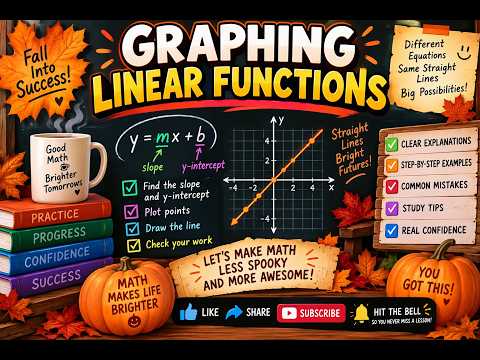 Watch on YouTube →
Overview
Christopher Lee teaches several ways to graph linear functions: plotting evaluated points, using slope and y-intercept, and applying transformations to the identity function. The lesson also explains how to find x-intercepts, distinguish horizontal and vertical lines, identify parallel and perpendicular slopes, and write a parallel line through a given point.
Key takeaways
- For f(x) = -3/4x + 6, the points (0, 6), (-4, 9), and (4, 3) form an easy-to-plot set and confirm that the line decreases from left to right.
- In y = mx + b, b identifies the y-intercept (0, b), while m gives rise over run; a negative slope requires exactly one of rise or run to be negative.
- A nonzero constant function such as y = 5 has no x-intercept, while a vertical line such as x = 2 is not a function and has undefined slope.
- Distinct parallel lines have equal slopes and different intercepts; perpendicular lines have slopes whose product is -1.
- To find a line parallel to y = 3x + 1 through (1, 7), retain slope 3 and substitute the point to obtain y = 3x + 4.
Chapters
0:00
Five Steps for Graphing a Linear Function with Points
- Choose at least two input values and evaluate the function at each one.
- Turn the input-output pairs into coordinates, plot them on a grid, and draw a line through the points.
2:41
Evaluate f(x) = -3/4x + 6 at Selected Inputs
- The class evaluates the function at inputs including 0, 1, 2, -4, and 4.
- The resulting coordinates include (0, 6), (-4, 9), and (4, 3); fractional inputs produce additional points such as (-4/3, 7) and (4/3, 5).
7:34
Plot Convenient Integer Points and Check the Slope Direction
- Christopher Lee graphs (0, 6), (-4, 9), and (4, 3), choosing integer coordinates that are easier to plot than fractional ones.
- The line for f(x) = -3/4x + 6 decreases from left to right, matching its negative slope.
- Zero is a useful input because it immediately gives the y-intercept; two points determine a line, while a third can help verify it.
13:23
Read Slope and Y-Intercept from f(x) = 1/2x + 1
- In slope-intercept form f(x) = mx + b, m is the slope and b is the y-coordinate where the graph crosses the y-axis.
- For f(x) = 1/2x + 1, the y-intercept is (0, 1), and the positive slope means the graph rises from left to right.
- Starting at (0, 1), rise 1 and run 2 to plot another point; repeat the same move to extend the line.
17:11
Slope Formula and a Four-Step Graphing Procedure
- Slope is change in output over change in input: m = (y₂ − y₁)/(x₂ − x₁), also described as rise over run.
- To graph from an equation, find the y-intercept by setting x = 0, identify the slope, plot the intercept, then use rise over run to add points.
- For a negative slope, make either the rise negative or the run negative—not both—so the ratio stays negative.
21:07
Graph f(x) = -2/3x + 5 Using Rise over Run
- Setting x = 0 gives the y-intercept (0, 5), while the slope is -2/3.
- From (0, 5), a negative rise and positive run reaches (3, 3); a positive rise and negative run reaches (-3, 7).
- Either direction along the line works, and both slope steps produce points consistent with a line that descends from left to right.
28:59
How the Slope Changes Steepness and Direction
- Multiplying the identity function f(x) = x by m changes the line’s steepness; the larger |m| is, the steeper the graph.
- Examples such as 3x, 2x, x, and 1/2x illustrate progressively less steep positive slopes.
- A negative multiplier reflects the line so it slopes downward rather than upward.
32:17
Vertical Shifts and the Transformation Graphing Method
- In f(x) = mx + b, b shifts the graph vertically without changing its slope: positive b moves it up and negative b moves it down.
- The transformation method starts with y = x, applies the vertical stretch or compression from m, then shifts by b.
- Lee notes that transformations offer another way to interpret a line, though plotting the y-intercept and using slope may be easier for accurate graphing.
34:47
Compare Transformations with Rise over Run for 1/2x − 3
- The example f(x) = 1/2x − 3 shifts the identity graph down three units and has a less steep positive slope.
- The y-intercept is (0, -3); rising 1 and running 2 gives the point (2, -2).
- The rise-over-run construction makes the line’s exact direction clearer than a rough transformation sketch.
38:49
Practice a Positive Slope and Apply Transformations in Order
- For a line with slope 2 and a vertical shift up 4, the intercept is (0, 4), and rising 2 over a run of 1 gives (1, 6).
- A positive slope can also be followed backward by falling 2 and running 1 to the left.
- The operations in f(x) = mx + b must follow the function’s order: multiply the input by m first, then add b.
45:31
Find an X-Intercept by Setting the Output to Zero
- An x-intercept is the point where the graph crosses the x-axis, so its y-value—or function output—is zero.
- Set f(x) = 0 and solve for x; for f(x) = 3x − 6, solving 0 = 3x − 6 gives x = 2 and the intercept (2, 0).
- A vertical line may have an x-intercept even though it is not a function.
47:07
Recognize Lines Without X-Intercepts and Solve More Examples
- A nonzero constant function such as y = 5 is horizontal and never crosses the x-axis, so it has no x-intercept.
- For f(x) = 1/2x − 3, setting the output to zero gives x = 6 and the intercept (6, 0).
- For f(x) = 1/4x − 4, solving 0 = 1/4x − 4 gives x = 16 and the intercept (16, 0).
56:03
Horizontal Lines Have Zero Slope; Vertical Lines Have Undefined Slope
- A horizontal line such as f(x) = 2 has the same output for every input, making the change in y—and therefore its slope—zero.
- A vertical line such as x = 2 has a constant input but multiple outputs, so it fails the function test.
- Vertical lines have undefined slope because the slope formula would divide by a zero change in x.
1:01:41
Write Equations for Horizontal and Vertical Lines
- Horizontal lines use the form f(x) = b; a graph four units below the x-axis is f(x) = -4, equivalently y = -4.
- Vertical lines use the form x = a; a vertical line through x = 7 is written x = 7.
- Lee emphasizes that these equation-writing questions apply the constant y-value or constant x-value directly.
1:03:53
Identify Parallel Lines by Comparing Slopes
- Distinct parallel lines never intersect and have equal slopes but different y-intercepts.
- The lines f(x) = -2x + 6 and f(x) = -2x − 4 are parallel because both slopes are -2.
- Lines with different slopes, such as 3x + 2 and 2x + 2, are not parallel even when their y-intercepts match.
1:06:11
Perpendicular Slopes Are Negative Reciprocals
- Perpendicular lines intersect at a 90-degree angle, and for non-horizontal, non-vertical lines their slopes are negative reciprocals.
- To find a negative reciprocal, flip the fraction and change its sign; for example, the negative reciprocal of 1/8 is -8.
- The slopes 1/4 and -4 give a product of -1, confirming perpendicular lines.
1:11:00
Test Line Pairs for Parallel and Perpendicular Relationships
- The lesson summarizes parallelism with equal slopes; lines with the same slope and same intercept coincide as one line.
- Perpendicular slopes satisfy m₁m₂ = -1, equivalently m₂ = -1/m₁.
- In the set of example functions, f(x) = 2x + 3 and j(x) = 2x − 6 are parallel, while g(x) = 1/2x − 4 and h(x) = -2x + 2 are perpendicular.
1:15:08
Write a Parallel Line Through a Given Point
- A line parallel to f(x) = 3x + 1 must keep slope 3; using point (1, 7) gives y − 7 = 3(x − 1), or y = 3x + 4.
- For a parallel line to f(x) = 3x + 6 through (3, 0), substituting into y = 3x + b gives b = -9 and the equation y = 3x − 9.
- The point-slope form y − y₁ = m(x − x₁) gives the same result; the class closes with upcoming test and course scheduling notes.
Summary, takeaways, and chapters were generated by AI from the video's transcript and may contain errors. The video belongs to its creator, Christopher Lee.