Math 1153 - 24 August 2026 - Introduction, Chapter 1
 Watch on YouTube →
Overview
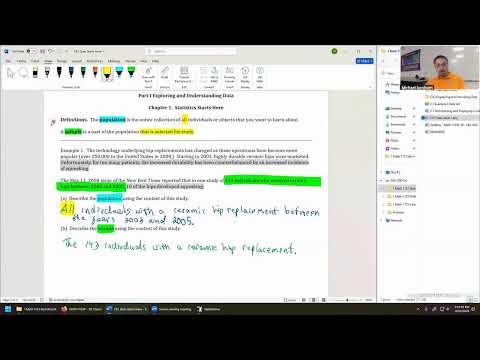
Mike Jacobsen introduces Fall 2026 Math 1153, explaining how Zoom, Canvas, Pearson MyLab, weekly coursework, and in-person exams will work. He begins Chapter 1 by defining population and sample, then applies those ideas to a 2008 report about 143 people with ceramic hip replacements from 2003–2005, 10 of whom experienced squeaking.
Key takeaways
- A population is everyone or everything a study seeks to understand; a sample is the subset researchers actually observe.
- In the ceramic-hip example, the population is all recipients from 2003–2005, while the sample is the 143 people studied; the 2008 figure is contextual information, not the population definition.
- The 10 squeaking cases among 143 study participants represent approximately 7% of the sample, not automatically the exact percentage in the full population.
- Math 1153 uses Pearson MyLab for homework and an online sixth-edition statistics text; students who opt out of the ISU book bundle receive a two-week access grace period before the stated $120 charge.
- The course includes three 75-minute exams worth 15% each and a comprehensive final worth 25%; students may bring one two-sided 8.5-by-11-inch note sheet to each exam.
- Jacobsen recommends reading before class, actively completing lecture notes, and then doing homework; completed Canvas notes and weekly quizzes provide ongoing review before exams.
Chapters
0:00
Before Class: Starting the Recording at 1:00
- Mike Jacobsen explains that class recordings officially begin at 1:00 to avoid long stretches of waiting.
- The session opens the Fall 2026 semester for Math 1153, a course in statistics and statistical reasoning.
1:03
Zoom Class Setup, Chat, and Participation
- Jacobsen teaches from a single monitor, using the center of the screen for mathematics and a small area to monitor participants.
- Students can participate with a microphone, Zoom reactions, or chat; classmates can alert Jacobsen if he misses a chat notification.
- Cameras are optional, and students should use a screen larger than a cell phone so digital-pen writing is readable.
6:00
Math 1153 Schedule, Email, and Walk-In Office Hours
- The section has 16 students and meets Monday, Tuesday, and Thursday; Wednesday is intended for catching up and asking questions.
- Jacobsen recommends email or Canvas messages for course, homework, and quiz questions, including questions sent late at night.
- Zoom walk-in office hours run Monday, Tuesday, and Thursday from 2:45–3:45, and Wednesday from 1:00–2:15.
10:05
TI-84 Plus Calculator Policy and Alternatives
- Jacobsen demonstrates the TI-84 Plus and recommends obtaining one as soon as practical; new models cost about $100, while used calculators may cost less.
- A newer TI-84 Plus model is acceptable, though screen layouts can differ slightly; students can email a calculator photo to confirm compatibility.
- Exam rules require a physical calculator rather than a phone app; other brands may work but require students to learn different controls and verify statistical features.
17:05
Weekly Quizzes, Three Exams, and Note-Page Rules
- Weekly Canvas quizzes begin in week two, with one short problem per week and the lowest two quiz scores dropped.
- The course has three 75-minute exams and a comprehensive final; each exam permits one 8.5-by-11-inch sheet of notes, front and back.
- Math and statistics department policy requires in-person exams at a testing center such as Pocatello, Idaho Falls, Meridian, or Twin Falls.
20:25
Exam Scheduling, Review Materials, and Grade Weights
- Jacobsen plans to send exam-one scheduling instructions during week four, ahead of the exam’s scheduled Monday in week five.
- Exam coverage and review problems will be set according to class pacing; the same preparation cycle repeats for later exams.
- The three exams count for 15% each, the comprehensive final for 25%, and homework plus quizzes together account for more than the final.
23:55
Canvas Syllabus, Department Policies, and Semester Calendar
- The syllabus supplement covers department policies and resources, including academic integrity, Title IX, and close-week policy.
- The day-by-day schedule is tentative except for fixed dates such as Labor Day, autumn break, exams, and finals week.
- The class plans to finish Chapter 17 and reserve at least two days for final-exam review.
26:52
Accessing Pearson MyLab and the Online Textbook
- The Canvas Access Pearson link connects students to MyLab and the online textbook; first-time users may need to link Canvas and Pearson accounts.
- Students in the ISU book bundle should have access through the link; students who opted out may need to pay about $120 after a two-week grace period.
- The eText is Introductory Statistics, sixth edition; students can open its table of contents and navigate to Chapter 1.
35:35
Canvas Lecture Notes and Active Study Routine
- Canvas holds blank lecture notes as PDF and Word files; Jacobsen fills them in during class and posts completed solutions for review.
- Students can print the notes, annotate downloaded files, or use scratch paper to work actively through examples.
- Jacobsen recommends reading or skimming each section before class, participating during lecture, then completing the notes and MyLab homework.
40:24
Chapter 1: Defining Population and Sample
- A population is the entire collection of individuals or objects a study aims to understand; the word “all” emphasizes its full scope.
- A sample is the selected subset that researchers actually study when measuring the whole population would be impractical.
- Statistics uses results from a manageable sample to learn about a larger population.
43:19
Ceramic Hip Study: Identifying the Population and Sample
- A New York Times report described a study of 143 people who received ceramic hip replacements between 2003 and 2005; 10 reported squeaking.
- The sample is those 143 recipients, while the population is all people with ceramic hip replacements from 2003–2005—not all recipients in the separate 2008 statistic.
- Ten out of 143 is about 7% of the sample; researchers could use that result to estimate the population proportion, while accounting for uncertainty.
- Jacobsen emphasizes that identifying the population and sample is essential to writing a meaningful statistical conclusion and previews returning to the example for inference later.
Summary, takeaways, and chapters were generated by AI from the video's transcript and may contain errors. The video belongs to its creator, Mike Jacobsen.