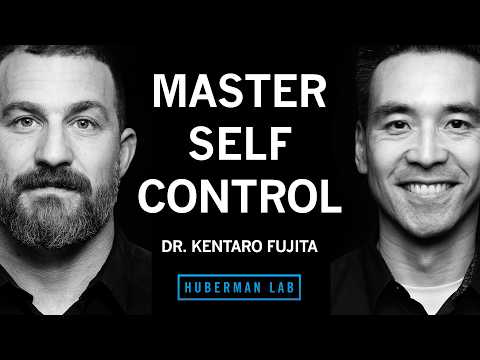
Master Self Control & Overcome Procrastination | Dr. Kentaro Fujita
 Watch on YouTube →
Overview
Dr. Kentaro Fujita and Andrew Huberman explore the science of self-control and motivation, challenging the notion of willpower as an innate trait. They discuss the marshmallow experiment's findings and criticisms, emphasizing that self-control strategies can be learned and taught. The conversation delves into the complexities of intrinsic vs. extrinsic motivation, the role of "whys" in driving behavior, and the concept of a "self-control toolkit" with various strategies applicable to different individuals and situations.
Key takeaways
- Self-control is a learned skill, not an innate trait, with strategies like distraction, reframing, and connecting to 'whys' being more effective than brute willpower.
- Leveraging emotional systems (e.g., disgust, aspiration) and psychological distancing techniques (third-person perspective, emulating admired figures) can enhance self-control.
- The choice between abstinence and moderation in goal pursuit depends on the goal's nature and individual preferences, with potential trade-offs for each.
- Intrinsic motivation, derived from enjoying the process itself, is crucial for sustaining effort in difficult tasks over the long term.
- Externalizing thoughts through self-talk, writing, or social validation can increase their potency, especially when creating a sense of shared reality or purpose.
- Embracing imperfection ('wabi-sabi') and finding meaning in mundane tasks ('ikigai') can foster well-being and sustainable motivation, counteracting the pressure for constant optimization.
Chapters
0:00
The Power of "Whys" in Overcoming Temptation
- Connecting decisions to higher-order purposes (e.g., for family, being a good example) increases the likelihood of resisting temptation.
- Focusing on "whys" provides meaning and motivation, making it easier to hold out for larger, later rewards.
- This contrasts with superficial reasons like "being on a diet," which lack motivational power.
0:50
Introduction to the Huberman Lab Podcast and Guest Dr. Kentaro Fujita
- Andrew Huberman introduces Dr. Kentaro Fujita, a psychology professor at Ohio State University and expert in self-control and motivation.
- The episode aims to provide practical, science-based tools for overcoming procrastination, sticking to goals, and defining life goals.
- Topics include the marshmallow experiment, intrinsic vs. extrinsic motivation, and effective strategies for achieving short and long-term goals.
5:13
The Marshmallow Experiment: Design and Initial Findings
- Walter Mischel's experiments (1960s-80s) involved children choosing between one marshmallow now or two later.
- The core concept is delayed gratification, with waiting time interpreted as a measure of self-control ability.
- Early interpretations linked longer waiting times to better life outcomes like academic success, career achievement, and better health.
10:26
Criticisms and Nuances of the Marshmallow Test
- Waiting times are influenced by trust in the experimenter; children from unstable environments may rationally not wait.
- The original Stanford studies used children from privileged backgrounds, potentially confounding results with socioeconomic status.
- Re-analyses controlling for socioeconomic factors showed mixed results, leading to debate about the test's predictive power.
12:21
Social Modeling and Observational Learning
- Children are highly observant of adult behavior, learning appropriate actions through social modeling.
- The Bobo doll experiment demonstrated that children imitate aggressive or gentle behavior they witness.
- This principle suggests that parental actions significantly influence a child's understanding and practice of behaviors, including self-control.
13:50
Valid Criticisms and Rebuttals of the Marshmallow Experiment
- A major criticism involved a large dataset where controlling for socioeconomic status and other covariates eliminated the predictive power of delay time.
- However, subsequent re-analyses using theory-driven covariates still found predictive links, suggesting the initial statistical adjustments were too broad.
- The setup of the experiment, particularly ensuring trust, is crucial for valid results.
21:51
The True Value: Self-Control is Learned, Not Innate
- The most significant finding from Mischel's work is that self-control strategies can be taught and learned.
- Children who learned strategies like covering their eyes or distracting themselves improved their delay ability.
- This highlights that self-control is a skill that can be cultivated through practice and knowledge, not just an inherent trait.
25:10
Sponsor Break: DAVID Protein Bars
- DAVID offers protein bars with 20g protein, 150 calories, and 0g sugar.
- Flavors include cookie dough, caramel chocolate, double chocolate, and peanut butter chocolate.
- Special offer: Buy four cartons, get the fifth free at davidprotein.com/huberman.
27:07
Sponsor Break: Lingo Continuous Glucose Monitor
- Lingo by Abbott provides minute-by-minute glucose data via a continuous glucose monitor and app.
- Helps users understand how food, exercise, and stress impact glucose levels.
- Offers 10% off a four-week plan for US/UK listeners at hellolingo.com/huberman.
28:55
Children's Self-Control Strategies and Top-Down Inhibition
- Children in marshmallow experiments employ various strategies like looking away or spinning to manage temptation.
- This reflects "top-down inhibition," the suppression of impulses, observed even in animals like puppies.
- These strategies demonstrate an awareness of impulse control and the ability to actively manage it.
31:45
Movement and Motivation: Channeling Energy
- The Latin root of "motivation" is "to move," suggesting a link between action and drive.
- Using physical actions like approaching or avoiding objects with a joystick can help develop self-control evaluations (e.g., cake=bad, broccoli=good).
- Fidgeting and taking notes by hand (vs. computer) may also enhance learning and engagement, illustrating the connection between movement and cognitive processes.
35:43
The Concept of a Self-Control Resource and Depletion
- The idea that doing hard things makes subsequent hard things easier is linked to self-efficacy.
- The controversial "ego depletion" theory suggests self-control acts like a muscle, exhausting after use.
- Multi-lab replication studies have yielded mixed results on ego depletion, with the current consensus leaning towards it not being a robust phenomenon in lab settings.
45:04
Beliefs About Willpower and Depletion
- Research by Veronica Job suggests lay beliefs about willpower significantly influence whether people experience depletion.
- Those who believe willpower is depletable show depletion effects, while those who believe it recharges act as if it recharges.
- This highlights the powerful role of mindset and narrative in shaping our experience of self-control.
48:23
Specificity of Self-Control Strategies and Regulatory Fit
- People can learn to manage internal states (e.g., stress) through techniques like deep breathing.
- The effectiveness of self-control strategies may depend on matching the strategy to the individual and the context.
- Regulatory fit research shows performance is enhanced when motivational orientation (promotion vs. prevention) matches the task.
52:12
Willpower vs. Self-Control: Strategies and Effectiveness
- Willpower is defined as effortful inhibition of impulses, while self-control encompasses broader strategies.
- Training focused solely on willpower (effortful inhibition) has shown limited success.
- Behavioral and psychological strategies (e.g., distraction, reframing) are more teachable and effective for enhancing self-control.
57:08
Neuroscience of Self-Control: Limbic System and Higher Cognition
- Self-control involves a distributed network, including forebrain areas for strategy formation and deeper limbic/hypothalamic circuits for basic drives.
- When facing friction, engaging deeper, more primal emotional responses (fear, disgust) or higher-order motivations (love, aspiration) can be effective.
- This challenges the traditional view of "cooling cognitions" and suggests leveraging emotional systems strategically.
1:02:31
Fighting Fire with Fire: Using Emotion for Self-Control
- Traditional self-control models emphasize "cooling cognitions" (shutting down emotion).
- An alternative is "fighting fire with fire," using strong emotions (like disgust, imagining a cockroach on cake) to counteract temptation.
- Research on "whys" shows connecting to higher-order values (love, family) can powerfully motivate self-control, acting as a positive "fire."
1:05:39
Short-Term Losses vs. Long-Term Gains in Self-Control
- Thinking about short-term losses of indulging (e.g., sugar crash) can be as effective as focusing on long-term gains.
- This "short-term repellent" strategy works by creating immediate aversion to the temptation.
- This challenges the status quo by suggesting the limbic system can be leveraged positively for self-control.
1:08:20
David Goggins and the "Embrace the Suck" Mentality
- David Goggins exemplifies extreme self-discipline, often using negative self-talk and challenging conditions to motivate himself.
- This "fight fire with fire" approach, while potentially extreme, works for him by leveraging intense internal motivation.
- The effectiveness of such strategies highlights the individual variability in self-control approaches.
1:10:42
Abstinence vs. Moderation in Self-Control
- Psychology traditionally emphasizes abstinence (consistency) over moderation (allowing occasional lapses).
- Patterns of behavior (e.g., closing an Apple Watch ring daily) gain motivational strength over sporadic acts.
- However, rigid adherence to abstinence can lead to inflexibility and all-or-nothing thinking when a lapse occurs.
1:20:28
The Role of Consistency and "Chop Wood, Carry Water"
- Consistency in practices, even mundane ones, builds a different kind of self-discipline than peak performance focus.
- The "chop wood, carry water" philosophy emphasizes the value and meaning found in simple, repetitive tasks.
- This contrasts with the modern emphasis on optimization and achieving perfect states before acting.
1:32:32
Task Switching Costs and Disengagement
- Switching between tasks incurs a "switch cost," a delay and decrease in performance due to cognitive inertia.
- Disengagement from goals is less understood than persistence but is crucial for well-being when goals become unattainable.
- Effective disengagement allows for re-engagement in new goals and is linked to better mental health outcomes.
1:39:01
The Value of "Starting from a Place of Suck"
- The "optimization culture" can justify avoiding difficult tasks by waiting for perfect conditions.
- Conversely, embracing challenging or imperfect conditions (like David Goggins) builds mental toughness.
- This involves recalibrating the notion of optimal performance and accepting that "suck" is often the starting line.
1:46:53
Mental Time Travel: Bridging Present and Future Self
- Self-control often fails when temptations are proximal, making it hard to access long-term "whys."
- Effective strategies involve psychological distancing, such as thinking about goals in terms of "why" (abstract, distant) rather than "how" (concrete, proximal).
- States like stress, fatigue, or alcohol consumption impair this ability to think distally.
1:53:38
Psychological Distancing Techniques
- Referring to oneself in the third person (e.g., "What would Ken do?") creates psychological distance.
- Emulating admired figures (e.g., "What would Batman do?") activates different neural circuitry and promotes better self-control.
- These techniques help simulate a more distant perspective, making proximal temptations easier to manage.
1:58:40
Competitiveness and Motivation
- Competitiveness can be a powerful motivator, often stemming from achievement motivation.
- Achievement motivation is likely normally distributed, stronger in some individuals than others.
- Other motivations like belonging, power, and competence also drive behavior, and leveraging the right type for the task is key.
2:04:35
The Self-Control Toolkit and Individualized Strategies
- Different self-control strategies work for different people at different times.
- Understanding personal motivations (e.g., competitiveness, belonging) is crucial for selecting effective tools.
- Exploring one's own motivations through trial and error is essential for building a personalized self-control strategy.
2:08:27
Sponsor Break: Element Electrolytes
- Element provides electrolytes (sodium, magnesium, potassium) without sugar for hydration and performance.
- Essential for nerve cell function and cognitive/physical performance.
- Offers a free sample pack with any purchase at drinkelement.com/huberman.
2:10:28
Consistency, Moderation, and "Ikigai"
- The concept of "Ikigai" involves finding purpose and meaning in mundane tasks.
- Rituals and consistent patterns can provide structure and motivation, but can also lead to rigidity.
- Moderation, involving occasional lapses within a goal-oriented pattern, may be more flexible and sustainable than strict abstinence.
2:24:09
Trade-offs Between Abstinence and Moderation
- Abstinence simplifies choices but can lead to inflexibility and all-or-nothing thinking after a lapse.
- Moderation requires more conscious decision-making but allows for adaptability and prevents goal abandonment after minor setbacks.
- The choice between abstinence and moderation depends on the goal's nature (e.g., fidelity vs. studying) and individual preferences.
21:53
Exploitation of Intrinsic Motivation in the Workplace
- Employers may pay intrinsically motivated individuals less, assuming their passion suffices.
- This creates a potential for exploitation, where passion is leveraged without fair compensation.
- The fairness of paying individuals differently for the same task based on motivation is a complex ethical question.
Summary, takeaways, and chapters were generated by AI from the video's transcript and may contain errors. The video belongs to its creator, Andrew Huberman.