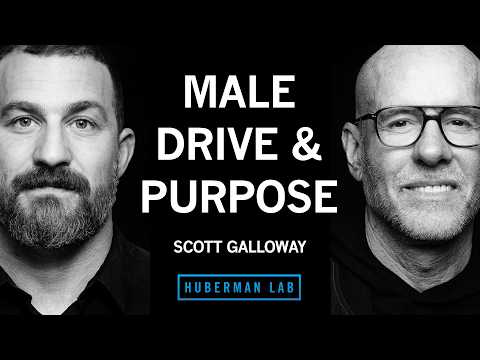
Male Roles, Obligations and Options for Building a Fulfilling Life | Scott Galloway
 Watch on YouTube →
Overview
Scott Galloway and Andrew Huberman discuss the evolving roles and challenges for men in contemporary society, emphasizing the need for a "code" of masculinity centered on being a provider, protector, and procreator. They explore the detrimental impact of big tech and social media on young men's development, advocating for a return to service, personal accountability, and robust male mentorship. The conversation also touches on the complexities of modern relationships, the societal shift in economic expectations, and the critical need for intergenerational wealth transfer and support for young men.
Key takeaways
- Men need a 'code' for a fulfilling life, encompassing being a provider (economic viability), protector (safeguarding others), and procreator (channeling desire constructively).
- Big tech and social media algorithms are designed to monetize user time, fostering addiction, unreasonable expectations, and hindering the development of essential life skills like perseverance.
- A societal shift is needed to support young men, emphasizing male mentorship, service, and providing 'on-ramps' to prosperity, as current systems often disadvantage them.
- Intergenerational wealth transfer policies and educational systems often favor older generations and elite individuals, leaving many young men feeling hopeless and without clear paths to success.
- Authentic masculinity involves balancing strength with kindness, valor with acceptance, and prioritizing service and adding 'surplus value' to society over personal attention.
- The renewal of the alliance between men and women, based on mutual respect and understanding rather than gender-based blame, is crucial for societal progress and individual well-being.
Chapters
- Success is built on a willingness to face and anticipate rejection.
- Every admired individual has experienced numerous 'nos' on their path.
- The goal is not to avoid rejection, but to learn from it and persist.
- Andrew Huberman hosts Scott Galloway, a professor at NYU Stern and expert in intelligent life design.
- Discussion focuses on masculinity, male roles in work, relationships, and health in 2026.
- Content combines data-driven insights with actionable steps for progress.
- Scott Galloway (62) and Andrew Huberman (50) discuss the challenge of relating to younger generations.
- Acknowledging one's own limited understanding of current youth experiences is crucial.
- Data and observation of younger individuals (sons) help bridge this gap.
- Every person needs a 'code' to navigate daily decisions.
- Masculinity can serve as a code for young men, emphasizing positive attributes.
- Three reductive qualities: Provider, Protector, Procreator.
- Every man should plan to be an economic lead or provider.
- Economic viability impacts male self-esteem, sexual currency, and societal esteem.
- A plan, whether through traditional careers or trades, is essential for moving towards something.
- Masculine jobs often involve protecting others (firefighter, police, military).
- Feeling that one's family is protected is a deeply satisfying masculine experience.
- The ultimate goal of earning money is to protect and provide for loved ones.
- Young men's desire for relationships and sex can be a powerful motivator.
- This desire, like fire, can be destructive or constructive if channeled.
- Channeling this desire leads to self-improvement: kindness, excellence, fitness, and perseverance.
- A key metric for masculinity is optimizing for service, not attention.
- Becoming a 'man' involves adding 'surplus value' to society.
- This means creating more than you consume, loving more than you are loved, and investing in others.
- David protein bars offer 20g protein, 150 calories, and zero sugar.
- Flavors include marshmallow base with chocolate coating.
- Available at davidprotein.com/huberman for a special offer.
- Wealthfront offers a cash account with a high APY (currently 3.3%).
- Features include instant, no-fee withdrawals and seamless transfer to investment portfolios.
- Special offer: 75% APY boost for 3 months, up to 4.05% variable APY.
- The goal is to make a higher proportion of good decisions than one's peer group.
- This concept is a powerful motivator for self-improvement at any age.
- The challenge lies in identifying appropriate comparison points and avoiding the 'Jerry Springer' effect.
- Success should not be equated with exploitation; striving for it is healthy.
- Role models should be chosen based on individual needs, such as economic security.
- Authentic masculinity involves resilience and understanding others' perspectives, not aggression.
- Identify and reclaim time spent on social media, porn, and gambling.
- Reallocate this 'human capital' to fitness, earning money, and group service.
- Fitness: Aim for strength, speed, or flexibility; build a 'monster' physique.
- Earn money outside the house, even through entry-level jobs, to learn capitalism.
- Engage in group activities (non-profits, sports, clubs) at least three times a month.
- Practice 'the approach': initiating friendships and romantic interests respectfully.
- The goal of 'the approach' is to receive 'no's, which build resilience.
- Big tech algorithms promote a frictionless life, hindering the development of perseverance.
- Enduring rejection builds skills to persevere and realize one's own okayness.
- Historically, most men were involuntarily celibate; modern agency is higher.
- Reproduction rates show men have historically had less success than women.
- Focusing on fitness, work, and service places young men in the top percentile.
- Big tech's primary goal is to monetize user time through AI-driven engagement.
- This leads to a cohort of asocial, asexual males who lack essential life skills.
- Modulating big tech product use is crucial for developing relationships and life skills.
- Huberman questions Elon Musk's role as a 'protector' due to his online conduct.
- Galloway defends Musk as a net good, citing his contributions to EVs and space exploration.
- The debate centers on whether Musk's aggressive online persona aligns with the 'protector' ideal.
- Musk is an inspiration for his ambition and focus, but not necessarily a role model for protection.
- Punching down online and inciting followers is seen as a failure of protection.
- Accountability for blessings: successful individuals should not punch down.
- Modern society's increased visibility of public figures' lives, both shared and unearthed.
- Contrast between American business culture (family photos facing out) and Argentinian culture (facing in).
- Oversharing online is a modern manifestation of this long-standing theme.
- Elon Musk is seen as a visionary but flawed role model.
- Jocko Willink is presented as a 'true warrior' and a more grounded example for young men.
- Public figures should be viewed as a 'buffet' of traits, not perfect ideals.
- The pressure on leaders to be flawless is unrealistic and damaging.
- The 'manosphere' is criticized for its toxic elements and mishmash of ideas.
- The difficulty for men to navigate dating and social interactions without being labeled 'creepy'.
- Myth 1: Women aim to embarrass men; respectful approaches are generally safe.
- Myth 2: Men are 16x more likely to harm themselves than a date.
- Online platforms amplify inflammatory content, hindering genuine connection and relationships.
- The greatest alliance in history, between men and women, needs renewal.
- Online discourse fuels mistrust and blame between genders.
- Women's ascent has not correlated with men's descent; men need to 'level up'.
- Getting men and women to hate each other is a strategy to destabilize society.
- This disrupts mating dynamics and creates infighting within genders.
- The standard for the opposite sex is being questioned, leading to confusion.
- Men are urged to embrace duties as protectors and providers, and be accountable.
- Avoidance of shame and guilt leads to a lack of empathy and accountability.
- Chivalry is seen as dead in some areas, with men avoiding obligations and 'leveling up'.
- Social media fuels unreasonable expectations for appearance, wealth, and relationships.
- Teen suicide rates are linked to social media use, especially for girls.
- Tech CEOs' focus on shareholder value overrides concern for user well-being.
- Antitrust measures: prevent monopolies like Meta's acquisition of Instagram.
- Remove Section 230 protections for algorithmically elevated content.
- Age-gate platforms like Instagram and YouTube for users under 16.
- Function offers over 160 advanced lab tests for health insights.
- Includes access to advanced MRI and CT scans.
- Use code 'HUBERMAN' for a $50 credit.
- Visit to the Naval Academy highlights discipline, physical activity, and service.
- Midshipmen live communally, prioritize PT, and have strict phone usage policies.
- Focus is on character, competence, and serving something larger than oneself.
- Mandatory national service (military, senior care, volunteering) fosters purpose and unity.
- It acts as a great equalizer, breaking down social and ethnic barriers.
- Countries like Israel and Singapore demonstrate the benefits of national service.
- Alcohol can be a social lubricant, facilitating connection and reducing isolation.
- Demonization of alcohol may lead to increased use of more isolating substances.
- The risks of loneliness may outweigh the risks of moderate alcohol consumption for many.
- Recorded 'stupid' comments due to alcohol can be harmful in the age of phones.
- Cancel culture and fear of public shaming discourage social risks and interactions.
- A shift towards more grace and forgiveness, especially for young people, is needed.
- Scott Galloway uses edibles twice a week for sleep and finds them beneficial.
- THC's impact is highly individual; caution advised for those with predisposition to psychosis.
- Cannabis can be additive for creatives or those managing anxiety, but context matters.
Summary, takeaways, and chapters were generated by AI from the video's transcript and may contain errors. The video belongs to its creator, Andrew Huberman.