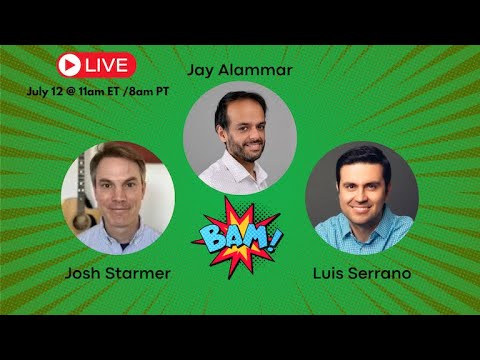
Luis Serrano + Jay Alammar + Josh Starmer Q&A Livestream!!!
 Watch on YouTube →
Overview
Josh Starmer, Luis Serrano, and Jay Alammar discuss their content creation styles, the evolution of AI, and career paths in generative AI. Josh details StatQuest's origin in teaching genetics researchers statistics with relatable examples, while Luis and Jay explain their approaches to making complex AI concepts accessible. The conversation highlights the shift from traditional NLP to Transformer-based models, the importance of representation and understanding in generative AI beyond just text, and practical advice for learning and entering the field, emphasizing hands-on experimentation and learning in public.
Key takeaways
- StatQuest's success stems from Josh Starmer's strategy of explaining complex statistics using relatable analogies for a smart, non-expert audience.
- Jay Alammar's 'Hands-On Large Language Models' book, featuring ~300 original images, aims to demystify Transformers and LLM applications.
- Generative AI's potential extends beyond NLP to image, video, and audio, with diffusion models being a key area.
- Learning Generative AI effectively involves starting with LLMs and prompting, focusing on practical application, and learning in public.
- Retrieval Augmented Generation (RAG) is the preferred method for grounding LLMs with factual or domain-specific data, superior to fine-tuning for this purpose.
- For high-stakes decisions, LLM outputs should inform, not replace, human experts; human oversight remains critical.
Chapters
- Josh Starmer welcomes Luis Serrano and Jay Alammar to a live Q&A stream.
- The stream aims to cover Transformers, career paths, and other AI topics.
- Participants introduce their locations: Josh from Canada, Luis from North Carolina, and Jay from Cohere's HQ in Toronto.
- StatQuest originated to teach statistics to genetics researchers at UNC Chapel Hill.
- Early examples used mouse genetics, later generalized with relatable analogies like M&M's.
- Target audience: smart individuals not necessarily from a math or statistics background.
- Style incorporates running gags (Squatch, Norm) and energetic delivery to make statistics engaging.
- Luis Serrano started making videos at Udacity to teach teammates, later becoming YouTube content.
- Goal: make content accessible to beginners while still offering value to advanced learners.
- Luis's running gag involved naming mountains after concepts (e.g., Mount Errorist, Mount Kagwa).
- Jay Alammar began with highly visual blog posts and transitioned to videos, influenced by Josh and Luis.
- Jay's content emphasizes visuals, initially from blogging and later enhanced by Apple Keynote.
- He learned advanced Keynote techniques from Luis Serrano's videos.
- Explores various platforms like LinkedIn, TikTok, Instagram Reels, and YouTube Shorts for content distribution.
- Views different platforms as ways to repackage core content for broader reach.
- Discussion on using ML for time series textual data.
- Suggestions include XGBoost, Recurrent Neural Networks (RNNs), Convolutional Neural Networks (1D CNNs), and ARA.
- Transformers are effective for time series when predicting multiple series simultaneously.
- State Space Models (SSMs) show promise as a hybrid RNN/Transformer approach.
- Jay's upcoming O'Reilly book, 'Hands-On Large Language Models,' is due in September.
- The book features ~300 original images explaining Transformers, applications, and fine-tuning.
- Chapter 3 revisits 'The Illustrated Transformer' with updates on modern Transformer architectures.
- The book aims to make LLMs accessible with a focus on practical applications.
- Question: Can one excel in Generative AI without starting with NLP?
- Generative AI extends to images, video, and audio generation.
- Understanding representations is as crucial as generation.
- Diffusion models (e.g., Stable Diffusion) are good starting points for non-NLP generative AI.
- Advice: Start with LLMs and prompting (e.g., ChatGPT, Google models), not necessarily historical NLP.
- Focus on what interests you and aligns with your career goals.
- Learn in public: document and share your learning process and projects.
- Experiment with available models, fine-tuning, and prompt chaining.
- GitHub Copilot and similar tools leverage LLMs trained on vast code datasets.
- LLM training involves base training, supervised fine-tuning (SFT), and preference tuning (RLHF).
- SFT is crucial for instruction following and specific use cases like code generation.
- Future opportunities lie in integrating AI natively into workflows and innovating human-computer interaction.
- Buy and read Jay Alammar's book for practical LLM use cases beyond basic generation.
- Focus on skills like configuration for LLMs, which are becoming key job requirements.
- Build a portfolio with well-documented GitHub projects; learn in public.
- Networking and attending events are crucial, as many jobs are filled through referrals.
Summary, takeaways, and chapters were generated by AI from the video's transcript and may contain errors. The video belongs to its creator, StatQuest with Josh Starmer.