Linearization (but mostly more related rates) (Calc 1; Lecture 2-5; Fall 26)
 Watch on YouTube →
Overview
Steve reviews related rates as a three-step method—find a relationship among changing quantities, differentiate with respect to time, then substitute known values—and applies it to trains and two shadow/light setups. He then introduces linearization as the tangent-line approximation, deriving an estimate of √65 from the tangent to √x at x = 64; the aperture example’s stated result of −20π in²/min conflicts with its diagram, which gives a 60-inch light-to-wall distance and a corrected rate of −28.8π in²/min.
Key takeaways
- A related-rates solution begins with an equation among changing quantities—not their rates—and only then differentiates with respect to time.
- In the train example, the Pythagorean relationship and the values 40, 30, and 50 produce a separation speed of 34 mph from the trains’ 20 mph and 30 mph speeds.
- For the rising light, similar triangles yield S = 60/(L − 5), showing that a light rising at 2 ft/min makes the 12-foot shadow shrink at 4.8 ft/min when the light is 10 feet high.
- The aperture diagram places the wall 60 inches from the source, not 50; using that geometry gives an illuminated-disc radius of 12 inches and an area rate of −28.8π in²/min, rather than the lecture’s stated −20π.
- The tangent-line approximation to √x at x = 64 is 8 + (x − 64)/16, giving the estimate √65 ≈ 8.0625.
Chapters
0:00
Quickfire Review: Simplifying Before Calculating
- For 31 × 48 ÷ 6, simplify first by computing 48 ÷ 6 = 8, then calculate 31 × 8 = 248.
- The radical expression √8 − √28 + √50 is simplified by rewriting radicals in terms of √2 and combining like terms.
- For the derivative of ln(1 − cos x), use the chain rule to obtain sin x / (1 − cos x).
2:51
Related Rates: Recognize Multiple Rates and Set Up Three Steps
- Multiple given rates and a requested rate are the key signal for a related-rates problem; wordiness alone is not.
- Use the sequence: find a relationship among the quantities, differentiate with respect to time, and plug in the known values.
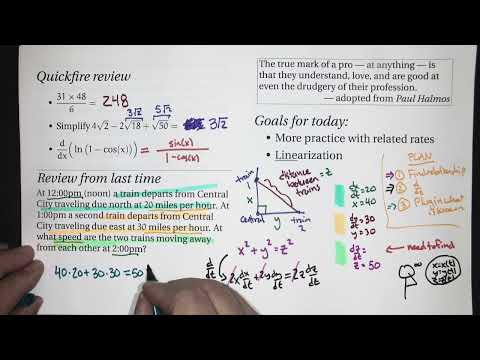
- For the train problem, perpendicular northbound and eastbound paths suggest a right triangle and the Pythagorean theorem.
5:13
Two Trains: Label Distances and Separate Values from Rates
- Let x be the northbound train’s distance, y the eastbound train’s distance, and z the distance between them; then x² + y² = z².
- At 2 p.m., the first train has traveled 40 miles at dx/dt = 20 mph, while the second has traveled 30 miles at dy/dt = 30 mph.
- The current separation is z = √(40² + 30²) = 50 miles; the requested quantity is dz/dt, not z.
11:00
Differentiate the Train Triangle to Find Separation Speed
- Differentiating x² + y² = z² with respect to time gives x(dx/dt) + y(dy/dt) = z(dz/dt) after canceling the common factor of 2.
- Substituting x = 40, y = 30, z = 50, dx/dt = 20, and dy/dt = 30 gives dz/dt = (800 + 900)/50 = 34 mph.
- The result has units of miles per hour because z measures miles and t measures hours.
13:46
Practice, Paul Halmos’s Drudgery Principle, and Linearization Preview
- A Paul Halmos quotation motivates practicing basic skills: professionals build expertise by mastering the repetitive fundamentals.
- Linearization is introduced as another use for tangent lines, connecting the new topic to differentiability and local behavior.
- The lecture emphasizes that related-rates work is concentrated in drawing a useful diagram and establishing the correct relationship.
16:37
Rising Stage Light: Similar Triangles Track a Microphone-Stand Shadow
- A light 10 feet above the ground rises at dL/dt = 2 ft/min; a stationary 5-foot microphone stand casts a currently 12-foot shadow.
- Similar triangles give 5/S = L/(12 + S), so the shadow length satisfies S = 60/(L − 5).
- Differentiating and evaluating at L = 10 gives dS/dt = −60/(10 − 5)² × 2 = −24/5 = −4.8 ft/min.
- The negative rate is physically sensible: raising the light shortens the shadow.
30:30
Circular Aperture: Relate the Hole Radius to the Wall’s Light Disc
- A fixed 2-inch-radius aperture is 10 inches from a light source and 50 inches from the wall; the aperture moves away from the source at 1 in/min.
- The diagram makes the source-to-wall distance 10 + 50 = 60 inches, so similar triangles give 2/x = R/60 and R = 120/x.
- At x = 10, R = 12 inches and dR/dt = −120/x² × dx/dt = −1.2 in/min.
- With A = πR², the diagram-consistent area rate is dA/dt = 2π(12)(−1.2) = −28.8π in²/min; the lecture instead concludes −20π by using R = 100/x, which uses 50 rather than the stated 60-inch total distance.
41:45
Linearization: A Tangent Line Approximates a Function Nearby
- Near a point of tangency, zooming in on a differentiable curve makes it resemble a line, so the tangent line can approximate the function.
- The approximation is most useful near the chosen point and becomes less reliable farther away.
- The tangent-line formula at x = a is L(x) = f(a) + f′(a)(x − a).
43:38
Approximate √65 Using the Tangent Line at x = 64
- For f(x) = √x, f(64) = 8 and f′(x) = 1/(2√x), so f′(64) = 1/16.
- The linearization is L(x) = 8 + (x − 64)/16.
- Since 65 is close to 64, √65 ≈ L(65) = 8 + 1/16 = 8.0625; this is an estimate, not an exact value.
Summary, takeaways, and chapters were generated by AI from the video's transcript and may contain errors. The video belongs to its creator, Beard Meets Calculus.