Linear Algebra - Lecture 7 - Fall, 2026
 Watch on YouTube →
Overview
Nathanson math lectures introduces matrices as rectangular arrays and develops their arithmetic, including coordinate-wise addition, scalar multiplication, transposition, symmetry, and row-by-column multiplication. The lecture connects matrix multiplication to linear systems through Ax=b, explains elementary row operations and augmented matrices, and demonstrates Gaussian elimination on a 2×2 system yielding x=39 and y=-32.
Key takeaways
- Matrix addition and subtraction require identical dimensions, whereas AB is defined when the number of columns in A equals the number of rows in B.
- A matrix product is built entry by entry from row-column dot products; a 2×3 matrix times a 3×2 matrix always produces a 2×2 matrix.
- Matrix multiplication is generally noncommutative: the lecture's matrices produce AB=[[11,−4],[19,2]] but BA=[[7,−28],[2,6]].
- Square matrices support powers and polynomial evaluation through the identity matrix, with p(A)=2A²+3A−7I for p(x)=2x²+3x−7.
- Any system of m linear equations in n unknowns can be written as Ax=b, where A is m×n, x is n×1, and b is m×1.
- Gaussian elimination on the augmented matrix [[9,11,−1],[5,6,3]] uses elementary row operations to solve the system as x=39 and y=−32.
Chapters
0:00
Matrix Dimensions, Entries, and Square Matrices
- An m×n matrix is a rectangular array with m rows and n columns; a 2×3 matrix has 2 rows and 3 columns.
- The entry aᵢⱼ denotes the number in row i and column j, with i ranging from 1 to m and j from 1 to n.
- A matrix is square when its row and column counts match, such as a 2×2 or 3×3 matrix.
5:00
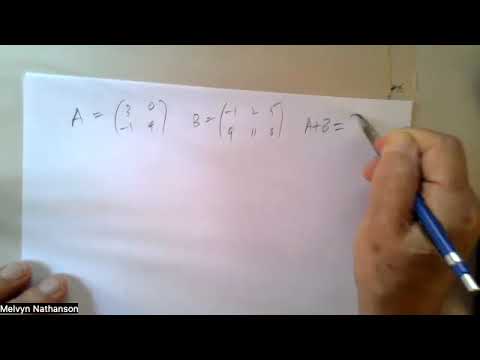
Coordinate-Wise Matrix Addition and Subtraction
- Matrices can be added or subtracted only when they have identical dimensions.
- Operations are performed entry by entry; for example, adding [[1,2],[3,4]] and [[5,6],[7,8]] produces [[6,8],[10,12]].
- For 2×3 matrices, entries such as 7−(−1)=8 and 1−17=−16 illustrate coordinate-wise subtraction.
12:00
Scalar Multiplication and Matrix Vector Spaces
- Scalar multiplication multiplies every matrix entry by the same real number; 7[[3,0],[-1,4]] gives [[21,0],[-7,28]].
- The space Rⁿ can be viewed as the set of n×1 column matrices.
- The set Mₘ,ₙ(R) of all m×n real matrices forms a vector space under matrix addition and scalar multiplication.
17:00
Transpose: Converting Rows into Columns
- The transpose Aᵀ switches rows and columns, so a 2×3 matrix becomes a 3×2 matrix.
- For A=[[1,2,3],[4,5,6]], the transpose is [[1,4],[2,5],[3,6]].
- Applying the transpose twice returns the original matrix: (Aᵀ)ᵀ=A.
22:00
Symmetric Matrices and the Main Diagonal
- A square matrix is symmetric when A=Aᵀ, meaning aᵢⱼ=aⱼᵢ for every pair of indices.
- The main diagonal consists of entries a₁₁, a₂₂, …, aₙₙ.
- Symmetry can be visualized as reflection across the main diagonal; entries such as a₁₂ and a₂₁ must match.
25:00
Matrix Multiplication: Compatibility by Dimensions
- For A of size m×n and B of size p×q, the product AB exists exactly when n=p.
- When multiplication is defined, AB has size m×q; the inner dimensions cancel in the dimension check.
- Unlike addition, matrix multiplication does not require A and B to have the same shape.
29:00
Dot Products and the Row-by-Column Rule
- A row times a column is computed by multiplying corresponding entries and adding the products.
- The row [1,2,3,4] times the column [5,6,7,8] gives 5+12+21+32=70.
- Every entry of a matrix product is formed by applying this dot-product rule to one row of the first matrix and one column of the second.
33:00
A 2×3 Times 3×2 Matrix Product
- A 2×3 matrix multiplied by a 3×2 matrix produces a 2×2 matrix.
- For A=[[1,0,-2],[4,1,1]] and B=[[2,4],[0,5],[-2,-3]], the product is [[6,10],[6,18]].
- The first product entry uses the first row of A and first column of B: 1·2+0·0+(−2)(−2)=6.
38:00
Noncommutativity: Why AB Usually Differs from BA
- For A=[[1,−4],[3,2]] and B=[[7,0],[−1,1]], AB=[[11,−4],[19,2]].
- Reversing the order gives BA=[[7,−28],[2,6]], which is different from AB.
- Matrix multiplication is therefore not commutative, unlike ordinary scalar multiplication.
43:00
Matrix Powers and the Identity Matrix
- Powers such as A² and A³ are defined only for square matrices, using repeated matrix multiplication.
- The n×n identity matrix Iₙ has ones on the main diagonal and zeros elsewhere; I₂=[[1,0],[0,1]].
- The identity behaves like the scalar 1: AIₙ=A and IₘA=A whenever the dimensions are compatible.
48:00
Kronecker Delta and Polynomials in a Matrix
- The identity entry can be written with the Kronecker delta δᵢⱼ, which equals 1 when i=j and 0 otherwise.
- For a square matrix A, a polynomial such as p(x)=2x²+3x−7 becomes p(A)=2A²+3A−7I.
- Scalar coefficients multiply matrices entrywise, while the constant term uses the identity matrix rather than a scalar by itself.
52:00
Encoding Linear Systems as Ax=b
- The system x+2y=5 and 3x+4y=6 has coefficient matrix A=[[1,2],[3,4]], variable vector [x,y]ᵀ, and right-hand side b=[5,6]ᵀ.
- Matrix multiplication produces A[x,y]ᵀ=[x+2y,3x+4y]ᵀ, so the system is equivalent to Ax=b.
- For m equations in n unknowns, A is m×n, x is n×1, and b is m×1.
57:00
General Coefficient Matrices for m Equations and n Unknowns
- A general system uses coefficients aᵢⱼ and variables xⱼ, with the i-th equation represented by the i-th row of A.
- The matrix product has entries (Ax)ᵢ=Σⱼ aᵢⱼxⱼ, reproducing each linear equation.
- Writing systems as Ax=b prepares the problem for matrix-based Gaussian elimination.
1:01:00
Elementary Row Operations and Augmented Matrices
- The three elementary row operations are swapping two rows, multiplying a row by a nonzero scalar, and adding a multiple of one row to another.
- These operations preserve the solution set of a linear system when applied consistently to the augmented matrix.
- For 9x+11y=−1 and 5x+6y=3, the augmented matrix is [[9,11,−1],[5,6,3]].
1:07:00
Gaussian Elimination Solves a 2×2 System
- Dividing the first row of [[9,11,−1],[5,6,3]] by 9 creates a leading 1.
- Subtracting 5 times the first row from the second and scaling produces a second pivot, reducing the matrix toward the identity form.
- Back substitution is unnecessary after full reduction: the final equations are x=39 and y=−32.
1:12:00
Linear Combinations of Matrices
- For A=[[1,2,3],[4,5,6]] and B=[[6,5,4],[3,2,1]], A+B is the 2×3 matrix whose six entries are all 7.
- The difference A−B is computed entrywise, producing entries −5, −3, −1, 1, 3, and 5.
- Expressions such as 7A+4B and 5A−3B are matrix linear combinations using scalar multiplication followed by addition or subtraction.
1:17:00
Index Formula for Matrix Products and a 3×3 Example
- If A is m×n and B is n×p, then C=AB is m×p with cᵢⱼ=Σₖ₌₁ⁿ aᵢₖbₖⱼ.
- The formula explicitly pairs the i-th row of A with the j-th column of B.
- Nathanson math lectures closes with a 3×3 multiplication exercise, emphasizing that nine row-by-column computations are required.
Summary, takeaways, and chapters were generated by AI from the video's transcript and may contain errors. The video belongs to its creator, Nathanson math lectures.