Linear Algebra - Lecture 6 - Fall, 2026
 Watch on YouTube →
Overview
Nathanson math lectures develops linear independence, spanning sets, bases, and dimension from Gaussian elimination and the theorem that a homogeneous system with more variables than equations has a nonzero solution. The lecture proves that any n+1 vectors in Rⁿ are dependent, that a finite spanning set contains an independent spanning subset, and that every finitely generated subspace has a basis; it also introduces the theorem that more than k vectors in a space spanned by k vectors must be dependent.
Key takeaways
- A homogeneous system with more variables than equations has a nonzero solution; this result underpins the lecture’s proofs about dependence and spanning.
- Three vectors in R² must be dependent; specifically, (1, 2) − 2(3, 4) + (5, 6) = (0, 0).
- Any set containing the zero vector is dependent because assigning coefficient 1 to that vector and 0 to all others gives a nontrivial zero combination.
- Every finite spanning set for a subspace contains an independent subset that still spans it: a smallest spanning subset cannot be dependent, since one vector could then be removed.
- If a subspace is spanned by k vectors, any collection of more than k vectors in that subspace is dependent.
- A basis combines two properties—linear independence and spanning—and the standard coordinate basis shows that Rⁿ has dimension n.
Chapters
0:00
Lecture Roadmap: From Linear Equations to Bases
- The lecture moves from solving linear equations toward linear independence, dependence, bases, and dimension.
- Nathanson math lectures begins by reviewing homework from sections 5 and 6.
0:46
Section 5: Gaussian Elimination on a Three-Equation System
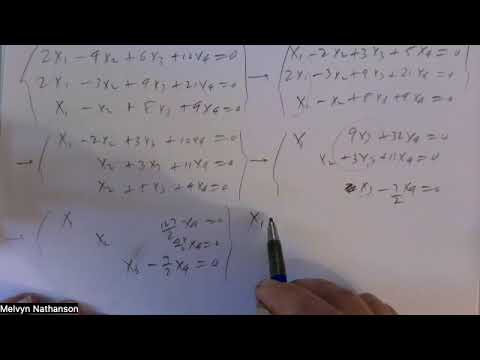
- The example has three homogeneous equations in four unknowns, x₁ through x₄.
- Gaussian elimination reduces the system by scaling the first equation and eliminating x₁ and x₂ from later rows.
- The calculation aims to express the solution set as a scalar multiple of one vector in R⁴.
8:50
Auditing the Elimination Arithmetic
- The reduction produces coefficients including 127/2 and 43/2, but substitution into the original equations does not verify the proposed solution.
- Nathanson checks earlier row operations but does not resolve the discrepancy, so the example ends without a reliable final solution.
- The takeaway is to verify a Gaussian-elimination result by substituting it into the original system.
12:58
Two Equations in Three Unknowns Have a Nonzero Solution
- For a homogeneous system of two equations in x, y, and z, if both z-coefficients vanish, (0, 0, 1) is a nonzero solution.
- If a z-coefficient is nonzero, solve one equation for z and substitute into the other, leaving one equation in x and y.
- A homogeneous equation in two unknowns has a nonzero solution, yielding a nonzero solution to the original system.
17:55
Homogeneous Solutions and Inhomogeneous Solution Families
- Multiplying a solution of a homogeneous system by any scalar t gives another solution because each equation still equals zero.
- When n > m, a homogeneous system of m equations in n variables has a nonzero solution and therefore infinitely many scalar multiples.
- If x solves an inhomogeneous system and z solves its corresponding homogeneous system, then x + tz also solves the inhomogeneous system for every scalar t.
25:31
Section 6: Defining Linear Dependence and Independence
- A set of vectors is dependent when some linear combination equals the zero vector with coefficients not all zero.
- A set is independent when the only linear combination equal to zero has every coefficient equal to zero.
- The definitions turn the question of dependence into finding solutions of a homogeneous linear system.
28:23
Dependence Example: Three Vectors in R²
- The vectors (1, 2), (3, 4), and (5, 6) produce two homogeneous equations in three coefficients.
- Elimination gives x₁ = x₃ and x₂ = −2x₃, so choosing x₃ = 1 yields coefficients (1, −2, 1).
- The combination (1, 2) − 2(3, 4) + (5, 6) equals (0, 0), proving the vectors are dependent.
34:29
Testing Three Vectors in R³ for Independence
- For vectors (1, 2, 3), (3, 4, 5), and (5, 6, 7), set up a vector equation with coefficients x, y, and z.
- Equating coordinates gives three homogeneous equations in three unknowns.
- The vectors are independent exactly when the system has only the zero solution; a nonzero solution proves dependence.
38:03
Why Any Set Containing the Zero Vector Is Dependent
- Assign coefficient 1 to the zero vector and coefficient 0 to every other vector in the set.
- This nontrivial linear combination equals the zero vector, which directly proves dependence.
- Nathanson emphasizes memorizing the formal definitions of dependence and independence for the midterm.
42:45
Theorem: Any n+1 Vectors in Rⁿ Are Dependent
- Write n+1 vectors in Rⁿ as columns with n coordinates each, then equate their linear combination to zero.
- Coordinate-by-coordinate, the vector equation becomes a homogeneous system of n equations in n+1 coefficient variables.
- The more-variables-than-equations theorem guarantees a nonzero coefficient solution, so the n+1 vectors are linearly dependent.
51:00
Subspaces, Linear Combinations, and Span
- A subspace is a subset closed under vector addition and scalar multiplication.
- In R², the x-axis and the line y = x/2 are examples of subspaces because sums and scalar multiples remain on each line.
- The span of a set S is the set of all linear combinations of vectors in S, and is itself a subspace.
54:21
Finite Generation and the Size of a Set
- A subspace is finitely generated if some finite set of vectors spans it.
- The x-axis in R² is spanned by the single vector (1, 0), since every point (x, 0) equals x(1, 0).
- The cardinality or size of a finite set S, written |S|, is its number of elements.
57:59
Reducing a Finite Spanning Set to an Independent One
- Choose a smallest subset S′ of a finite spanning set S that still spans the subspace W.
- Assume S′ is dependent; a nontrivial relation lets one vector be written as a linear combination of the others.
- Removing that vector still leaves a set spanning W, contradicting the minimality of S′; therefore S′ is independent.
1:07:49
Basis Examples and the Existence of Bases
- A basis is a linearly independent set that spans the vector space or subspace.
- The standard basis of R² is {(1, 0), (0, 1)}; each (x, y) equals x(1, 0) + y(0, 1).
- The standard coordinate vectors give bases for R³ and R⁴, and the finite-spanning-set result proves every finitely generated subspace has a basis.
1:10:42
Dimension Preview: Counting Basis Vectors
- The standard basis of Rⁿ contains n coordinate vectors, so dim(Rⁿ) = n.
- A subspace may have many different bases, but the lecture previews that all its bases have the same number of vectors.
- That shared number of basis vectors is the dimension of the space.
1:14:42
More Vectors Than a Spanning Set Must Be Dependent
- Suppose W is spanned by k vectors and contains a proposed set of l vectors, with k < l.
- Express each of the l vectors as a linear combination of the k spanning vectors; a dependence relation then becomes k homogeneous equations in l unknown coefficients.
- Because l > k, a nonzero solution exists, proving every set of l vectors in W is dependent.
- The lecture closes by stressing that proofs, definitions, and numerical exercises all require sustained study.
Summary, takeaways, and chapters were generated by AI from the video's transcript and may contain errors. The video belongs to its creator, Nathanson math lectures.