Linear Algebra - Lecture 5 - Fall 2026
 Watch on YouTube →
Overview
Nathanson math lectures develops linear independence, spanning sets, bases, and dimension as foundational tools in linear algebra. The lecture proves that any n+1 vectors in R^n are dependent, that a subspace spanned by K vectors cannot contain more than K independent vectors, and that all bases of the same subspace have equal size—making dimension well-defined.
Key takeaways
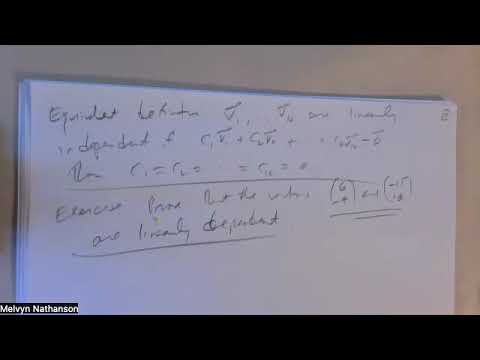
- A set of vectors is dependent exactly when a nonzero coefficient choice makes their linear combination equal the zero vector; for example, 5(6,-4) + 2(-15,10) = (0,0).
- Any n+1 vectors in R^n are dependent because their zero-combination equations form a homogeneous system of n equations in n+1 unknown coefficients.
- If a subspace is spanned by K vectors, every set of more than K vectors in that subspace is dependent, as its dependence equations have more unknowns than equations.
- A finite spanning set can be reduced to a basis: choose a smallest spanning subset, then dependence would let one vector be removed without losing the span.
- Any two finite bases of the same subspace have equal size, so dimension—the number of vectors in a basis—is well-defined.
- The standard coordinate vectors form a basis of R^n, establishing dim(R^n) = n; consequently, any n independent vectors in an n-dimensional space form a basis.
Chapters
0:00
Linear Combinations in R^n Set Up the Lecture
- A vector in R^n is an n-coordinate column vector with real-number entries.
- A linear combination of vectors v_1 through v_k has the form c_1v_1 + … + c_kv_k, with scalar coefficients.
- The lecture introduces linear independence, bases, and dimension as central concepts.
5:00
Linear Dependence Means a Nontrivial Combination Equals Zero
- Vectors v_1 through v_k are linearly dependent if some coefficients, not all zero, satisfy c_1v_1 + … + c_kv_k = 0.
- The zero vector can therefore be produced by a meaningful combination of dependent vectors, not only by setting every coefficient to zero.
- Linear independence is the opposite condition: the zero vector has only the all-zero coefficient solution.
9:00
The Standard Basis Vectors in R² Are Independent
- For e_1 = (1,0) and e_2 = (0,1), a combination c_1e_1 + c_2e_2 equals (c_1,c_2).
- That combination is (0,0) only when c_1 = c_2 = 0, proving the two vectors are linearly independent.
- The coordinate argument works because vector equality requires every corresponding coordinate to match.
10:00
A Dependence Exercise Uses Two Proportional Vectors
- The exercise asks whether (6,-4) and (-15,10) are linearly dependent.
- Setting 5(6,-4) + 2(-15,10) gives (30,-20) + (-30,20) = (0,0).
- Because the coefficients 5 and 2 are not both zero, this explicitly proves dependence.
18:00
Coordinate Equations Verify Independence in R²
- The standard vectors e_1 = (1,0) and e_2 = (0,1) are tested by expanding an arbitrary linear combination coordinate by coordinate.
- The resulting vector (c_1,c_2) can equal zero only if both coefficients vanish.
- Nathanson emphasizes that understanding these definitions requires working through the coefficient equations rather than memorizing labels.
22:00
Any n+1 Vectors in R^n Must Be Dependent
- Write n+1 vectors in R^n by listing their n coordinates, then seek coefficients x_1 through x_(n+1) whose combination is zero.
- Equating coordinates to zero produces n homogeneous linear equations in n+1 unknowns.
- The earlier theorem that a homogeneous system with more variables than equations has a nonzero solution supplies a nontrivial dependence relation.
29:00
Subspaces Are Closed Under Linear Combinations
- A subspace W contains the zero vector and is closed under vector addition and scalar multiplication.
- Those closure conditions imply that every finite linear combination of vectors in W remains in W.
- The span of a nonempty set S is the set of all linear combinations of vectors in S; it is a subspace generated by S.
35:00
A Minimal Spanning Set Must Be Linearly Independent
- For a nonzero subspace W spanned by a finite set S, choose a smallest subset S′ that still spans W.
- Assume S′ has k vectors and is dependent; a nontrivial relation lets one vector be written as a combination of the other k−1.
- Substituting that expression into representations of vectors in W shows the remaining k−1 vectors still span W, contradicting minimality.
48:00
A Basis Combines Independence and Spanning
- A basis of W is a linearly independent set of vectors that spans W.
- The minimal-spanning-set result guarantees that every nonzero subspace spanned by finitely many vectors has a basis.
- A basis removes redundant spanning vectors while retaining the ability to represent every vector in the subspace.
51:00
More Vectors Than a Spanning Set Forces Dependence
- Suppose W is spanned by K vectors and contains L chosen vectors, where L > K.
- Express each chosen vector as a combination of the K spanning vectors; a proposed dependence among the L vectors becomes K homogeneous equations in L coefficients.
- Since L exceeds K, a nonzero solution exists, proving that every such set of L vectors in W is dependent.
1:00:00
All Bases of the Same Subspace Have Equal Size
- Let S and T be finite bases for the same subspace, with K and L vectors respectively.
- If L > K, the spanning-set bound makes T dependent, contradicting that T is a basis; therefore L ≤ K.
- Reversing the roles gives K ≤ L, so K = L and every basis of W has the same number of vectors.
1:06:00
Dimension Is the Number of Vectors in a Basis
- The dimension dim(W) is defined as the number of vectors in a basis for W.
- Equal basis sizes make this definition independent of which basis is chosen.
- The zero subspace is separately noted as a subspace; the lecture’s minimal-subset argument is stated for nonzero W.
1:09:00
Standard Basis Vectors Establish dim(R^n) = n
- In R², e_1 = (1,0) and e_2 = (0,1) form a basis, so dim(R²) = 2.
- In R^n, e_j has a 1 in coordinate j and zeros elsewhere; the n standard vectors form a basis.
- Thus dim(R^n) = n, giving the phrase “n-dimensional” a precise basis-count meaning.
1:10:00
Two Independent Vectors Form a Basis for R²
- The vectors (3,7) and (-2,-1) are tested using x(3,7) + y(-2,-1) = (0,0).
- The coordinate equations are 3x − 2y = 0 and 7x − y = 0; substitution gives −11x = 0, hence x = y = 0.
- They are independent, and in a two-dimensional space two independent vectors form a basis.
1:12:00
n Independent Vectors in an n-Dimensional Space Form a Basis
- Take n linearly independent vectors in a vector space V of dimension n, and let W be their span.
- If W were proper, a vector v* outside W could be added; the resulting n+1 vectors would remain independent.
- That contradicts the dimension bound that more than n vectors in an n-dimensional space are dependent, so the original n vectors span V and form a basis.
1:18:00
Lecture Recap: Span, Basis, Independence, and Dimension
- The closing review lists linear dependence and independence, cardinality, span, basis, and dimension as the lecture’s core concepts.
- The key structural result is that basis size is fixed for a subspace; for R^n, that size is n.
- Nathanson recommends studying the notes, working through examples, and solving problems; the next class is announced for Wednesday, September 23.
Summary, takeaways, and chapters were generated by AI from the video's transcript and may contain errors. The video belongs to its creator, Nathanson math lectures.