Limits (Calc 1; Lecture 1-2; Fall 26)
 Watch on YouTube →
Overview
Beard Meets Calculus introduces limits as a way to determine what a function approaches nearby, then connects that idea to instantaneous rate of change through secant lines approximating a tangent line. Examples include solving an average-rate-of-change system, resolving a 0/0 expression by factoring, identifying the failure of the limit of sin(1/x), and applying limit laws to polynomials.
Key takeaways
- Instantaneous rate of change is obtained by letting a secant slope, (f(b) - f(a))/(b - a), approach the tangent slope as b approaches a.
- A 0/0 result is an indeterminate form, not a value: factoring or another algebraic transformation may reveal the nearby behavior while leaving the function's value at the point unchanged.
- For the piecewise function (x² + 3x - 10)/(x - 2) away from 2 and f(2) = 1, the function value is 1 but the limit is 7, demonstrating that a limit need not equal the function's value.
- The limit of sin(1/x) as x approaches 0 does not exist because the function oscillates through values from -1 to 1 without settling near a single number.
- Limit information is local: knowing h approaches 4 near 0 and 0 near 2 does not determine its behavior near 1.
- Polynomials allow direct substitution for limits, while quotient limit laws require the denominator's limiting value to be nonzero.
Chapters
0:00
Quick Algebra Review and the Average-Rate Problem
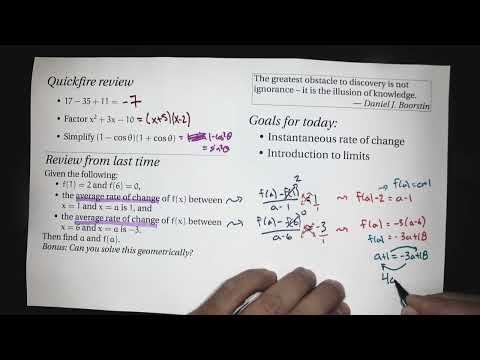
- Warm-up calculations review integer arithmetic with 17 - 35 + 11 = -7 and factoring x² + 3x - 10 as (x + 5)(x - 2).
- The identity (1 - cos θ)(1 + cos θ) simplifies to 1 - cos² θ, or sin² θ using sin² θ + cos² θ = 1.
- The review problem gives f(1) = 2, f(6) = 0, and average rates of change 1 from x = 1 to x = a and -3 from x = 6 to x = a.
3:00
Solve the Average-Rate System and Interpret It Geometrically
- Substituting the known function values gives (f(a) - 2)/(a - 1) = 1 and f(a)/(a - 6) = -3.
- Cross-multiplication yields f(a) = a + 1 and f(a) = -3a + 18; equating them gives a = 17/4 and f(a) = 21/4.
- Geometrically, (1, 2) and (6, 0) are known points, while the unknown point (a, f(a)) lies on a slope-1 line through the first and a slope--3 line through the second.
- The algebraic solution is the intersection of those two lines, linking average rate of change to slope.
12:03
From Average Change to Instantaneous Rate of Change
- Average rate of change describes a function over an interval; instantaneous rate asks how it changes at one moment.
- Zooming in on a curve makes it look increasingly flat and locally line-like, motivating the tangent-line model.
- The tangent line's slope represents the function's instantaneous rate of change at the point.
17:34
Secant Slopes Approach the Tangent Slope—and Reveal 0/0
- For a point A and a nearby point B, the secant slope is (f(b) - f(a))/(b - a), the average rate of change between them.
- As B moves toward A, the secant line and its slope approach the tangent line and its slope.
- Setting b = a directly produces 0/0, so substitution cannot determine the instantaneous rate.
- Division by zero is impossible for a nonzero numerator, while 0/0 is ambiguous because the equation 0 = 0 · c holds for every c.
22:43
Limit Notation, Nearby Behavior, and Epsilon-Delta Intuition
- The limit notation lim x→a f(x) = L expresses the intuition that f(x) gets close to L as x gets close to a.
- Limits ask what should happen based on nearby values, not what the function actually equals at x = a.
- In the informal epsilon-delta description, δ measures how close x is to a, while ε measures how close f(x) is to L.
- Absolute value in |x - a| represents distance, and the condition excludes x = a itself.
26:46
Factor a 0/0 Limit Without Changing the Domain
- For f(x) = (x² + 3x - 10)/(x - 2) when x ≠ 2 and f(2) = 1, direct evaluation gives f(2) = 1.
- The limit uses the x ≠ 2 rule; substituting 2 into its fraction gives 0/0, signaling that more work is needed.
- Factoring the numerator as (x + 5)(x - 2) allows cancellation because values near 2, but not equal to 2, are being considered.
- The resulting nearby expression x + 5 approaches 7, even though the original function's value at 2 is 1 and its graph has a hole in the fraction's simplified form.
34:07
When Limits Fail: Oscillation and Missing Local Information
- For g(x) = sin(1/x) when x ≠ 0 and g(0) = 0, the function value is 0, but its nearby behavior oscillates increasingly rapidly.
- As x approaches 0, sin(1/x) does not settle near one value; it continues to range between -1 and 1, so the limit does not exist.
- Knowing lim x→0 h(x) = 4 and lim x→2 h(x) = 0 gives no conclusion about lim x→1 h(x).
- Limits provide local information: behavior near 0 and 2 cannot determine behavior at the gap between them.
40:52
Basic Limit Laws and Direct Substitution for Polynomials
- A constant C has limit C, and lim x→a x = a.
- When the component limits exist, limits preserve linear combinations: if f(x)→L and g(x)→M, then c f(x) + d g(x)→cL + dM.
- Products approach LM, and quotients approach L/M when M ≠ 0; the component limits must satisfy the required conditions.
- Polynomials can be evaluated by direct substitution because they are built from constants and x using addition and multiplication; for example, lim y→2 (y³ - 6y + 7) = 3.
45:41
Strategies for Resolving Indeterminate 0/0 Forms
- When substitution produces 0/0, the goal is to rewrite the expression so shared zero-producing factors can be canceled.
- For rational functions, expand or factor polynomial numerators and denominators to expose cancellable factors.
- For expressions involving square roots, multiplying by the conjugate can remove the radical and reveal simplification.
- For trigonometric expressions, look for identities such as sin² θ + cos² θ = 1; a worked conjugate example is deferred to the next lecture.
Summary, takeaways, and chapters were generated by AI from the video's transcript and may contain errors. The video belongs to its creator, Beard Meets Calculus.