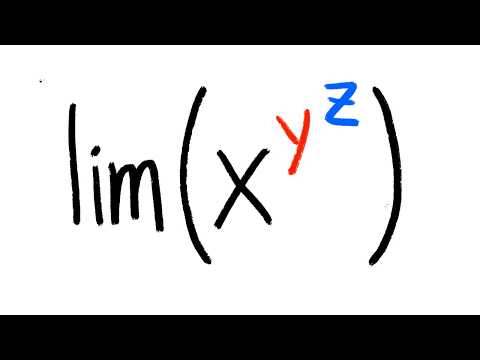
Limit of x^(y^z) as (x, y, z) goes to (0, 0, 0)
 Watch on YouTube →
Overview
blackpenredpen shows that the positive-domain limit of x^(y^z) as (x, y, z) approaches (0, 0, 0) does not exist by constructing two paths with different outcomes. Along x = y = z = t, the expression tends to 0; a carefully chosen logarithmic path makes y^z tend to 0 while x^(y^z) tends to 1/e.
Key takeaways
- For x^(y^z), the exponent is evaluated right-associatively: the inner quantity y^z determines how the outer power behaves.
- The diagonal path x = y = z = t gives t^(t^t) → 0 because t^t → 1 as t → 0+.
- With z = 1/ln(-ln y), y^z = exp(ln y / ln(-ln y)) tends to 0 as y → 0+.
- Defining x = exp(-1/(y^z)) makes x approach 0 while forcing x^(y^z) to equal 1/e along that path.
- Different path limits, 0 and 1/e, are sufficient to prove that the limit at the origin does not exist.
Chapters
0:00
Diagonal Path x = y = z = t Gives a Limit of 0
- blackpenredpen interprets the power tower right-associatively: x^(y^z), with y^z evaluated first.
- On the positive diagonal x = y = z = t, t^t tends to 1 as t approaches 0 from above.
- Therefore t^(t^t) tends to 0, providing the first path-dependent value.
4:20
Why a Second Path Must Control the Inner Exponent
- A path where y^z approaches a nonzero value would still make x^(y^z) tend to 0 when x approaches 0.
- To obtain a different outcome, blackpenredpen seeks a path where y^z also approaches 0.
- The construction restricts x, y, and z to positive values so the real-valued powers remain defined.
5:20
Logarithmic Path Produces the Distinct Limit 1/e
- Set z = 1/ln(-ln y) for sufficiently small positive y; then z approaches 0 from above.
- Since y^z = exp(ln y / ln(-ln y)) and the exponent tends to negative infinity, y^z approaches 0.
- Choose x = exp(-1/(y^z)); this also approaches 0, while (x)^(y^z) simplifies exactly to e^-1.
- The path limits 0 and 1/e differ, so the multivariable limit does not exist.
Summary, takeaways, and chapters were generated by AI from the video's transcript and may contain errors. The video belongs to its creator, blackpenredpen.