Light Reactions, BIO105 Introductory Biology, David Champlin, USM
 Watch on YouTube →
Overview
David Champlin explains how light reactions in the thylakoid membrane convert light energy into ATP and NADPH while releasing oxygen. He traces electron movement through Photosystems II and I, shows how electron transport builds a proton gradient and powers ATP production, and describes cyclic photophosphorylation as a route for making extra ATP without NADPH.
Key takeaways
- Reaction-center chlorophyll can transfer a light-excited electron to a nearby primary electron acceptor, preventing the energy from being lost as fluorescence.
- Photosystem II electron transport builds the proton gradient used for ATP synthesis, while Photosystem I supplies electrons for reducing NADP+ to NADPH.
- Water splitting replenishes Photosystem II electrons and releases protons and oxygen during the light reactions.
- The Z scheme represents electrons receiving energy at both Photosystem II and Photosystem I before helping produce ATP and NADPH.
- Cyclic photophosphorylation reroutes Photosystem I electrons through the ATP-producing chain, allowing ATP generation without corresponding NADPH production.
Chapters
0:00
Chlorophyll Captures Light and Transfers Excited Electrons
- Photosystems I and II are pigment-protein complexes in the thylakoid membrane; their names reflect discovery order.
- Accessory pigments can absorb light and transfer energy to reaction-center chlorophyll, while other pigments screen leaves from excessive sunlight.
- Light raises a chlorophyll valence electron to a higher energy state; without an electron acceptor nearby, chlorophyll can release the energy as fluorescence.
- A primary electron acceptor takes the excited electron, oxidizing chlorophyll and reducing the acceptor.
6:00
Photosystems II and I Drive ATP and NADPH Production
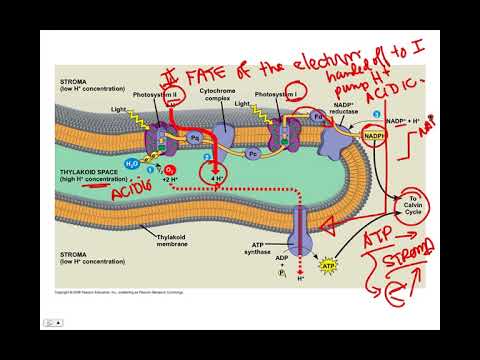
- Electrons from Photosystem II pass through a thylakoid electron transport chain toward Photosystem I, powering proton movement into the thylakoid space.
- The resulting proton gradient drives ATP synthesis; Photosystem I electrons instead reduce NADP+ to NADPH for the Calvin cycle.
- Photosystem I replaces its lost electrons with electrons from Photosystem II; Photosystem II replaces its electrons by splitting water.
- Water splitting supplies electrons and protons and releases oxygen, a byproduct of the light reactions.
12:00
The Z Scheme, Proton Gradients, and Cyclic Photophosphorylation
- The Z scheme charts two light-driven boosts in electron energy: Photosystem II electron transport supports ATP production, and Photosystem I supports NADPH production.
- Like mitochondrial respiration, light reactions use an electron transport chain to build a proton gradient that ATP synthase converts into ATP.
- When a plant needs ATP without as much NADPH, cyclic photophosphorylation routes Photosystem I electrons back into the ATP-producing transport chain.
- Champlin gives early leaf growth as an example of a situation when a plant may favor ATP for processes such as protein or DNA synthesis.
Summary, takeaways, and chapters were generated by AI from the video's transcript and may contain errors. The video belongs to its creator, The New Evolution for Everyone.