Lecture 9: Excitations of the Z2 spin liquid
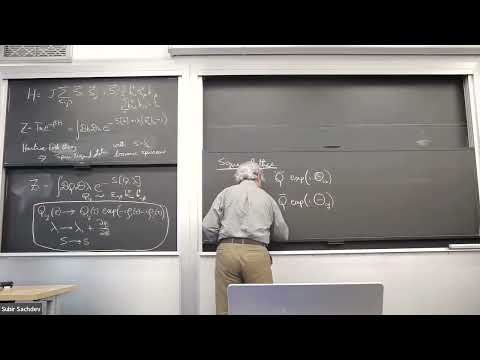 Watch on YouTube →
Overview
Subir Sachdev develops the excitations of a Z2 spin liquid from bosonic partons, showing how gauge fluctuations distinguish square- and triangular-lattice saddle points. The square-lattice theory can produce an emergent U(1) photon but is generally destabilized by monopoles, while the triangular-lattice theory has Z2 topological excitations: a spin-1/2 spinon, a spinless vison, and their fermionic bound state, with mutual semionic statistics.
Key takeaways
- On the square lattice, staggered gauge charges let the bond-phase fluctuations form a 2+1-dimensional Maxwell field with an emergent photon, but compact-gauge monopoles generally drive the system toward valence-bond solid order.
- On the triangular lattice, no two-sublattice charge assignment makes every bond yield a smooth gauge gradient; the fluctuation spectrum therefore lacks a photon and retains a Z2 gauge structure.
- A vison is a finite-energy, spinless Z2-flux excitation: its branch cut is invisible to local gauge-invariant operators except near its endpoint, and visons must be created in pairs.
- The basic Z2 topological order contains a spin-1/2 spinon, a spinless vison, and their bound state; the first two are bosons in the bosonic-parton description, while the bound state is a fermion.
- Taking a spinon around a vison yields a -1 Berry phase, establishing mutual semionic statistics; neutron-scattering continua can provide evidence for spinon pairs, unlike the sharp magnon lines of conventional magnets.
- A locally stable mean-field saddle does not establish a stable spin liquid: the many possible vison configurations and their finite-density dynamics must also be accounted for.
Chapters
0:00
Bosonic Partons and the Gauge Redundancy of Spin-1/2
- Sachdev represents each spin-1/2 using bosonic partons with a constraint of exactly one boson per site.
- The spin operators are gauge-invariant, although the parton fields can undergo local phase rotations.
- The gauge structure allows fractionalized excitations that cannot be created individually by local physical operators.
5:00
Why Mean-Field Spinons Are Not the Whole Story
- The parton mean-field saddle points preserve symmetries on square and triangular lattices and contain bosonic spinons.
- Physical spin operators create spinons in pairs, potentially producing continua in probes such as neutron scattering.
- A spin-1/2 bosonic excitation alone does not provide a complete, consistent account of the spin-liquid phase; additional anyons must be considered.
10:00
Gauge-Invariant Fluctuations of the Bond Field
- Sachdev introduces a path-integral description of the bond field Q and constraint-enforcing Lagrange multiplier.
- The mean-field treatment relaxes the dimer constraint, so fluctuations must preserve the underlying local gauge invariance.
- The low-energy question is whether fluctuations around each lattice’s saddle point introduce modes that invalidate the mean-field description.
15:00
Square-Lattice Staggering Produces a Maxwell Gauge Field
- On the square lattice, Sachdev separates the phase of Q into a staggered, slowly varying gauge field.
- The phase on spatial links supplies the spatial components of the field, while the Lagrange multiplier supplies its time component.
- Gauge invariance permits a long-wavelength Maxwell action built from squared electric and magnetic field strengths.
21:00
The Square-Lattice Saddle Point Has an Emergent Photon
- Quantizing the Maxwell action gives a gapless emergent U(1) photon in the square-lattice saddle-point theory.
- A gauge symmetry alone does not guarantee a photon; the mode follows from the low-energy dynamics around this particular saddle point.
- In 2+1 dimensions, the photon mediates long-range interactions between gauge charges.
25:00
Monopoles Can Destabilize the Square-Lattice U(1) Liquid
- Lattice-scale monopole events are allowed in the compact U(1) gauge theory and can change its long-distance behavior.
- Sachdev compares their effect to vortices in the two-dimensional XY model: defects can destroy the ordered or photon phase.
- The square-lattice U(1) spin liquid is generally unstable toward valence-bond solid order, although special deconfined critical points may retain U(1) behavior.
29:00
Why the Triangular Lattice Has No U(1) Photon
- The square-lattice construction assigns opposite staggered gauge charges to neighboring sites, producing a smooth phase gradient.
- Triangular-lattice bonds cannot all connect opposite charges under a two-sublattice assignment.
- A quadratic fluctuation analysis finds no low-energy zero modes beyond the gauge mode, so the triangular saddle point has no emergent photon.
33:00
The Triangular Saddle Point Retains a Z2 Gauge Structure
- Although the triangular lattice lacks the soft modes that generate a U(1) photon, a residual sign-flip gauge transformation remains.
- This surviving Z2 gauge structure is associated with new saddle points, not with long-wavelength fluctuations around the uniform saddle.
- Sachdev connects these configurations to the branch-cut picture used to describe visons in spin liquids.
37:00
Constructing a Vis on with a Z2 Branch Cut
- A vison configuration flips the sign of Q on every bond crossing a line drawn from its core.
- Gauge-invariant local terms involve closed loops of Q fields, such as products around plaquettes and larger even loops.
- A closed loop crosses the branch cut an even number of times, making the cut invisible to local gauge-invariant measurements away from the endpoint.
42:00
Visons Are Finite-Energy, Spinless Topological Excitations
- Only gauge-invariant loops surrounding the branch-cut endpoint detect the sign change, so the energy cost is localized near the vison core.
- The branch cut can end at another vison, meaning visons are created in pairs and can be separated without an energy cost proportional to their distance.
- The vison, also called the M particle, is a spin-singlet excitation carrying Z2 flux; it is analogous to a vortex rather than a 2+1-dimensional monopole event.
47:00
The Spinon and Vis on Form a Mutual-Semion Pair
- Assuming the triangular-lattice phase is stable, its basic excitations include a spin-1/2 bosonic spinon and a spinless bosonic vison.
- Taking a gauge-charged spinon around the vison crosses the vison’s branch cut an odd number of times.
- That encircling process produces a phase of -1, so the spinon and vison have mutual semionic statistics.
52:00
The Epsilon Anyon Is the Spinon–Vison Bound State
- Combining the spinon and vison defines a third topological excitation, epsilon, regardless of whether a particular microscopic Hamiltonian binds them energetically.
- The three nontrivial anyons are conventionally identified as the spinon, vison, and their bound state.
- Exchanging two epsilon particles gives a -1 phase, making epsilon a fermion even though the spinon and vison are bosons.
57:00
Bosonic and Fermionic Partons Describe the Same Z2 Order
- With bosonic partons, the spinon and vison are bosons and their bound state is a fermion.
- With fermionic partons, the spinon is a fermion, the vison remains a boson, and the bound state is a boson.
- Changing the parton representation relabels the excitations but preserves the same underlying pattern of two bosonic anyons and one fermionic anyon with mutual semionic statistics.
1:02:00
Neutron Continua as Evidence for Fractionalized Spinons
- A conventional magnon produces a sharp neutron-scattering line because it contributes a single-particle energy at each momentum.
- A neutron that creates a pair of spinons can instead yield a broad two-particle continuum.
- Sachdev cites kagome antiferromagnet measurements as strong evidence for spin-liquid behavior, while noting that identifying the precise Z2 order remains a separate question.
1:07:00
Why Local Stability Does Not Prove a Spin Liquid
- The uniform triangular-lattice saddle point is locally stable, but the vison construction generates many additional saddle points.
- A finite density of visons and their interactions may destabilize the phase, so checking only small fluctuations around one saddle is insufficient.
- Sachdev proposes isolating the low-energy vison sector as a tractable way to investigate confinement and stability.
1:12:00
A Link-Based Z2 Gauge Theory for Vison Dynamics
- The simplified vison-only theory replaces complex bond fields with link variables Z taking values +1 or -1.
- Products of Z around plaquettes give gauge-invariant energy terms, while conjugate link operators X flip Z and move visons.
- The resulting Z2 lattice gauge theory is a generic toy model for vison creation, annihilation, and dynamics; Sachdev leaves its detailed study for the next lecture.
Summary, takeaways, and chapters were generated by AI from the video's transcript and may contain errors. The video belongs to its creator, Subir Sachdev.