Lecture 8: Multivariate calculus (cont); Proof of second-order necessary condition for optimality
 Watch on YouTube →
Overview
Burton Ma reviews directional derivatives and the Jacobian, including how the polar-coordinate transformation produces the area factor r. He then proves the second-order necessary condition: at a twice-differentiable local minimum with f'(t*) = 0, the Taylor expansion's quadratic term must have f''(t*) ≥ 0 because the remainder is little-o of (t − t*)².
Key takeaways
- The directional derivative of the norm at a nonzero vector is 1 when the movement direction is the vector's own unit direction; the result follows immediately from the limit definition.
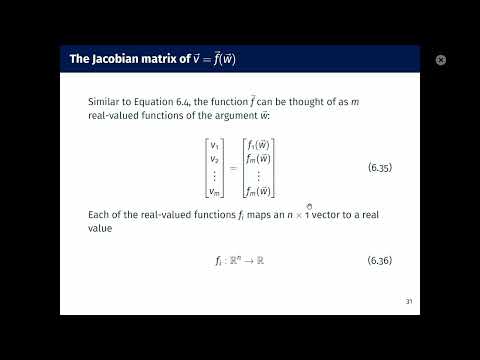
- For f: Rⁿ → Rᵐ, the Jacobian is an m-by-n matrix whose i-th row contains the partial derivatives of output component fᵢ.
- The polar-coordinate transformation has Jacobian determinant r, which supplies the r factor in the area element r dr dθ.
- At a twice-differentiable local minimum t* with f'(t*) = 0, the second derivative must satisfy f''(t*) ≥ 0, although equality does not guarantee a minimum.
- The Taylor remainder condition R(t) = o((t − t*)²) ensures the remainder becomes smaller than the quadratic term near t*, allowing the quadratic term to determine the sign.
- If f''(t*) were negative, a sufficiently small remainder could not prevent the Taylor expansion from decreasing near t*, contradicting local minimality.
Chapters
0:00
Directional Derivative of Vector Length Along Its Own Direction
- A directional derivative measures the change in a function divided by the distance moved in a chosen direction.
- For the length function at a nonzero vector W, moving along the unit direction W/||W|| increases the length at rate 1.
- The result follows directly from the limit definition: ||W + h(W/||W||)|| = ||W|| + h for positive h, so the difference quotient is 1.
6:00
From Scalar Gradients to the Jacobian Matrix
- The gradient of a scalar-valued function f is the column vector of its partial derivatives and is central to optimization.
- For a vector-valued map f: Rⁿ → Rᵐ, each component function fᵢ has a row of partial derivatives.
- Stacking the m rows produces the m-by-n Jacobian matrix; each row is the transpose of the gradient of one output component.
12:00
Polar Coordinates and the Jacobian Area Factor r
- The coordinate map from (r, θ) to (x, y) is x = r cos θ and y = r sin θ.
- Its Jacobian matrix has rows [cos θ, −r sin θ] and [sin θ, r cos θ].
- The determinant is r(cos² θ + sin² θ) = r, explaining the r factor in the polar area element r dr dθ.
17:00
Why a Local Minimum Requires a Nonnegative Second Derivative
- For a local minimizer t*, the first-order necessary condition is f'(t*) = 0.
- The second-order necessary condition states f''(t*) ≥ 0, but f''(t*) = 0 does not by itself prove that t* is a minimum.
- A second-order Taylor expansion leaves a remainder term that must be controlled before the sign of the quadratic term can establish the result.
22:00
Bounding the Taylor Remainder with Little-o Notation
- Write f(t) = f(t*) + f'(t*)(t − t*) + ½f''(t*)(t − t*)² + R(t).
- The remainder satisfies R(t) = o((t − t*)²) as t approaches t*, meaning R(t)/(t − t*)² tends to zero.
- Burton Ma derives this limit from the remainder formula using L’Hôpital’s rule and the definition of the derivative, showing the remainder is negligible relative to the quadratic term.
30:00
Contradiction Proof: A Negative Curvature Cannot Occur at a Minimum
- Assume f''(t*) < 0; the Taylor expansion then has a negative quadratic term proportional to (t − t*)².
- Because the remainder divided by (t − t*)² tends to zero, it can be bounded by an arbitrarily small positive multiple of that square near t*.
- Choosing the bound smaller than half the magnitude of f''(t*) makes the full Taylor change negative, contradicting the local-minimum condition f(t) − f(t*) ≥ 0.
- Therefore f''(t*) cannot be negative, proving the second-order necessary condition f''(t*) ≥ 0.
36:00
Lecture Wrap-up and Test One Scope
- Burton Ma closes the lecture after completing the proof and postpones the next gradient-focused lecture set.
- He says Test One covers lecture slides 1 through 5 and plans to post a sample question set over the weekend.
- A student is directed to the Lecture 03 addendum for previously posted material.
Summary, takeaways, and chapters were generated by AI from the video's transcript and may contain errors. The video belongs to its creator, Burton Ma.