Lecture 5: Line search
 Watch on YouTube →
Overview
Burton Ma explains bracket-based dichotomous line search and derivative-driven one-dimensional searches, showing how step size affects evaluation cost, accuracy, and convergence. He compares dichotomous search with Fibonacci and golden-section variants, then demonstrates fixed-step and derivative-scaled updates, stopping criteria, and why an oversized step can cause divergence.
Key takeaways
- Dichotomous line search narrows a bracket by comparing two nearby interior points, while Fibonacci search can reduce a bracket to 1% of its initial width in 10 function evaluations.
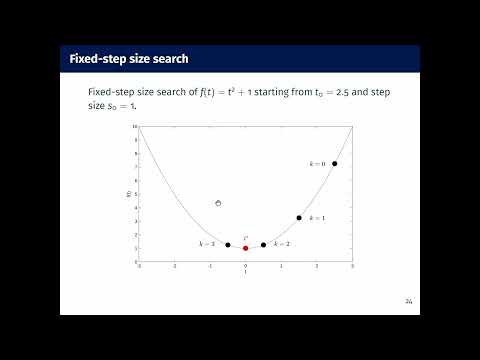
- A fixed-step search using only derivative signs brackets the minimum when the sign flips; taking the midpoint of the crossing points yields an error bound of half the step size.
- Larger fixed steps save derivative evaluations but worsen the possible minimizer error, while smaller steps improve precision at the cost of more evaluations.
- Scaling steps by derivative magnitude can make progress faster when far from a minimum, but a large scale can cause oscillation or divergence.
- A practical stopping rule can combine a derivative-magnitude threshold such as |f′(t)| < ε with a maximum iteration count, illustrated with a cap of 100.
- Starting point and step-size choices are consequential: an oversized update can increase the objective repeatedly and may lead a search to a different local minimum.
Chapters
0:00
Dichotomous Line Search: Narrowing a Bracket Around the Minimum
- Burton Ma illustrates dichotomous search on a parabola with a known minimum at t = 0.
- The algorithm evaluates two nearby points near the interval midpoint, then removes the side that cannot contain the minimum.
- The demonstration repeats interval reduction until the bracket reaches the desired width; Jupyter with NumPy and MATLAB implementations are mentioned.
4:08
Fibonacci and Golden-Section Search Reduce Function Evaluations
- Fibonacci and golden-section line searches retain one interior function evaluation between iterations, unlike dichotomous search.
- Burton Ma gives Fibonacci search as requiring 9 iterations and 10 total evaluations to reduce the bracket to 1% of its initial width.
- Dichotomous search would need about 14 evaluations for that reduction, while quadratic interpolation generally needs fewer evaluations but requires solving a system of equations.
5:36
Using Derivative Signs to Choose a Search Direction
- A derivative sign can replace bracketing information: a negative derivative means move right, while a positive derivative means move left.
- The search direction combines a sign with a step magnitude; Burton Ma uses the sign function to choose whether to move left or right.
- The approach requires a derivative or a numerical approximation of one and assumes a starting point reasonably close to the minimum.
7:44
Fixed-Step Search: Accuracy Depends on Step Size
- The fixed-step method repeatedly moves by a constant positive step size in the direction opposite the derivative sign.
- A derivative sign change indicates that the minimum has been crossed; the midpoint of the two points gives an estimate with error no greater than half the step size.
- Large steps reduce derivative evaluations but can produce a poor estimate: a step of 3 in the example returns 1 instead of the true minimum at 0.
- Small steps can improve accuracy but require more derivative evaluations.
14:21
Scaling Fixed Steps by the Derivative Can Overshoot
- Instead of using only the derivative sign, the update can scale a fixed parameter by the derivative magnitude: larger slopes produce larger steps.
- For f(t) = t² + 1, the derivative is 2t; starting at t = 2.5 gives derivative 5, so a scale of 0.75 produces an oversized initial move.
- Derivative-scaled steps may shrink near a minimum, but this behavior is not guaranteed for every function or starting point.
- In the example, updates oscillate around t = 0 before approaching it, showing why overshoot and stopping rules matter.
21:00
Stopping Rules and MATLAB Implementation Choices
- Burton Ma's MATLAB example stops when the derivative magnitude falls below epsilon and also imposes a maximum of 100 iterations.
- Other possible stopping rules include detecting a derivative sign change, limiting iterations, or checking whether the objective value changes only slightly.
- A sign change alone may stop too early after an overshoot; some one-dimensional searches used inside higher-dimensional optimization need only an approximate minimizer.
- The example needs a derivative, starting estimate, step size, and convergence settings, though the objective function itself is not required by that implementation.
23:12
Oversized Steps Cause Divergence and Make Tuning Necessary
- With f(t) = ½t², the derivative is t and a derivative-scaled update is tₖ₊₁ = tₖ − s₀tₖ; a step parameter that is too large can move away from the minimum.
- For a symmetric function, an overshoot can increase the objective value at each iteration and rapidly drive the search farther from the minimum.
- The algorithm’s outcome depends on the starting point, step size, and convergence parameters; Burton Ma emphasizes that convergence is not guaranteed.
- On functions with multiple minima, a diverging trajectory may enter another basin and converge to a different local minimum.
Summary, takeaways, and chapters were generated by AI from the video's transcript and may contain errors. The video belongs to its creator, Burton Ma.