Lecture 3: How Should We Join Climate Change to Energy Policy?
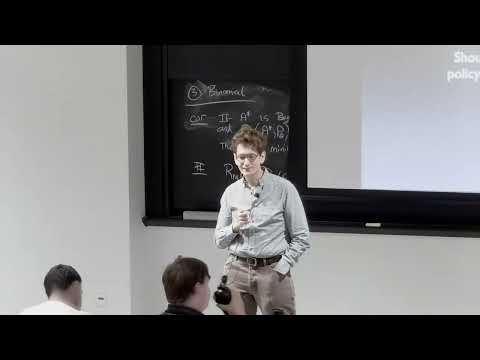 Watch on YouTube →
Overview
R. Scott Kemp argues that energy policy decisions, particularly regarding nuclear energy and climate change, should be guided by a modified cost-benefit analysis rather than technological enthusiasm or a flawed pursuit of zero carbon emissions. He highlights the significant uncertainties in climate modeling, such as climate sensitivity, and the difficulty in quantifying the social cost of carbon, suggesting that the cost of energy generation and learning rates are the most critical parameters for policy decisions.
Key takeaways
- The optimal level of CO2 abatement is not zero; it's determined by the intersection of marginal benefits and marginal costs, acknowledging that abating the last units is prohibitively expensive.
- Climate sensitivity estimates have remained highly uncertain (1.8-5.6°C) for over a century, and IPCC assessments rely heavily on expert judgment, making precise climate impact predictions unreliable.
- Concorde serves as a cautionary tale against technological enthusiasm without rigorous cost-benefit analysis, highlighting how externalities can outweigh perceived benefits.
- The Social Cost of Carbon (SCC) is currently not reliably calculable due to fundamental uncertainties in climate modeling and economic valuation, making it a poor basis for policy.
- Energy policy should focus on a modified cost-benefit analysis where the cost of energy generation and learning rates are dominant parameters, treating the SCC as a free parameter to explore its impact.
- Market-based economies, while imperfect, are preferred for enabling individual choices and reaching Pareto optimality, but they do not guarantee equality and require policy overlays to address issues like equity and externalities.
Chapters
0:00
Introduction to Levelized Cost of Energy (LCOE)
- LCOE measures the cost of energy per megawatt-hour.
- Investor demands (cost of capital, equity) influence total electricity cost.
- In the US, solar PV and onshore wind are cheapest; nuclear is most expensive.
4:15
The Climate Change Motivation for Nuclear Energy
- Nuclear energy's justification often stems from a desire to reduce CO2 emissions.
- The primary motivation for nuclear is the existence of a climate change problem.
- Different countries have varying energy landscapes (e.g., Japan's solar limitations).
5:30
Optimal Carbon Abatement vs. Zero Emissions
- Ideally, CO2 emissions should be zero, but abatement has costs.
- The optimal amount of carbon abatement occurs where marginal benefit equals marginal cost.
- Pursuing zero carbon emissions from the outset is a mistake; the optimal amount is not zero.
8:21
Marginal Benefit and Cost of CO2 Abatement
- Abating the first units of CO2 can be cost-negative (e.g., LED bulbs saving money).
- Abating the last units of CO2 becomes prohibitively expensive.
- The intersection of marginal benefit and marginal cost defines the optimal carbon level.
13:32
Earth's Carbon Absorption Capacity and Naturalistic Fallacy
- The Earth has a carbon absorption capacity with a long half-life (over 1000 years).
- Focusing solely on natural absorption misses the point and can lead to the naturalistic fallacy (humans shouldn't change anything).
- CO2 levels have fluctuated historically, making a strict 'natural' state hard to defend.
16:43
Models of Energy Policy: France's Nuclear Push
- Jasper's reading discussed different energy policy models.
- France's nuclear expansion was driven by energy independence concerns (oil crisis), not climate.
- This contrasts with countries like Sweden and the US, which evaluated nuclear costs and benefits more cautiously.
20:13
Political vs. Economic Decision-Making in Energy Policy
- Energy policy decisions are inherently political, influenced by factors like international agreements (Paris Agreement) and public perception.
- Politicians may prioritize votes or international standing over pure economic benefit.
- Cost-benefit analysis is one framework, but political will and other forces shape outcomes.
24:06
The Problem of Discount Rates in Long-Term Analysis
- Long-term benefits of energy policies (like nuclear) can be negligible due to high discount rates.
- Pindyck suggests a discount rate above 2% makes significant action seem not worthwhile.
- The construction of the Ramsey rate for social discounting is complex and debated.
25:36
Limitations of Cost-Benefit Analysis
- No single approach to energy policy is perfect; cost-benefit, command-and-control, and market approaches all have flaws.
- Advocates for a modified cost-benefit approach.
- Challenges include defining the scope of analysis and quantifying non-monetary values.
26:46
Concorde as a Case Study of Technological Enthusiasm
- Concorde, a supersonic jet, was technologically impressive but economically and environmentally disastrous.
- It used four times more fuel per passenger and generated significant sonic boom externalities.
- This illustrates the danger of pursuing technology without rigorous cost-benefit analysis.
34:00
Challenges in Quantifying Externalities and Values
- Cost-benefit analysis struggles with incomplete scope (e.g., car inspection time costs) and unquantifiable factors (human lives, ethics).
- Valuing human lives varies widely ($2M-$15M range).
- Optimizing for multiple objectives (cost, emissions, inequality) simultaneously is mathematically impossible.
45:04
The Social Cost of Carbon (SCC) and its Uncertainties
- The SCC attempts to quantify damages from CO2 emissions in dollars.
- Pindyck's analysis highlights flaws in SCC calculation methods.
- Key steps involve estimating climate sensitivity (CO2 doubling effect) and its impact on social welfare.
47:11
Climate Sensitivity and Model Uncertainties
- Climate sensitivity (expected temperature change from CO2 doubling) has a 1.8-5.6°C uncertainty range, unchanged since 1896.
- This uncertainty stems from complex climate system feedbacks.
- IPCC estimates rely heavily on expert judgment, which can be subject to biases and overconfidence.
1:00:34
The Fundamental Badness of Greenhouse Gas Emissions
- Despite quantification uncertainties, the science is clear: CO2 traps infrared energy and causes warming.
- The ocean acts as a heat sink, absorbing most energy, but its capacity to do so is not fully understood.
- Current models struggle to accurately constrain heat flux, making precise impact statements difficult.
1:07:21
Critique of Social Cost of Carbon Models
- Models used to estimate SCC often have arbitrarily chosen parameters (fit, beta, pi).
- These models can act as 'noise amplifiers', producing unreliable outputs from uncertain inputs.
- The SCC is essentially not a calculable number with current methods.
1:10:11
Proposed Energy Policy Framework: Modified Cost-Benefit
- Treat energy benefit as independent of source (nuclear, solar, wind), subject to availability.
- Balance explicit costs and estimated externalities (pollution, land use, bird deaths) against benefits.
- Treat the Social Cost of Carbon (SCC) as a free parameter to explore its impact across orders of magnitude.
1:18:24
Importance of Cost and Learning Rates
- Models are only as good as their data; costs and learning rates are crucial.
- For zero-carbon technologies (solar, wind, geothermal, nuclear), the SCC penalty is zero.
- The cost of electricity generation and learning rates are the dominant parameters.
Summary, takeaways, and chapters were generated by AI from the video's transcript and may contain errors. The video belongs to its creator, MIT OpenCourseWare.