Lecture 2: Nuclear Technology 101
 Watch on YouTube →
Overview
This lecture provides a foundational overview of nuclear technology, covering atomic-scale energy units (electron volts), nuclear structure (protons, neutrons, nucleons), and the forces governing nuclei (strong, weak, coulombic). It explains radioactive decay, the binding energy curve, and the principles behind fusion (e.g., D-T reaction yielding 17.6 MeV) and fission (e.g., U-235 fission yielding ~200 MeV). The lecture details how fission chain reactions are controlled in reactors using delayed neutrons and control rods, contrasting thermal and fast reactors, and discussing moderators like water and graphite.
Key takeaways
- Nuclear energy release stems from rearranging nucleons to achieve more stable configurations, as depicted by the binding energy curve.
- Fission of Uranium-235 releases ~200 MeV per atom, significantly more than radioactive decay (~1 MeV per nucleon), but requires controlled chain reactions.
- Reactor control relies on delayed neutrons and neutron-absorbing control rods to maintain a stable fission rate, preventing runaway exponential growth.
- Thermal reactors, using slowed neutrons, are easier to design and safer due to the increased fission probability of U-235 at lower neutron energies.
- Fusion requires overcoming immense coulombic repulsion through extreme temperatures (millions of degrees Celsius) and confinement, making it technologically challenging.
- Various reactor designs (BWR, PWR, HTGR, MSR, Fast Reactors) offer different approaches to heat transfer, neutron moderation, fuel utilization, and safety, each with unique advantages and drawbacks.
Chapters
- Course designed for individuals with no prior nuclear background.
- Covers physics, reactor types, energy extraction, and nomenclature.
- Emphasizes putting all students on the same page regarding fundamental concepts.
- Introduces the electron volt (eV) as the preferred unit for atomic-scale energy.
- Defines 1 eV as the energy to move one electron through 1 volt of potential.
- Compares eV to joules, noting 1 eV is approximately 1.6 x 10^-19 joules.
- Explains the nucleus is composed of protons (positive charge) and neutrons (neutral).
- Introduces 'nucleons' as the collective term for protons and neutrons.
- Defines Z as the number of protons (atomic number) and mass number (protons + neutrons).
- Protons contribute coulombic repulsive forces.
- The strong force acts as the primary 'glue' holding the nucleus together.
- The weak force is mentioned in relation to beta decay.
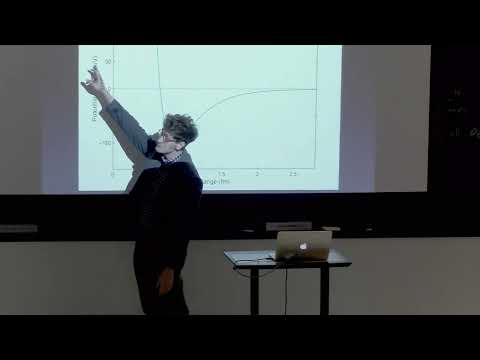
- The strong force has a minimum (attractive) at very short distances (~1 fm).
- It becomes repulsive at even shorter distances (<1 fm) and falls off rapidly beyond ~3 fm.
- This short-range attraction explains why nuclei have a stable nucleon spacing around 0.8 fm.
- Coulombic repulsion between protons is approximately 1.4 MeV.
- The attractive force from the strong force is about 100 MeV.
- The strong force overcomes electrostatic repulsion to bind the nucleus.
- Other factors like spin and exclusion rules dictate specific nuclear configurations.
- The table of isotopes shows allowed combinations of protons and neutrons.
- Color coding on the isotope chart indicates lifetime (e.g., black for stable).
- Disassembling nuclei releases energy; radioactive decay can yield useful heat.
- Plutonium-238 (half-life 87 years) self-heats significantly, used in RTGs for spacecraft.
- Strontium-90 and Cesium-137 were used in Soviet nuclear batteries for lighthouses.
- Plots binding energy per nucleon against the number of nucleons.
- Shows that very light and very heavy nuclei have lower binding energy per nucleon.
- Iron is the most stable element, representing the peak of the curve.
- Unstable isotopes transition to more stable states via radioactive decay.
- Energy released per nucleon in typical radioactive decay is small (100 keV to 1 MeV).
- Macroscopic energy is generated due to the large number of atoms (Avogadro's number).
- To control energy release, stimulated reactions are needed.
- Fusion involves joining nuclei; the Deuterium-Tritium (D-T) reaction is a common example.
- D-T fusion yields approximately 17.6 MeV, significantly more than radioactive decay.
- Overcoming coulombic repulsion requires extremely high temperatures (10 million degrees Celsius).
- Stable confinement of charged particles at these temperatures is difficult.
- Fission involves splitting heavy nuclei.
- The (n, 2n) reaction produces more neutrons but yields little net energy.
- Uranium-235 undergoes fission when hit by a neutron, releasing ~200 MeV per fission.
- Criticality is a geometric consideration for sustaining a chain reaction.
- A subcritical mass loses neutrons faster than they are produced.
- A supercritical mass allows the chain reaction to grow exponentially.
- About 0.6% of neutrons from fission are 'delayed neutrons', emitted later via radioactive decay.
- Reactors are designed to be prompt subcritical but become momentarily supercritical due to delayed neutrons.
- This allows for control over the reaction rate, preventing runaway exponential growth.
- Neutron loss (leakage) is managed by reactor geometry and size.
- Control rods (e.g., made of Boron) absorb excess neutrons to fine-tune the reaction rate.
- The goal is to maintain a stable, controlled fission rate.
- Fast reactors use high-energy ('fast') neutrons; thermal reactors use slowed-down ('thermal') neutrons.
- Neutrons born from fission have ~2 MeV kinetic energy.
- Slowing neutrons down (thermalization) dramatically increases the fission cross-section for Uranium-235.
- Natural uranium is ~99.3% U-238 and ~0.7% U-235.
- U-235 has a much higher fission probability with thermal neutrons.
- Uranium enrichment separates U-235 from U-238 by mass, producing low-enriched uranium (LEU, ~5% U-235) for most reactors.
Summary, takeaways, and chapters were generated by AI from the video's transcript and may contain errors. The video belongs to its creator, MIT OpenCourseWare.