Lecture 12: Exam Review
 Watch on YouTube →
Overview
Professor Rosen reviews a 105-point introductory Python practice exam, explaining core concepts and clarifying that the actual exam should be somewhat shorter, with many written answers converted to multiple choice. The review covers algorithm fundamentals, arithmetic and Boolean evaluation, assignment, string slicing, loops and functions, turtle graphics, and pass-by-value behavior, while emphasizing that clear reasoning matters more than perfect syntax or artwork.
Key takeaways
- Python arithmetic questions rely on operator precedence: multiplication, division, and modulo share a tier and evaluate left to right, while multiplication precedes addition and subtraction.
- For string slices, the stop index is excluded and the third field controls direction and spacing; a step of -1 reverses a string, while a step of 2 selects every other character.
- Nested loops can create growing patterns by using range(row + 1): successive rows execute the inner loop 1, 2, 3, and more times.
- Turtle tracing becomes manageable by recording position, heading, and pen state after each command; penup prevents unwanted connector lines between shapes.
- Python function parameters are local copies for the numeric examples discussed, so changing a parameter inside a function does not change the caller’s original variable without a returned value.
- On the 105-point practice exam, clear communication of an algorithm is more important than perfect syntax or precise drawing; the actual exam is expected to be shorter and use more multiple-choice questions.
Chapters
0:00
Exam Review Format, Grading, and Test-Taking Advice
- The practice exam is worth 105 points, and the actual exam is expected to be somewhat shorter.
- Many open-answer questions will become multiple choice to speed grading and reduce handwriting issues.
- Code does not need perfect syntax if the intended algorithm is clear; question difficulty corresponds to points, not answer space.
- Professor Rosen advises students not to panic and notes that an unintentional exam error may merit an extra point.
2:16
Computer Science, Algorithms, and Early Programming History
- Computer science is presented as the study of algorithms, not simply the study of computers.
- An algorithm is a finite set of well-ordered, unambiguous instructions that produces a result.
- The word algorithm derives from the name of Persian mathematician al-Khwarizmi, whose name was Latinized.
- Ada Lovelace is often considered the first programmer for her work on papers about Charles Babbage’s Analytical Engine; Alan Turing was not the first.
4:16
Python Arithmetic, Operator Precedence, and Integer Division
- Multiplication, division, and modulo share precedence and are evaluated left to right; for example, 2 * 3 / 6 * 100 evaluates to 100.
- Modulo returns a remainder, so 1 % 2 + 3 % 2 evaluates to 2.
- Multiplication precedes addition and subtraction: 4 + 5 - 2 * 3 evaluates to 3, while 2 * 4 - 20 evaluates to -12.
- Integer division of a smaller number by a much larger number yields 0; exponents also appear, as in 10 ** 2 * 2 = 200.
11:01
Tracing Sequential Variable Assignments
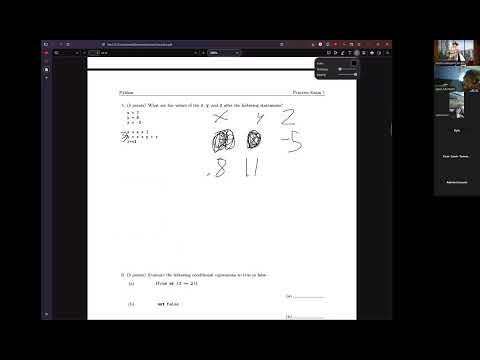
- Track each variable’s current value as statements run; starting with x = 7, y = 8, z = -5, the assignment x = x + 1 changes x to 8.
- Then y = x + y + z uses the updated x and stores 11 in y.
- The statement z = z + 1 changes z from -5 to -4; assignment updates the named variable rather than creating a separate algebraic equation.
- The exam’s analogous variable-tracing question is expected to use two variables rather than the practice problem’s three.
14:18
Evaluating Boolean Expressions and Mixed Numeric Types
- An OR expression is true when either side is true, while an AND expression requires both sides to be true.
- The not operator flips a Boolean result, so not (4 < 2) is true.
- Parentheses determine which part of a compound expression is negated; evaluate inner comparisons and Boolean operators before applying an outer not.
- Python compares integer and float values numerically: 32 / 8 and 32.0 / 8 both yield values that compare equal as 4 and 4.0.
20:32
String Indexing, Slicing, and Step Values
- Write string indexes beside the characters to avoid mistakes, especially when a string contains spaces.
- For the string “an apple a day,” index 3 is “a,” and the slice [3:8] returns “apple” because the stop index is excluded.
- Negative indexes count backward from the end: index -2 selects the second-to-last character.
- Slicing follows start:stop:step; a negative step reverses direction, while a step of 2 selects every other character.
28:10
Three Ways to Reverse a String in Python
- The concise Python solution prints text[::-1], using a slice with a step of -1.
- A loop can build a reversed string by iterating over letters and prepending each letter to the accumulated result.
- Another loop approach iterates through indexes from len(text) - 1 down to 0, retrieving text[index] each time.
- Appending letters in their original order produces the original string, so reversing requires either reverse iteration or prepending.
36:17
Tracing Turtle Turns and Repeated Sawtooth Patterns
- For turtle questions, track the turtle’s direction after every left or right turn as well as its position after each forward command.
- The example repeats a sequence of 45-degree turns and equal-length forward movements five times, producing a sawtooth-like outline.
- A function parameter such as size lets the calling programmer control the length of each stroke instead of hard-coding 10.
- Drawings need only communicate the intended angles and relative lengths; a ruler or highly precise geometry is unnecessary.
45:00
Nested For Loops Build a Stamped Triangle
- The outer loop runs row through range(5), giving row the values 0 through 4.
- The inner loop runs range(row + 1), so it stamps and advances once on row 0, twice on row 1, and three times on row 2.
- The turtle uses pen-up movement and stamps to create dots; 90-degree turns and distances based on 50 align each successive row.
- The resulting pattern is a triangular or pyramid-like arrangement of stamps, and the overall shape matters more than exact spacing.
53:51
Exam Coding Questions and the Draw-Square Function
- The exam will include two code-writing questions worth 10 points each, primarily asking students to fill blanks or add missing turtle strokes.
- A draw_square function can repeat four times, moving the turtle forward by size and turning 90 degrees after each side.
- Professor Rosen prioritizes whether code performs the intended task over minor syntax omissions such as a forgotten colon or import.
- Returning a turtle to its starting position and orientation after drawing a shape makes later drawing steps easier to reason about.
1:00:16
Drawing Four Connected Squares with Turtle Functions
- The practice figure consists of four equal squares arranged around a shared central point, not a puzzle requiring a hidden square count.
- After drawing one square, move the turtle half the square’s size to the right and half the size downward to reach the next square’s center.
- Turn the pen up while repositioning so the connecting travel stroke is not drawn, then put the pen down before drawing again.
- A repeat loop can call draw_square four times, with each square using the same size parameter.
1:07:00
Paper Exams, Attendance, and Turtle Command Shorthands
- Written coding exams allow students to move on after a minor syntax slip instead of spending time debugging in an editor.
- Turtle shorthand commands include up and down for penup and pendown, and rt and lt for right and left.
- Class attendance is not formally taken, but Professor Rosen notes that attendance is strongly correlated with performance.
- The exam is scheduled for the next lab; students with scheduling issues should contact their TA.
1:09:37
Function Calls, Recursion, and Stack Overflow
- Functions can call other functions, which can in turn call additional functions.
- If functions such as bar and baz call each other recursively without a stopping condition, execution continues until Python raises a stack overflow-related error.
- This function-calling example is presented as useful background rather than as a direct match for an exam question.
1:10:46
Pass-by-Value and Local Function Parameters
- When values such as 4, 6, and 8 are passed into a function, the parameters inside the function are separate local variables.
- Renaming local parameters to A, B, and C helps distinguish them from outer variables named x, y, and z.
- In the worked trace, incrementing B changes it to 7, then setting A = A - B + C makes A equal 5; printing CBA yields 8, 7, 5.
- Changes to local numeric parameters do not alter the original variables unless the function returns values and the caller assigns them.
1:14:22
Final Exam Preparation: Nested Loops and Practice Problems
- Professor Rosen recommends practice problems 20 and 21, which exercise nested for loops and are strong preparation for the exam.
- Project Problem 1 is another suggested source of practice.
- Understanding how local function variables differ from caller variables helps prevent confusion in code-tracing questions.
- The review concludes with a reminder to check course announcements and arrange exam logistics through the TA when needed.
Summary, takeaways, and chapters were generated by AI from the video's transcript and may contain errors. The video belongs to its creator, Professor Rosen.