Lecture 11: Z_2 gauge theory (continued)
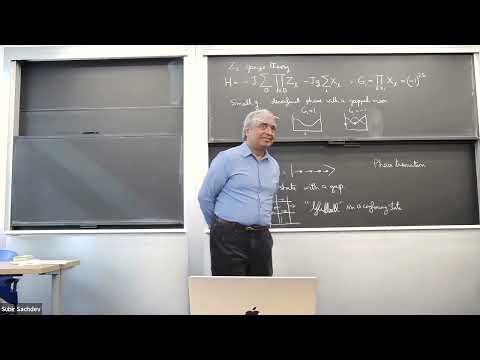 Watch on YouTube →
Overview
Subir Sachdev completes the square-lattice Z₂ gauge-theory analysis: the even Gauss-law sector has a trivial large-coupling confined state, while the odd sector leads to dimer coverings and a constraint against a trivial symmetric gapped state. He then develops the square-lattice bosonic-parton description, deriving a CP¹ theory of spinons coupled to a U(1) photon and explaining why monopoles destabilize the apparent two-dimensional spin liquid.
Key takeaways
- The local Gauss-law sector determines whether large-coupling confinement can yield a trivial product state: G_i = +1 permits one, while G_i = -1 imposes an odd background charge that obstructs a trivial symmetric gapped state.
- In the odd Z₂ gauge theory, the large-coupling low-energy manifold is the set of hard-core dimer coverings, and projected plaquette dynamics generates the Rokhsar–Kivelson quantum dimer model.
- Odd background gauge charge makes vison translations anticommute, TxTy = -TyTx, forcing symmetry-breaking, fractionalized, or gapless outcomes in the spirit of the Lieb–Schultz–Mattis constraint.
- Square-lattice vison condensation can have emergent XY critical behavior even though microscopic lattice symmetry permits an eighth-order anisotropy that ultimately selects discrete valence-bond-solid orientations.
- The square-lattice Schwinger-boson continuum limit yields a CP¹ theory of two complex spinons coupled to a U(1) photon; the gauge-invariant Néel vector is N = z†σz.
- A two-dimensional compact U(1) spin liquid is only an intermediate or approximate description when monopoles are relevant, whereas three-dimensional pyrochlore systems can support stable U(1) spin liquids with emergent photons.
Chapters
0:00
Z₂ Gauge-Theory Recap and Course Roadmap
- Sachdev frames the lecture as a wrap-up of Z₂ gauge theory before moving to gapless spin liquids.
- The link variables are qubits with Pauli operators X and Z; plaquette-Z and link-X terms play roles analogous to magnetic and electric energy.
- At small gauge coupling, the model has a deconfined phase with gapped visons; the vison band can have one or two minima depending on the Gauss-law sector.
4:30
Odd Gauss Law as a Background Z₂ Gauge Charge
- The local Gauss-law operator G_i commutes with the Hamiltonian and fixes the allowed gauge-charge sector.
- G_i = -1 corresponds to a background Z₂ gauge charge at every site, consistent with an odd number of bosonic partons per site.
- That odd background charge changes the vison translation properties and distinguishes the odd gauge theory from the G_i = +1 case.
6:54
Large-Coupling Confinement and the Wilson–Wegner Loop
- For G_i = +1 and large coupling, the ground state has all link X variables aligned, giving a unique, gapped product state.
- A plaquette-Z operator flips four links and creates a simple local, gauge-neutral excitation, described as glueball-like.
- The Wilson–Wegner loop, the product of Z operators around a loop, distinguishes phases through area-law behavior in the confined phase and perimeter-law behavior in the deconfined phase.
13:00
Vison Condensation and the Ising Critical Theory
- Near the G_i = +1 confinement transition, the vison gap Δ closes and the low-energy mode is represented by a real scalar field φ.
- The resulting long-wavelength theory is an Ising φ⁴ field theory, with the mass parameter tuning through the transition.
- A single vison is not created by a local gauge-invariant operator, so φ is nonlocal while observables such as φ² are local; this affects boundary conditions and torus sectors.
16:31
Odd Gauss Law Produces Degenerate Dimer Coverings
- For G_i = -1 at infinite coupling, the constraint requires an odd number of flipped links around every site.
- The allowed lowest-energy configurations correspond to hard-core dimer coverings, with each dimer identified with a spin singlet.
- Unlike the even-charge sector, the large-coupling ground-state manifold is extensively degenerate, so perturbation theory must act within that manifold.
19:45
Rokhsar–Kivelson Quantum Dimer Dynamics
- Projecting the plaquette-Z term into the dimer manifold produces local resonance moves that flip two parallel dimers around a square.
- The resulting effective Hamiltonian is the Rokhsar–Kivelson quantum dimer model, with a tunneling amplitude and potential terms that count flippable configurations.
- The effective dimer model retains the constraint of one dimer touching each site and is generally analyzed with lattice-specific numerical methods.
24:30
Odd-Sector Outcomes: Topological Liquid or VBS Order
- Depending on the lattice and effective dimer couplings, the large-coupling phase can remain a deconfined Z₂ spin liquid or become a confined valence-bond solid.
- On the square lattice, visons have two symmetry-related band minima, represented by fields φ₁ and φ₂.
- Condensing the visons breaks lattice symmetry in the odd sector, leading to a dimer crystal rather than a featureless confined state.
28:30
Torus Symmetries and Winding Operators
- Putting the gauge theory on an Lx × Ly torus reveals conserved local Gauss-law operators, lattice translations, and noncontractible winding operators Vx and Vy.
- Products of local Gauss-law operators generate closed-loop operators, while Vx and Vy wrap around the two independent cycles of the torus.
- These global operators expose constraints on the ground-state structure that are hidden in an infinite-plane discussion.
34:20
Translation–Winding Algebra and the LSM Obstruction
- In the odd Gauss-law sector, translating a winding operator can produce a sign depending on the system size; for example, Ty and Vx acquire a factor of (-1) raised to a transverse length.
- The noncommuting symmetry algebra means states retain information about boundary conditions and cannot behave like a simple local product state.
- This is a gauge-theory version of the Lieb–Schultz–Mattis constraint: the system must avoid a trivial symmetric gapped state, for example through symmetry breaking, fractionalization, or gaplessness.
40:30
Projective Visons and the Odd-Sector Critical Modes
- Visons moving around one lattice cell pick up a π flux, so their translations obey TxTy = -TyTx.
- The two low-energy vison modes transform into one another under lattice symmetries, forming a projective representation rather than ordinary scalar translation rules.
- For square-lattice vison condensation, the symmetry action constrains the order parameter and links the confined phase to valence-bond-solid order.
44:30
Emergent XY Symmetry and Eighth-Order Lattice Anisotropy
- Combining the two vison fields as s = φ₁ + iφ₂ gives an XY-like continuum theory near a possible critical point.
- Vison number is conserved only modulo two, while square-lattice rotations impose additional restrictions on allowed anisotropies.
- The leading lattice anisotropy appears at eighth order in s, so the critical behavior can exhibit emergent U(1) symmetry even though the microscopic lattice has discrete rotational symmetry.
56:20
From Z₂ Liquids to Square-Lattice Bosonic Partons
- Sachdev turns to the square-lattice Schwinger-boson construction, writing each spin using bosonic partons subject to a local constraint.
- A bond mean-field amplitude Q carries a phase that becomes the spatial component of an emergent U(1) gauge field; fluctuations of the constraint supply its temporal component.
- The low-energy theory contains both charged spinons and an emergent photon, extending beyond the earlier gapped Z₂ gauge-theory description.
1:00:50
Long-Wavelength Spinons and the Emergent Gauge Field
- Sachdev expands the lattice bosons around low-energy momentum minima and introduces slowly varying fields on the two square-lattice sublattices.
- The two complex spinon fields are combined into continuum variables, while the bond-phase fluctuations become components of the U(1) gauge field.
- Integrating out the canonical momentum converts the phase-space description into a configuration-space field theory with gauge-covariant spinon dynamics.
1:05:30
The CP¹ Gauge Theory and Néel Order
- The continuum theory is the CP¹ model: two complex fields z₁ and z₂ couple to a U(1) gauge field, and a common phase rotation is gauge redundancy.
- For positive spinon mass parameter r, the spinons are gapped and the mean-field state resembles a U(1) spin liquid with a gapless photon.
- When the spinons condense, the gauge-invariant vector N = z†σz acquires an expectation value with Néel symmetry, producing antiferromagnetic order.
1:12:30
Monopoles Destabilize the 2D U(1) Spin Liquid
- The initial CP¹ derivation omits monopole events, which are allowed in a compact two-dimensional U(1) gauge theory and ultimately destabilize the apparent spin liquid.
- Monopoles can be sufficiently dilute that finite-scale experiments or simulations still observe behavior resembling a photon-bearing spin liquid.
- In three-dimensional pyrochlore systems, monopole effects are less destabilizing, allowing genuine U(1) spin-liquid phases with emergent photon signatures.
Summary, takeaways, and chapters were generated by AI from the video's transcript and may contain errors. The video belongs to its creator, Subir Sachdev.