Lecture 11: Algorithmic Game Theory
 Watch on YouTube →
Overview
Samuel Bruce presents an algorithmic game theory lecture focusing on Dubey's limit order market mechanism and its application to blockchain technology. The discussion explores alternative equilibria like correlated and coarse correlated equilibria, contrasting their computational tractability with Nash equilibria (PPAD-complete). The lecture highlights the SPEEDEX decentralized exchange as a practical implementation and introduces no-regret learning algorithms (external and swap regret) as a computationally feasible approach to finding these equilibria in large, continuous strategy spaces, particularly relevant for blockchain constraints.
Key takeaways
- Computing Nash equilibria is PPAD-complete, making it computationally intractable for complex games and blockchain applications.
- Correlated and coarse correlated equilibria offer more tractable alternatives, especially when using linear programming or no-regret learning.
- No-regret learning algorithms (external and swap regret) provide a polynomial-time method to estimate correlated/coarse correlated equilibria without needing to compute the full joint probability distribution.
- SPEEDEX is a real-world blockchain implementation of a limit order exchange that addresses arbitrage and front-running but uses clearing prices, differing from Dubey's original mechanism.
- Blockchain environments impose strict computational limits (polynomial time), necessitating algorithms like no-regret learning that scale efficiently with strategy space size and player count.
- Adapting no-regret learners to dynamic market conditions (shocks to endowments, utilities) and determining the optimal information setting for these learners are key areas of ongoing research.
Chapters
- Samuel Bruce presents on market mechanisms and alternative equilibria using algorithmic game theory.
- Focus on computationally feasible algorithms for mechanisms deployable in code.
- Roadmap includes Dubey's limit order market, Nash equilibria complexity, correlated/coarse correlated equilibria, and machine learning algorithms.
- Mechanism involves 'n' players, 'k' goods, endowments, and utility functions.
- Player strategies consist of four quantities: buy/sell quantity (q, q-tilde) at specific prices (p, p-tilde).
- Players can buy/sell any goods, but cannot sell more than their endowment; penalties for negative credit.
- Each good has a separate trading post where orders are filtered.
- Bids are accrued, matching the highest buyer with the lowest seller.
- Trades execute at the buyer's quoted price if it meets or exceeds the seller's price.
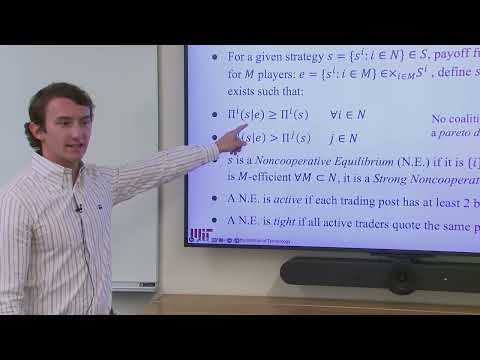
- Efficiency: No subset of players can achieve a Pareto-dominant outcome through deviation.
- Non-cooperative equilibrium: Efficient for each individual player, similar to Nash equilibrium.
- Strong non-cooperative equilibrium: Efficient for any arbitrary coalition of any size.
- Active non-cooperative equilibria: At least two active buyers and sellers at each trading post.
- Tight equilibria: All active buyers and sellers quote the same price.
- Active non-cooperative equilibria are competitive; tight active ones are also competitive and strong.
- SPEEDEX (2023) is a decentralized limit order exchange on blockchain.
- Implements a mechanism similar to Dubey's, handling currency exchanges.
- Calculates market-clearing prices per block and executes outstanding orders.
- SPEEDEX executes trades at the clearing price (intersection price).
- Dubey's mechanism executes trades at the buyer's quoted price.
- Executing at intersection price in SPEEDEX breaks Dubey's competitive equilibrium guarantee.
- Runtime is O(assets^2 * log(orders)), efficient for many orders.
- Consistent clearing prices prevent arbitrage opportunities between currencies.
- All transactions in a block occur at the same prices, preventing front-running attacks and miner-extractable value.
- Finding non-cooperative or Nash equilibria is computationally hard.
- Requires agents to predict others' strategies, leading to a vast strategy space.
- Convergence to equilibria is dubious due to exponential complexity.
- Computing Nash equilibria is PPAD-complete, with no known polynomial-time algorithms.
- Competitive equilibria for general exchange economies are also PPAD-complete.
- Rational agents face complex optimization problems, making convergence difficult.
- NP: Problems with polynomial-time verifiers.
- Hard Problem: At least as difficult as any other problem in a complexity class.
- Complete Problem: Any problem in the class can be mapped to it in polynomial time.
- Nash proved every game has a Nash equilibrium.
- For general games, finding Nash equilibria is PPAD-complete.
- PPAD defined by finding an unbalanced node in a directed graph with one unbalanced node.
- Nash equilibria are hard to compute; alternative concepts like correlated equilibria are explored.
- Correlated equilibrium: Players receive signals from a coordinator and have no incentive to deviate.
- Coarse correlated equilibrium: Weaker than correlated; players commit before learning strategies, incentive compatible in expectation.
- Illustrates constraints for a 2-player game with utility matrices and a joint distribution.
- Player utility for playing a signaled strategy vs. deviating, weighted by probabilities of other players' signals.
- Constraints ensure incentive compatibility for each player.
- Players commit before learning their strategy; must be better off in expectation than any fixed deviation.
- Constraints are based on expected utility of playing the distribution vs. any fixed deviation.
- Fewer constraints than correlated equilibrium (O(N*K) vs. O(N*K^2)).
- All Nash equilibria are correlated; all correlated are coarse correlated.
- Nash equilibrium is a special case of correlated where player strategies are independent.
- Coarse correlated requires commitment before learning strategy; correlated allows learning signal before decision.
- Constraints for correlated/coarse correlated equilibria are linear.
- Linear programming methods can find distributions in polynomial time.
- Can incorporate optimization (e.g., Pareto planner's problem) at no extra cost.
- Blockchain (e.g., Ethereum) has strict limits on contract complexity and execution time (polynomial time required).
- Exponential algorithms for Nash equilibria are incompatible with blockchain architectures.
- Linear programming for correlated equilibria faces scalability issues with large strategy spaces (exponential growth in variables).
- No-regret learning is a machine learning approach that avoids optimizing over joint probability distributions.
- Optimizes over individual strategies, scaling better with the number of players.
- Algorithms exist for continuous and large action spaces, even under limited information.
Summary, takeaways, and chapters were generated by AI from the video's transcript and may contain errors. The video belongs to its creator, MIT OpenCourseWare.