Lecture 10: Z_2 gauge theory
 Watch on YouTube →
Overview
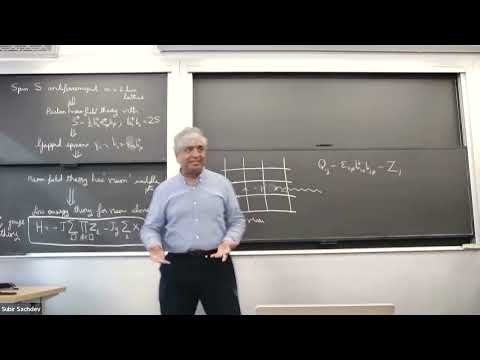
Subir Sachdev derives the low-energy Z₂ gauge theory for two-dimensional quantum spin liquids, with link variables whose plaquette products encode vison flux and link-flip operators give visons dynamics. He relates the gauge theory to the transverse-field Ising model by duality, then shows how the microscopic spin parity fixes the gauge-charge sector: half-integer spins give visons a π Berry phase, projective translations, and a twofold-degenerate dispersion. The large-coupling limit connects this constraint to dimer coverings and the Lieb-Schultz-Mattis obstruction to a featureless symmetric state.
Key takeaways
- The Z₂ gauge Hamiltonian has plaquette products of link Z operators for flux energy and link X operators for vison dynamics; its duality to a transverse-field Ising model establishes the stability of the weak-coupling deconfined phase.
- The physical gauge-charge constraint is fixed by microscopic spin: Gᵢ = (−1)²ˢ, giving +1 for integer spins and −1 for half-integer spins.
- A vison encircling one spin acquires Berry phase (−1)²ˢ; half-integer spin therefore produces π flux for vison motion on the dual lattice.
- In the half-integer-spin case, vison translations satisfy TₓTᵧ = −TᵧTₓ, forcing at least twofold degeneracy and producing two symmetry-related band minima.
- At large gauge coupling, integer-spin systems can admit a simple gauge-invariant product state, whereas the half-integer constraint produces dimer coverings and obstructs a featureless symmetric state.
- On a torus, noncontractible X and Z loop operators label global sectors and supply the logical operators underlying toric-code quantum information.
Chapters
- Sachdev reviews representing spins with bosonic partons subject to the local constraint that the parton number equals 2S.
- Mean-field theory yields gapped spinon excitations and, for suitable frustrated lattices, a Z₂ spin-liquid saddle point without a gapless photon.
- A vison saddle point can be represented by a branch cut across which the sign of the link variable Q changes; moving the cut is a gauge choice.
- Each lattice link carries Pauli operators X and Z, and gauge-invariant flux is measured by the product of Z variables around a plaquette.
- The plaquette-flux term favors zero flux, while the link X term flips Z and allows visons to move.
- This is Wegner’s Z₂ lattice gauge theory, used here to test whether the spin-liquid saddle point remains stable beyond mean-field theory.
- Sachdev places dual Ising variables on the dual lattice and maps each gauge-theory plaquette product of Z operators to a dual-site X operator.
- An Ising bond operator maps to the gauge-theory link Z crossed by that bond, exchanging dual sites and plaquettes under a 90-degree rotation.
- Matching the operators’ squares and commutation relations establishes the duality, with boundary and global-sector subtleties on a torus.
- The local operators have simple duals: gauge plaquette flux maps to dual X, while dual Ising bonds map to gauge-link Z.
- Their matching commutation and anticommutation relations preserve the operator algebra and therefore the spectra and corresponding correlation functions.
- A single Z operator maps nonlocally, involving a string; the simple local mapping is sufficient to establish the duality.
- Under the duality, weak gauge coupling corresponds to the disordered, strong-coupling Ising regime, where the Z₂ spin liquid is stable.
- The small-coupling gauge phase is deconfined: spinons remain distinct excitations and visons are gapped.
- At the other end, vison proliferation corresponds to the dual Ising-ordered phase and confines spinons, destroying the fractionalized regime.
- The Ising duality supplies a stability argument for the small-gauge-coupling phase rather than relying only on the mean-field saddle point.
- Sachdev notes that related duality constructions extend to discrete Z_N gauge groups, although the mapping is less straightforward for non-Abelian groups.
- The rest of the analysis focuses on vison and spin-liquid properties in the deconfined regime.
- At zero gauge coupling, setting every link Z to +1 minimizes the plaquette terms and gives a simple ground-state configuration.
- Flipping all links incident on one site leaves every plaquette flux unchanged, so it produces a gauge-equivalent configuration rather than a distinct physical state.
- Only gauge-invariant measurements distinguish physical states; the apparent ground-state multiplicity must be treated through gauge symmetry.
- Sachdev defines a local gauge charge Gᵢ as the product of X operators on all links incident on site i.
- Each Gᵢ commutes with the Hamiltonian: its X factors commute with the link-flip terms and produce an even number of sign changes through each plaquette term.
- The charges obey Gᵢ² = 1, so their eigenvalues are ±1; choosing their values specifies the physical gauge-theory sector, analogous to imposing Gauss’s law.
- The microscopic spin model selects a definite gauge-charge sector: Gᵢ = (−1)²ˢ at every site.
- Half-integer spins require Gᵢ = −1, while integer spins require Gᵢ = +1; a site with a different spin acts like a gauge-charge defect.
- This dependence of the low-energy gauge theory on microscopic spin parity is tied to translation symmetry and is understood through Lieb-Schultz-Mattis-type anomaly constraints.
- Applying Gᵢ moves a vison around a closed path surrounding site i, so the phase acquired by that motion reveals the local gauge-charge value.
- Returning the parton configuration to its original gauge requires a transformation whose sign depends on the number of bosonic partons at the enclosed site.
- The resulting vison Berry phase is +1 for integer spin and −1 for half-integer spin, equivalently (−1)²ˢ.
- At small gauge coupling, a vison hops between dual-lattice sites with amplitudes set by the link-flip term.
- For half-integer spin, the Berry phase of −1 around each original site means the vison moves in a background of π flux per dual plaquette.
- For integer spin there is no such required π flux, so the half-integer case has distinct band and symmetry properties.
- A gauge choice represents the π flux with alternating hopping signs and doubles the vison hopping unit cell, without physically breaking translation symmetry.
- The resulting tight-binding problem has two sublattices, A and B, and a reduced Brillouin zone.
- The lowest vison band has two distinct minima, at momenta (0, 0) and (0, π) in the reduced-zone convention.
- For a vison moving in π flux, translations in the x and y directions obey TₓTᵧ = −TᵧTₓ, even though each translation separately preserves the Hamiltonian.
- This projective translation algebra has no one-dimensional representation, so vison states must occur in at least twofold multiplets.
- The two dispersion minima are therefore symmetry-related; Sachdev identifies this as a physical consequence for half-integer-spin Z₂ spin liquids, unlike the integer-spin case.
- On a torus, additional conserved operators are noncontractible loops of X or Z that cannot be written as products of local Gᵢ charges.
- These topological loop operators distinguish global sectors and connect the gauge theory to the toric code.
- In the toric-code setting, long loop operators provide the logical degrees of freedom used to store quantum information.
- At large coupling and integer spin, the local constraint allows X = +1 on every link, yielding a simple gauge-invariant state; Sachdev also cites AKLT-type singlet constructions as examples.
- For half-integer spin, Gᵢ = −1 prevents every incident-link X configuration from being +1, so the strong-coupling states correspond to arrangements of dimers or valence bonds.
- The many dimer configurations signal that a featureless symmetric product ground state is unavailable; depending on lattice and interactions, the system may form a valence-bond solid or another nontrivial phase, as in Lieb-Schultz-Mattis constraints.
Summary, takeaways, and chapters were generated by AI from the video's transcript and may contain errors. The video belongs to its creator, Subir Sachdev.