Lecture 1: Introduction to 22.04 and the History of Nuclear Power
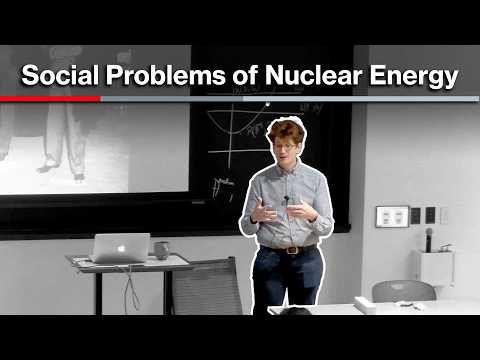 Watch on YouTube →
Overview
R. Scott Kemp introduces MIT's 22.04 nuclear engineering course, emphasizing critical thinking and writing skills, with a unique AI-assisted grading system for homework assignments. The lecture then delves into the history of nuclear energy, tracing its origins from understanding stellar energy (Kelvin-Helmholtz mechanism) to the discovery of fission by Ida Noddack, Otto Hahn, and Lise Meitner, and the subsequent development of nuclear weapons during WWII, leading to the establishment of the Atomic Energy Commission (AEC) and the eventual dominance of the Pressurized Water Reactor (PWR) due to political and economic factors rather than pure technological evaluation.
Key takeaways
- The historical development of nuclear power was heavily influenced by military imperatives (WWII, Cold War) and political/economic motivations, not solely by scientific merit or economic efficiency.
- Ida Noddack's early proposal of nuclear fission was historically overlooked, with Otto Hahn and Lise Meitner receiving primary credit.
- The dominance of the Pressurized Water Reactor (PWR) in the US was a result of the Navy's strategic needs and lobbying efforts during the Cold War, rather than a deliberate technological evaluation of all available options.
- Secrecy, government control (via the AEC), and the desire to compete with the Soviet Union shaped the early trajectory of nuclear research and industry structure.
- The 'too cheap to meter' prediction for fusion power by Lewis Strauss highlights the initial optimistic, business-driven outlook on nuclear energy's potential.
- Technological lock-in, exemplified by the PWR's entrenchment, demonstrates how early decisions, driven by factors beyond pure performance, can have long-lasting consequences.
Chapters
- R. Scott Kemp welcomes students to 22.04 and 22.103, noting the course's growth from a small seminar to a large, mandatory class.
- Emphasis on understanding the debate surrounding nuclear energy's struggles and the importance of coherent, convincing writing.
- Homework assignments involve AI-generated feedback on logical errors, requiring students to respond to criticisms or justify their arguments.
- The final paper is a research paper, not a book report, requiring original research and a well-defined question, with a mandatory one-on-one oral exam.
- The question of why stars shine led to the rejection of chemical burning (like coal) due to insufficient lifespan.
- Hermann von Helmholtz proposed gravitational contraction (Kelvin-Helmholtz mechanism) as a source of solar energy, estimating the sun's age at 20 million years.
- Lord Kelvin's calculation of Earth's cooling rate suggested an age of 20-100 million years, initially consistent with the sun's estimated age.
- Henri Becquerel's discovery of radioactivity in the Earth introduced a new heat source, implying Earth's age was billions of years, creating a paradox with the sun's age.
- The Hertzsprung-Russell diagram revealed an unexpected order in stars' luminosity and temperature, not predicted by the Kelvin-Helmholtz mechanism.
- Measurements of binary stars showed luminosity scales with mass to the third or fourth power, indicating a temperature-dependent energy production mechanism.
- This suggested an underlying process, later identified as fusion, with high temperature dependence, potentially occurring at the star's core.
- Arthur Eddington, in 1920, speculated that stars draw energy from subatomic sources and envisioned harnessing this power for human use or destruction.
- Leo Szilard, in 1933, conceived of a nuclear chain reaction where absorbing one neutron could release two, potentially leading to uncontrolled energy release.
- He filed a secret patent with the British Navy to control this technology, fearing its implications.
- The concept of binding energy explained energy release from splitting heavy isotopes or fusing light ones.
- Ida Noddack is credited with the initial proposal of nuclear fission, though largely unrecognized.
- Otto Hahn and Lise Meitner experimentally demonstrated nuclear fission in 1938, splitting uranium.
- Frédéric Joliot demonstrated in 1939 that uranium fission released neutrons, and crucially, more than one neutron, confirming the possibility of a chain reaction.
- This discovery, occurring at the dawn of WWII, raised immediate concerns about the potential for nuclear weapons, as foreseen by Eddington.
- Concurrent research in fusion included plasma confinement concepts like the linear pinch and Z-pinch, developed in the UK and later in the US.
- The Z Machine uses capacitor banks to compress a metal capsule, creating fusion neutrons for diagnostics.
- The discovery of fission coincided with rising global tensions, including Germany's invasion of Poland and the start of WWII.
- Szilard, fearing German nuclear capabilities, urged Joliot not to publish his neutron release findings, highlighting the first moral dilemma of the nuclear age.
- Leo Szilard, concerned about the implications of fission, enlisted Albert Einstein to write a letter to President Roosevelt, warning of potential German nuclear weapons.
- This led to the formation of the Uranium Committee and initial research into uranium extraction and fission.
- Otto Frisch and Rudolf Peierls wrote a memo to the British government in 1940 detailing the feasibility of a 'super-bomb' based on atomic nuclei.
- This spurred the British Tube Alloys Program, which, in collaboration with the US and Canada, evolved into the top-secret Manhattan Project.
- The Manhattan Project established a precedent of extreme secrecy around all nuclear research, including fission and fusion concepts.
- This secrecy fostered large bureaucratic institutions and a division between those 'in the know' and those who were not.
- The government's control extended to all nuclear research, shaping the industry's emergence and funding.
- The Smyth Report outlined the initial decisions on what information from the Manhattan Project would be released and what would remain classified.
Summary, takeaways, and chapters were generated by AI from the video's transcript and may contain errors. The video belongs to its creator, MIT OpenCourseWare.