Lecture 1: Introduction to 14.129 Blockchain and Design of Financial Systems
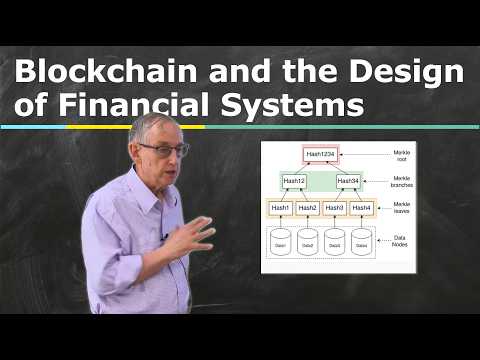 Watch on YouTube →
Overview
Robert M. Townsend introduces MIT's 14.129 Blockchain and the Design of Financial Systems course, emphasizing a synthesis of computer science (cryptocurrency, blockchain, tokenization) and economics (contract theory, mechanism design). The course explores the assumptions and shortcomings of distributed ledgers, smart contracts, and encryption, examining their impact on legacy financial systems and potential for new designs, with a focus on objective analysis beyond hype. The lectures cover topics from blockchain fundamentals and financial accounts to algorithmic flows, mechanism design, and encryption applications in auctions and matching.
Key takeaways
- The course 14.129 aims to bridge computer science concepts like blockchain and encryption with economic theories like contract design and general equilibrium.
- Distributed ledgers and smart contracts offer potential solutions for improving financial infrastructure by enabling atomic settlement and addressing coordination problems.
- Algorithmic flows on networks and advanced encryption techniques (fully homomorphic encryption, zero-knowledge proofs) are crucial for complex financial operations like multilateral settlement and secure auctions.
- The course emphasizes an objective, analytical approach, moving beyond the hype surrounding blockchain and cryptocurrencies to explore practical use cases and implications for policy designers.
- Historical economic concepts, such as Bagehot's analysis of money markets and the CAP theorem, provide foundational context for understanding modern financial system design challenges.
- Mechanism design principles are applied to ensure incentives align with protocols, addressing issues of trust and Byzantine fault tolerance in decentralized systems.
Chapters
- Course 14.129 focuses on Blockchain and the Design of Financial Systems, blending computer science and economics.
- Key computer science terms: cryptocurrency, blockchain, tokenization, platforms, computational algorithms.
- Key economics terms: contract theory, mechanism design, general equilibrium theory, monetary theory.
- Objective: understand assumptions/shortcomings of distributed ledgers, smart contracts, encryption, and their impact on financial systems.
- Both blockchains and financial accounts function as databases of transactions.
- Blockchains are associated with cryptocurrencies (e.g., Bitcoin), while financial accounts track fiat money or demand deposits.
- Both systems can incorporate multiple objects (goods, assets, certificates) and can support multiple forms of money.
- Blockchains are fundamentally a way to write and execute contracts, generalizing the concept of balance and state changes.
- The CAP theorem states that distributed systems cannot simultaneously achieve consistency, availability, and partition tolerance.
- This trilemma necessitates making choices in system design.
- The concept can be applied to interpret village and contemporary economies, highlighting inherent trade-offs.
- Featured readings include works by Agustin Carstens, Paul Krugman, and research on cryptocurrency use in Kenya.
- Lecture 3 explores using distributed ledgers to address problems in fragmented financial markets.
- Focuses on regulatory solutions and using distributed ledgers to solve information problems.
- Examines how to achieve competitive or efficient outcomes in markets with constraints, using a community perspective.
- Discusses the inadequacy of decentralized systems for achieving efficient Walrasian allocation and the need for liquidity-saving mechanisms.
- Lecture 4 features smart contracts as solutions to coordination problems in fragmented markets.
- Examines how privately issued securities can circulate but lead to crises if coordination fails.
- Discusses historical examples like Walter Bagehot's description of London money markets and periodic crashes.
- Addresses concerns in low/middle-income countries regarding uncoordinated digitization and liquidity issues in DeFi.
- Lecture 5 covers tokenized and programmable assets enabling atomic trade and settlement.
- Compares blockchain-based immediate settlement with legacy systems prone to trade fails (e.g., trillions in US Treasuries).
- Discusses challenges like information revelation during tokenization and the need for trust in escrow mechanisms.
- Explores proposals for cross-border exchange and unified ledgers from institutions like the BIS.
Summary, takeaways, and chapters were generated by AI from the video's transcript and may contain errors. The video belongs to its creator, MIT OpenCourseWare.