Lecture 08- PWBB III - Respiration II
 Watch on YouTube →
Overview
Animal size creates a diffusion challenge: as volume grows faster than surface area, organisms need strategies beyond direct exchange, including circulation and oxygen-binding respiratory pigments. The lecture compares open, closed, and intermediate circulatory systems across taxa, explains how hemoglobin, hemocyanin, chlorocruorin, and hemerythrin transport oxygen, and uses the salmon parasite Henneguya salminicola to show that even aerobic respiration is not universal among animals.
Key takeaways
- Because volume grows faster than surface area, large animals cannot rely on direct diffusion alone; circulation and oxygen-binding pigments help move gases between exchange surfaces and tissues.
- Open and closed circulatory systems are not a simple evolutionary hierarchy: both have arisen repeatedly, and groups such as sea cucumbers show intermediate arrangements.
- Insects combine open hemolymph circulation with a tracheal oxygen-delivery system; the larger Carboniferous insects likely benefited from higher atmospheric oxygen without a fundamentally different respiratory design.
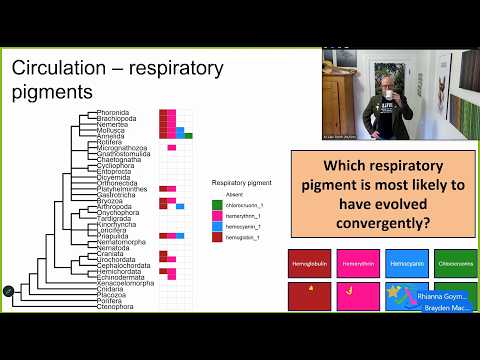
- Hemocyanin evolved independently in mollusks and arthropods, despite serving the same oxygen-transport role, while respiratory pigments differ in metal chemistry and oxygenated color.
- A left-shifted oxygen-binding curve helps animals such as Arenicola load oxygen in hypoxic mud, but makes oxygen release to tissues more difficult.
- Henneguya salminicola demonstrates that aerobic respiration is not essential in every animal lineage: this salmon parasite has lost genes for the pathway.
Chapters
0:00
The 1-Millimeter Diffusion Challenge and Respiration Recap
- The lecture continues the “problems with being big” unit, building on gas exchange through skin, gills, tracheae, and lungs.
- Flatworms illustrate a geometric solution to limited diffusion: a long, thin body keeps tissues close to the external surface.
- The Schmidt Ocean Institute’s deep-sea expedition aboard Falkor (too), using ROV SuBastian, is mentioned as a source of live ocean exploration.
4:05
Surface Area, Fick’s Law, and Why Large Animals Need Circulation
- Surface area scales with length squared while volume scales with length cubed, so a round organism’s oxygen demand can outgrow its exchange surface.
- Fick’s law predicts faster diffusion when the concentration gradient across a membrane is larger.
- Circulating fluid carries oxygen from gas-exchange surfaces to tissues and returns carbon dioxide; it also transports nutrients, wastes, hormones, and immune components.
8:27
Open Circulation in Bivalves and Other Invertebrates
- Open and closed circulation are useful categories, not a strict evolutionary split: both systems have evolved multiple times.
- In an open system, a heart or other pumping action moves hemolymph into body spaces where it directly bathes organs.
- Bivalve gills serve in both feeding and respiration; their heart pumps fluid through vessels, while countercurrent flow helps maintain an oxygen gradient.
- Open systems generally operate at lower pressure and offer less control over flow rate, but are widespread among arthropods and non-cephalopod mollusks.
13:57
Insect Circulation, Tracheae, and Carboniferous Giant Insects
- Insects have an open circulatory system: abdominal muscle activity and accessory pumps help move hemolymph through the body.
- Insect oxygen delivery relies primarily on the tracheal system, which brings air through body openings toward tissues.
- Fossil evidence indicates that very large Carboniferous insects retained the basic tracheal infrastructure seen in modern insects.
- Higher atmospheric oxygen in the Carboniferous likely helped support larger insects; at today’s oxygen levels, their respiratory system would constrain extreme body size.
17:53
Closed Systems in Cephalopods, Earthworms, and Sea Cucumbers
- Closed circulation keeps blood within vessels that branch from arteries to arterioles and capillaries, bringing exchange surfaces close to working tissues.
- Active cephalopods such as octopuses, squid, and cuttlefish have a highly developed closed system suited to a mobile predatory lifestyle.
- Earthworms circulate blood through vessels and aortic arches; segmentation may help explain why elaborate vessel networks occur in annelids.
- Sea cucumbers combine developed vessels with open sinuses and hundreds of muscular pumping structures, placing their circulation between simple open and fully closed systems.
24:46
Ribbon Worms Combine Flat-Body Diffusion with Internal Circulation
- Nemertean ribbon worms can reach meters in length while exchanging gases across a long, flattened body surface.
- A muscular rhynchocoel and paired lateral vessels move hemolymph through the body, supplementing surface-based diffusion.
- Their circulation includes sinus-like spaces that approach capillary-like intimacy with tissues without forming a fully conventional closed network.
28:00
Four Respiratory Pigments and the Evolution of Hemocyanin
- Hemoglobin, hemocyanin, chlorocruorin, and hemerythrin bind oxygen and help transport it through circulatory fluid; their metal chemistry produces distinct blood colors.
- Hemoglobin is red when oxygenated and contains iron; hemocyanin is copper-based and blue when oxygenated; chlorocruorin is green when oxygenated; hemerythrin is violet or pink when oxygenated.
- Hemocyanins in mollusks and arthropods are functionally similar but evolved independently, as shown by differences in their protein-coding sequences.
- Hemoglobin is broadly distributed across animals and also has structurally related forms in plants; genomic research has expanded the known distribution of hemerythrin.
38:41
Hill Curves Show Oxygen Affinity and Environmental Adaptation
- A Hill curve plots oxygen saturation against partial pressure and shows how readily a respiratory pigment loads and releases oxygen.
- A left shift indicates greater oxygen affinity: loading at the gills is favored, but unloading at tissues becomes harder; a right shift favors release.
- Temperature, pH, salinity, water content, and environmental oxygen availability can alter pigment performance.
- The annelid Arenicola, which inhabits oxygen-poor mud, has high-affinity hemoglobin; Eudistylia requires a well-oxygenated environment.
43:37
Henneguya salminicola Challenges the Rule of Animal Respiration
- Henneguya salminicola is a highly reduced myxozoan cnidarian parasite found in salmon, not an apicomplexan protozoan.
- Research reported in 2020 found that it lacks genes associated with aerobic respiration, showing that this metabolic pathway is not universal among animals.
- Its parasitic evolution involved morphological, genomic, and biochemical reduction from a free-living cnidarian ancestor.
- The lecture closes by previewing excretion and reminding students about the group project, the postponed dichotomous-key lab, and the Friday deadline for the Invert R assignment.
Summary, takeaways, and chapters were generated by AI from the video's transcript and may contain errors. The video belongs to its creator, Alex Smith.