Lecture 07- PWBB II - Respiration I
 Watch on YouTube →
Overview
Alex Smith frames invertebrate respiration through Fick’s law: gas exchange improves with greater surface area and concentration gradients, and with thinner exchange barriers. Examples including cutaneous respiration, gills, plastrons, book lungs, and tracheae show how animal structures and behaviors work within those physical constraints, while coastal eutrophication and winter lake ice illustrate how oxygen availability changes across ecosystems.
Key takeaways
- Fick’s law gives three actionable routes to improve diffusion: enlarge the exchange surface, reduce barrier thickness, or maintain a larger concentration gradient.
- Water-moving behaviors—including planarian or spoonworm movement and the crustacean scaphognathite’s beating—reduce boundary layers and bring oxygen-rich medium to respiratory surfaces.
- Cutaneous respiration requires moist, thin skin and substantial surface area, favoring flattened body forms; rising temperature can sharply increase oxygen demand, as in the flatworm comparison between about 30°C and 12–13°C.
- Countercurrent flow in gills helps sustain oxygen transfer, while increased gill folding and whorls provide more exchange area as animals grow.
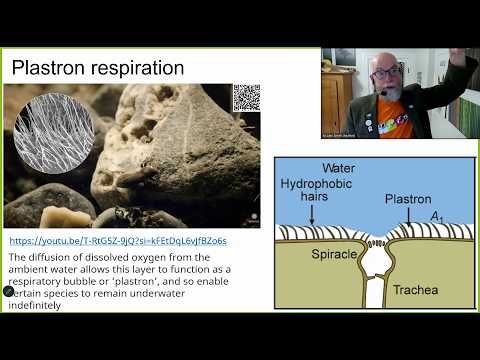
- Plastron-bearing aquatic insects use hydrophobic hairs to hold an air layer that exchanges oxygen and carbon dioxide with surrounding water, enabling underwater respiration without surfacing.
- Coastal eutrophication depletes oxygen through nutrient-driven biomass growth and bacterial decomposition; winter ice can also cause lake hypoxia by restricting both photosynthesis and atmospheric oxygen replenishment.
Chapters
0:00
Respiration as a Challenge for Large Invertebrates
- The lecture continues the course theme of problems associated with being large, following earlier material on mating and arthropod molting.
- Arthropod chitinous exoskeletons are also respiratory surfaces, linking body structure to gas exchange.
- The plan covers diffusion, respiratory surfaces, and oxygen-depleted marine and lake environments; circulation is reserved for the next lecture.
4:54
Fick’s Law: Surface Area, Barrier Thickness, and Concentration
- Animal gas exchange brings oxygen into the body and releases carbon dioxide produced by cellular respiration.
- Fick’s law predicts faster diffusion with greater respiratory surface area and a larger concentration gradient, and with a thinner barrier.
- The diffusion coefficient also depends on temperature, fluid, and material; diffusion behaves very differently in water than in air.
11:00
Boundary Layers and Behavior-Driven Water Flow
- Slow flow over a planarian creates a thick boundary layer where water velocity declines near the body, limiting access to fresh, oxygen-rich water.
- Faster movement reduces the boundary layer and helps maintain a stronger oxygen gradient across the respiratory surface.
- A spoonworm’s body movements and a crustacean’s scaphognathite, or gill bailer, move water across exchange surfaces to improve diffusion.
18:50
Cutaneous Respiration and the Constraints of Body Shape
- Cutaneous respiration occurs directly across moist, highly vascularized skin and appears across diverse groups, including flatworms, nematodes, mollusks, and sponges.
- Thin skin and a large exchange area favor long, flat body shapes; some species use this strategy only during particular life stages.
- A flatworm consumed nearly three times as much oxygen at about 30°C as at 12–13°C, illustrating how temperature changes respiratory demand.
27:10
Gills: Folded Surfaces and Countercurrent Exchange
- Many larger marine invertebrates, including bivalves, annelids, crustaceans, and cephalopods, use thin, folded gills supplied with blood or other body fluids.
- Cilia and environmental currents move water across gills, while countercurrent flow helps preserve an oxygen gradient along the exchange surface.
- As body size increases in the illustrated taxa, additional gill whorls increase surface area to meet greater respiratory needs.
32:00
Plastrons Let Diving Insects Exchange Gases Underwater
- Some beetles and true bugs retain a thin air layer, called a plastron, using dense, hydrophobic hairs on their bodies.
- The plastron acts like a replenished underwater breathing supply: oxygen diffuses from surrounding water into the air layer, while carbon dioxide diffuses outward.
- Unlike insects that close their spiracles and hold their breath underwater, plastron-breathing beetles can exchange gases without surfacing.
35:00
Spider Book Lungs and the Snail Pneumostome
- Spider book lungs are modified abdominal appendages with alternating air spaces and hemolymph-filled tissue; some spiders also have tracheae.
- The terrestrial snail Cepaea nemoralis breathes through a lung-like cavity that opens to the air through a pneumostome.
- In laboratory hypoxia, the snail increased both the number of pneumostome openings and the proportion of time spent opening them.
41:00
Insect Tracheae, Molting, and Limits on Body Size
- Insect tracheae are inward-folded tubes that carry air from spiracles through branching tracheoles directly to tissues, sometimes reaching muscle cells.
- Because parts of the tracheal system are shed during molting, respiration can be disrupted during that process.
- Diffusion-dependent tracheal systems constrain insect body size; Carboniferous insects with dragonfly-like wingspans of roughly 4–5 feet may have benefited from higher atmospheric oxygen.
44:48
Human-Caused Coastal Hypoxia and Eutrophication
- Documented marine hypoxic areas and areas of concern are increasing, especially in coastal systems near human activity.
- Nitrate and phosphate inputs can drive eutrophication, phytoplankton growth, and biomass accumulation.
- Bacterial decomposition of the resulting organic waste consumes oxygen, creating hypoxic dead zones.
48:44
Winter Lake Hypoxia, Climate Questions, and Course Tasks
- When ice covers northern temperate lakes, it reduces light-driven oxygen production and limits replenishment from the air-water interface while aquatic animals continue using oxygen.
- Smith raises an open question about how shorter or absent ice cover under climate change could alter winter hypoxia and later effects on lake animals.
- Course reminders include a three-minute assignment due October 9 as a YouTube link, ImageJ calculations due to Dropbox within 24 hours of the field excursion, and group preparation for case studies.
Summary, takeaways, and chapters were generated by AI from the video's transcript and may contain errors. The video belongs to its creator, Alex Smith.