Lec8 Review for Exam1 M2001 Odd Even Function, Transformation, Domain, Range, Inverse Function
 Watch on YouTube →
Overview
Shahera Jannah reviews the M2001 Exam 1 topics, including line equations and linear models, function tests, odd/even symmetry, graph transformations, domains and ranges, and finding inverse functions. The review emphasizes showing algebraic work, identifying domain restrictions from radicals and denominators, and applying transformations in order; the exam is described as having no calculator section.
Key takeaways
- For the score data (130, 470) and (142, 386), the linear model is s = −7m + 1,380; the negative slope represents a 7-point decrease per additional study minute across those two observations.
- A $10 price increase paired with a 5-package sales decrease produces N(p) = −(1/2)p + 250, with price p as input and package count N(p) as output.
- A graph passes the function test only if every vertical line intersects it at most once; a circle and a vertical line fail, while a standard parabola passes.
- Radical and denominator restrictions must be combined: √x with denominator 1 − √x has domain [0, 1) ∪ (1, ∞), while 1/√(4 − x²) has domain (−2, 2).
- In f(x) = −g(x + 1) − 2, the negative outside reflects across the x-axis, x + 1 shifts left 1, and −2 shifts down 2; apply the reflection before translating.
- To find the inverse of f(x) = (2 − 3x)/(4x + 5), swap x and y and solve, yielding f⁻¹(x) = (2 − 5x)/(4x + 3).
Chapters
0:00
Exam Review Scope: Line Equations and Slope Relationships
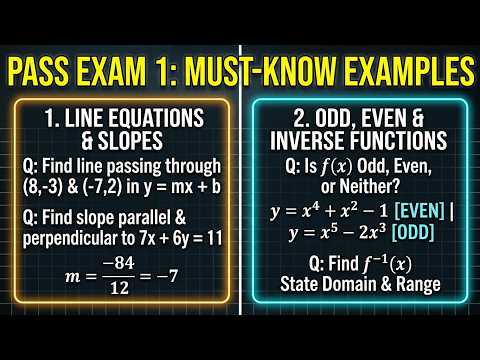
- The review begins with line equations through two points, through one point with a given slope, and for parallel or perpendicular lines.
- Parallel lines have the same slope; perpendicular slopes are negative reciprocals.
- For standard form ax + by = c, the slope shortcut is −a/b; the examples include slopes −7/6 and 5/8.
4:00
Linear Score Model from Two Study-Time Data Points
- The study-score data are (130 minutes, 470 points) and (142 minutes, 386 points).
- The slope is (386 − 470)/(142 − 130) = −7 points per minute.
- Using b = y − mx gives an intercept of 1,380, so the model is s = −7m + 1,380.
- The instructor says the exam has no calculator section and stresses showing work for both slope and intercept.
10:00
Package Sales Model: Price as Input, Packages as Output
- At a price of $100, sales are 200 packages; raising the price by $10 reduces sales by 5, giving the second point (110, 195).
- The slope is −5/10 = −1/2 package per dollar, and the intercept is 250.
- The requested function is N(p) = −(1/2)p + 250; use N(p) and p rather than generic y and x in the final answer.
- The example highlights interpreting which quantity is the input and which is the function output.
17:00
Recognizing Functions with Graphs and Equations
- The vertical line test checks graphs: a circle fails because some vertical lines intersect it twice, while a downward-opening parabola passes.
- A vertical line fails the test and therefore is not a function of x.
- For equations, the key idea is whether each input x determines only one output y; the lesson also presents a shortcut based on powers of y.
21:00
Even Polynomial Patterns and Constant Shifts
- The lesson identifies x⁴, x², and their sums as even functions because replacing x with −x leaves their values unchanged.
- Adding or subtracting a constant preserves evenness; for example, x⁴ − 1 remains even.
- The graph-based explanation is symmetry about the y-axis, which remains after a vertical shift.
25:00
Testing Odd and Even Functions by Substitution
- For f(x) = x⁴ − 2x + 1, replacing x with −x changes the middle-term sign, so the function is neither even nor odd.
- The algebraic tests are f(−x) = f(x) for evenness and f(−x) = −f(x) for oddness.
- The lesson demonstrates evaluating at 1 and −1 as an informal check, but matching values at a single pair does not by itself prove a function is even or odd.
35:00
Why Adding a Constant Usually Breaks Odd Symmetry
- An odd function such as x³ has origin symmetry, while adding a nonzero constant shifts the graph vertically and generally removes that symmetry.
- The example x³ + 3 is described as neither odd nor even after its vertical shift.
- By contrast, a vertical shift of an even function preserves its y-axis symmetry.
39:00
Parity Checks for Rational and Mixed Expressions
- The expression 1/x² + 7 is even because replacing x with −x leaves the value unchanged.
- For a mixed expression such as x³/(x² + 1), the lesson compares values at 1 and −1 to illustrate odd behavior.
- The example (x²)/(1 − x³) is treated as neither even nor odd; its domain also excludes x = 1.
- The instructor advises checking mixed odd/even combinations instead of classifying them by appearance alone.
48:00
Fractional Powers and Symmetry Types
- A function involving x^(2/3) is examined at 1 and −1; both inputs produce the same output, illustrating even behavior.
- Even functions are symmetric about the y-axis; odd functions have symmetry about the origin.
- The review distinguishes x-axis, y-axis, and origin symmetry, though the reliable algebraic tests are the identities f(−x) = f(x) and f(−x) = −f(x).
55:00
Reading Domain and Range from Graphs
- Domain records x-values and range records y-values.
- Use parentheses for excluded endpoints such as holes and brackets for included endpoints such as closed circles.
- If a graph extends without omissions across all x-values or y-values, the corresponding interval can be (−∞, ∞).
1:00:00
Domain Rules for Radicals and Rational Functions
- For a square root in the numerator or elsewhere outside a denominator, require the radicand to be greater than or equal to zero.
- For a denominator, require the entire denominator to be nonzero and exclude its zeros from the domain.
- When several factors determine a radical inequality, find critical values and use a number line to test intervals.
1:06:00
Domain Example: Radical in a Denominator
- For the example with √x and denominator 1 − √x, the radical requires x ≥ 0.
- The denominator vanishes at x = 1, so that value must be excluded.
- Combining both restrictions gives the domain [0, 1) ∪ (1, ∞).
1:10:00
Domain Example: Square Root of 4 − x² in the Denominator
- For a denominator containing √(4 − x²), the radicand must be strictly positive because a zero denominator is not allowed.
- Solving 4 − x² > 0 gives −2 < x < 2.
- The domain is (−2, 2); unlike a numerator radical, the endpoints cannot be included.
1:14:00
Transformation Rules for Reflections and Shifts
- A negative sign outside a function, as in −f(x), reflects its graph across the x-axis.
- A negative input, as in f(−x), reflects across the y-axis.
- An inside shift f(x + 2) moves left 2, while an outside shift f(x) + 1 moves up 1.
1:20:00
Transforming a Graph with Reflection and Translation
- For −f(x + 1) − 2, first reflect the original graph across the x-axis, then move it left 1 and down 2.
- The worked graph uses key points, including the origin and points at x = −1 and x = 1, to track the transformation.
- The reflected graph is translated only after the reflection is completed.
1:23:00
Applying the Same Transformation to a Second Graph
- A second example repeats the reflection across the x-axis, followed by a 1-unit shift left and a 2-unit shift down.
- The graph is reconstructed by reflecting its bends and turning points, then translating each point.
- The example distinguishes the original graph, the reflected graph, and the final translated graph.
1:27:00
Finding the Inverse of a Rational Function
- For f(x) = (2 − 3x)/(4x + 5), the procedure is to write y, swap x and y, and solve for y.
- After cross-multiplying and collecting y terms, the inverse is f⁻¹(x) = (2 − 5x)/(4x + 3).
- The instructor notes that graphing is not required for this algebraic inverse problem.
1:30:35
Closing Exam Advice and a Quick Parity Check
- The closing reminders are to arrive on time, study strategically, and email questions if needed.
- A student asks whether substituting 1 and −1 can simplify odd/even checks; the instructor says it can be used as a shortcut.
- For a conclusive classification, compare the full expressions f(−x), f(x), and −f(x), since one pair of numerical evaluations may not establish a general identity.
Summary, takeaways, and chapters were generated by AI from the video's transcript and may contain errors. The video belongs to its creator, Shahera Jannah's Math World! 😁😎.