Lec7 Sec1.9 M2001 Inverse Function
 Watch on YouTube →
Overview
Shahera Jannah explains that an inverse function reverses the input-output relationship of a one-to-one function, so its domain and range switch and its graph reflects across y = x. She demonstrates how to find inverse values and equations by swapping x and y, tests one-to-one functions with horizontal lines, checks inverses by composition, and evaluates piecewise functions using their specified domains.
Key takeaways
- An inverse reverses function pairs: if f(a) = b, then f⁻¹(b) = a, and the original domain and range become the inverse range and domain.
- Only one-to-one functions have inverses that are functions; graphically, test one-to-one behavior with horizontal lines after confirming the vertical line test.
- To find an inverse equation, write y = f(x), swap x and y, and solve for y; for f(x) = (2 − 3x)/(4x + 5), this produces f⁻¹(x) = (2 − 5x)/(4x + 3).
- The graphs of f and f⁻¹ reflect across y = x, because every point (a, b) on the original becomes (b, a) on the inverse.
- To verify inverse functions algebraically, check both compositions, f⁻¹(f(x)) = x and f(f⁻¹(x)) = x; testing one input is only a quick spot-check.
- For a piecewise function, select the formula whose domain condition contains the input before evaluating, and carefully preserve signs when combining branch results.
Chapters
0:00
Chapter 1 Exam Plans and Chapter 1 Review
- The first exam is scheduled for the following Tuesday and covers topics listed on the Brightspace review sheet.
- Students are asked to bring review questions for Friday; the planned exam is about 20 questions with 1 hour 40 minutes to complete it.
- Homework provides extra practice, but class time focuses on topics identified for the exam.
5:34
Inverse Notation and the Input-Output Relationship
- The notation f⁻¹(x) means the inverse function, not the reciprocal 1/f(x); parentheses around the whole function indicate the reciprocal.
- If f(a) = b, then f⁻¹(b) = a: an inverse reverses the original function’s input and output.
- The domain of f becomes the range of f⁻¹, while the range of f becomes the domain of f⁻¹.
8:35
Reversing Function Mappings to Find Inverse Pairs
- For a mapping that sends input 1 to output 5, the inverse mapping sends 5 back to 1.
- To construct an inverse mapping, reverse each input-output pair, which swaps the original domain and range.
- The notation f⁻¹ identifies the inverse of f; it does not mean raising f to the power −1.
11:00
Why Inverses Require One-to-One Functions
- A function assigns exactly one output y to each input x; an inverse function also needs each output to come from exactly one input.
- A function is one-to-one when distinct inputs do not share the same output, allowing the reversed input-output pairs to remain a function.
- A function that maps multiple x-values to the same y-value cannot have an inverse function unless its domain is restricted.
14:22
Finding Inverse Values Without Finding the Full Inverse
- To find f⁻¹(1) for f(x) = √(8x + 17), set f(x) = 1 and solve: 1 = √(8x + 17), giving x = −2.
- The result f⁻¹(1) = −2 means f(−2) = 1; the inverse’s input becomes the original function’s output.
- For f(x) = 7x + 1, solving f(x) = 0 gives f⁻¹(0) = −1/7.
28:11
Switching the Domain and Range of an Inverse
- If f has domain [−5, ∞) and range [0, ∞), then f⁻¹ has domain [0, ∞) and range [−5, ∞).
- The interval endpoints and inclusion symbols follow the original sets; the operation is to exchange domain and range.
- This set relationship is the same input-output reversal used to find individual inverse values.
30:38
Testing One-to-One Functions with Horizontal Lines
- The vertical line test checks whether a graph is a function; the horizontal line test checks whether that function is one-to-one.
- A graph that passes the horizontal line test has an inverse that is also a function.
- Passing the horizontal test alone is not enough: a graph must first pass the vertical line test to be a function.
36:36
Inverse Graphs Reflect Across y = x
- The graph of an inverse is the reflection of the original function’s graph across the line y = x.
- A square-root curve and a cubic curve illustrate how reflecting across y = x swaps their x- and y-coordinates.
- Each point (a, b) on f corresponds to the point (b, a) on f⁻¹; slow growth in one graph can appear as faster growth in its reflected inverse.
46:09
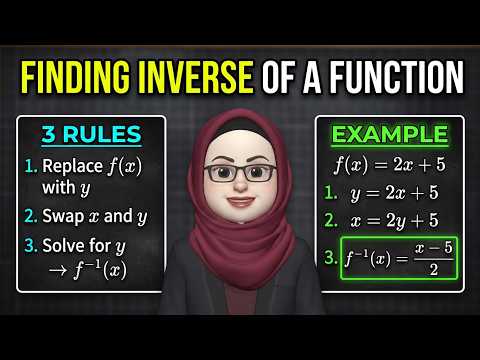
Three Steps for Finding an Inverse Equation
- Rewrite f(x) as y so the equation contains both variables.
- Swap x and y, then solve the new equation for y; the resulting expression is f⁻¹(x).
- For f(x) = ¼x − 2, swapping gives x = ¼y − 2, and solving yields f⁻¹(x) = 4x + 8.
50:18
Solving a Rational Inverse with Two y-Terms
- For f(x) = (2 − 3x)/(4x + 5), first swap x and y to get x = (2 − 3y)/(4y + 5).
- Clear the denominator by multiplying both sides by 4y + 5, producing 4xy + 5x = 2 − 3y.
- Collect the y-terms and factor: y(4x + 3) = 2 − 5x, so f⁻¹(x) = (2 − 5x)/(4x + 3).
55:20
Finding Another Rational Inverse Step by Step
- For f(x) = (6x + 1)/(1 − 7x), swapping variables gives x = (6y + 1)/(1 − 7y).
- After clearing the denominator and grouping terms, x − 1 = y(6 + 7x).
- Solving for y gives f⁻¹(x) = (x − 1)/(6 + 7x), equivalent to the form (1 − x)/(−6 − 7x).
1:06:15
Checking Inverses by Composition
- Two functions are inverses when composing them in either order returns the input: f⁻¹(f(x)) = x and f(f⁻¹(x)) = x.
- For the rational example, f(0) = 1 and the proposed inverse gives f⁻¹(1) = 0, providing a quick spot-check of the reversed pair.
- A single input check is not a proof; the homework method is to verify the compositions algebraically.
1:10:20
Graphing a Two-Branch Piecewise Function
- A piecewise function uses separate equations on specified parts of the domain; each branch is graphed only where its condition applies.
- The example uses y = 2x + 3 for x ≤ 1 and y = −x + 4 for x > 1.
- The first branch includes x = 1, while the second branch applies only to inputs greater than 1.
1:13:46
Evaluating Piecewise Values from Their Domains
- For the example branches, f(0) = 3 because 0 ≤ 1 and the applicable rule is 2x + 3.
- At x = 1, use the first branch because its condition is x ≤ 1; this gives f(1) = 5.
- At x = 4, use the second branch, −x + 4, giving f(4) = 0.
1:17:18
Choosing the Correct Branch in a Multi-Rule Function
- A later exercise has three domain-defined rules and asks students to evaluate separate inputs before combining the results.
- The same selection procedure works with any number of branches: match each input to its domain condition, then use that rule.
- The exercise is intended as exam practice, with the instructor noting that similar questions may appear on the exam.
1:20:00
Combining Piecewise Results and Handling Negative Signs
- In the class exercise, the evaluated branch results include −1, 1, and −24; students then combine them according to the requested expression.
- The combined arithmetic is −9 + 1 + 24 = 16, with the positive 24 arising from subtracting a negative result.
- Students are warned that exam inputs and expressions may be rearranged, so they must identify each domain and track subtraction signs carefully.
1:25:12
Exam Reminders and Equivalent Rational-Inverse Forms
- The class closes Chapter 1 and reminds students to review the posted sheet and bring questions for Friday before the Tuesday exam.
- For the inverse (x − 1)/(6 + 7x), factoring out −1 from both numerator and denominator gives (1 − x)/(−6 − 7x), an equivalent expression.
- The final reminder is to complete the Chapter 1 homework and check sign changes when rewriting rational expressions.
Summary, takeaways, and chapters were generated by AI from the video's transcript and may contain errors. The video belongs to its creator, Shahera Jannah's Math World! 😁😎.