Lec6 Sec1.6-7-8 M2001 Trasformation of Different types of functions, Composition, Decomposition
 Watch on YouTube →
Overview
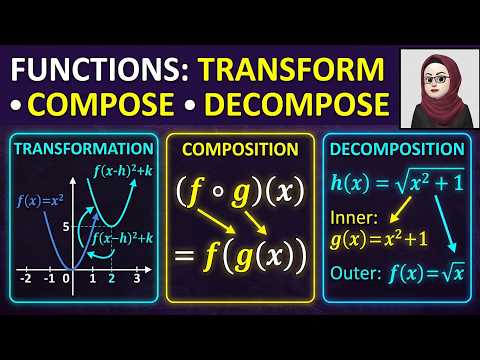
Shahera Jannah teaches parent-function graphs and transformations, then explains how to evaluate, solve, and decompose composite functions. The lesson covers eight parent graphs, shifts, reflections, and scaling, followed by composition examples using equations, graphs, and tables—including solving a composite-function equation with solutions x = 5 and x = -1.
Key takeaways
- A vertical translation is written outside the function, while a horizontal translation is written inside with the opposite sign: f(x + 2) + 5 shifts f left 2 and up 5.
- A negative sign outside a function reflects its graph across the x-axis; a negative input, as in f(−x), reflects it across the y-axis.
- To evaluate f(g(a)), find g(a) first and use that output as the input to f; reversing the order generally produces a different value.
- When composing from graphs or tables, read the inner function's y-value first, then use that number as the outer function's x-input.
- If a composite function is set equal to a value but no input is given, first form and simplify the composite; the example g(f(x)) = 4 reduces to x² − 4x − 5 = 0, with solutions 5 and −1.
- Decomposition identifies an inner expression and an outer rule, but multiple pairs of functions can sometimes produce the same composite.
Chapters
0:00
Course Plan, Exam Scope, and Sections 1.6–1.8
- The class begins Sections 1.6 and 1.7 on function graphs and transformations, then moves to Section 1.8 on composite functions.
- Shahera estimates the upcoming exam review will cover Sections 1.2–1.8, depending on what the class completes.
- She says the exam is scheduled for the following Tuesday, not the next Tuesday.
4:45
Eight Parent Functions and Their Reference Points
- The parent functions reviewed are y = x, y = |x|, y = √x, y = x², y = x³, and y = 1/x.
- The lesson adds exponential functions of the form a·bˣ and logarithmic functions of the form a·log_b(x).
- The exponential parent graph passes through y = 1 when x = 0; the logarithmic parent graph passes through x = 1 when y = 0.
- For many other parent graphs, the origin is the reference point used to understand translations.
10:51
Vertical and Horizontal Shifts, Reflections, and Scaling
- Adding a constant outside a function shifts it vertically: x² + 2 moves up 2, while x² − 2 moves down 2.
- Horizontal shifts use the opposite sign inside the function: √(x + 2) moves left 2, while (x − 2)³ moves right 2.
- A negative sign outside a function reflects its graph across the x-axis; a negative input inside reflects it across the y-axis.
- Multiplying a function by a factor greater than 1 makes its graph vertically narrower, while a fraction between 0 and 1 makes it wider.
17:32
Writing Equations for Shifted and Reflected Parent Graphs
- Starting from y = x², a shift up 2 is written x² + 2, and a shift right 2 is written (x − 2)².
- For y = √x, reflecting across the x-axis gives −√x, while reflecting across the y-axis gives √(−x).
- Combining a left shift of 2 with an x-axis reflection gives −√(x + 2).
- The equation's position of a sign or constant identifies which transformation is applied.
21:05
Reflecting a Given Function Graph Across the Axes
- For −f(x), each point (x, y) becomes (x, −y), so points above the x-axis move below it and vice versa.
- The example graph keeps its x-intercepts at −1 and 1 under an x-axis reflection, while its peaks and valleys switch vertical positions.
- For a negative input, f(−x), the graph is reflected across the y-axis: left-side features move right and right-side features move left.
29:02
Combining Graph Reflections and Translations
- The class practices applying more than one transformation by first reflecting a graph and then shifting the reflected result.
- For a combined transformation, the order shown in the equation is followed; the example −f(x − 1) reflects across the x-axis and shifts right 1.
- A separate graph example uses a shift left 2 and up 3, with the log graph's x = 1 reference point helping identify the translation.
34:00
Recognizing Exponential and Logarithmic Graph Anchors
- The exponential parent graph is identified by its y-intercept at 1, while the logarithmic parent graph has its x-intercept at 1.
- Translations move these anchor points along with the rest of the graph, which helps distinguish horizontal and vertical shifts.
- The class uses graph position and recognizable reference points to identify transformations from displayed options.
38:06
Graphing a Reflection Followed by a One-Unit Shift
- For −f(x − 1), the example first reflects the original graph across the x-axis and then shifts every point one unit right.
- The reflected graph is drawn as an intermediate step so the second translation can be applied to its peaks, corners, and intercepts.
- For −f(x) − 1, the graph is reflected across the x-axis and then moved one unit down.
41:05
Applying Vertical Shifts to a Reflected Graph
- The class reuses the reflected graph from the prior example and lowers each recognizable point by one unit.
- A point with y-value 1 moves to y = 0, and a point with y-value 0 moves to y = −1.
- Shifting the transformed graph point by point preserves its shape while changing its vertical position.
47:46
Writing a Function After Left and Up Translations
- A graph translated two units left and five units up is represented by f(x + 2) + 5.
- The horizontal shift is written inside the function, with the opposite sign; the vertical shift is added outside.
- Shahera marks Sections 1.6 and 1.7 complete and directs students to begin their homework.
50:13
Composite Functions as One Function Inside Another
- A composite function inserts one function into another, like placing a pillow inside a pillowcase.
- With f(x) = √x and g(x) = x² + 1, f(g(x)) becomes √(x² + 1).
- The expression under the square root cannot be split across addition: √(x² + 1) is not √(x²) + √1.
53:51
Using f∘g Notation and Substitution Structure
- The notation f∘g means f(g(x)); g is the inner function and f is the outer function.
- To find f(g(x)), keep the outer function's structure and replace each x in it with the entire inner function.
- For f(x) = −x² + 1 and g(x) = 2x − 2, f(g(x)) is written −(2x − 2)² + 1 without requiring simplification.
57:17
Evaluating f(g(2)) and g(f(2)) in Inner-to-Outer Order
- With f(x) = x² + 5x and g(x) = 2x + 2, evaluate g(2) = 6 first, then calculate f(6) = 66.
- For g(f(2)), evaluate f(2) = 14 first, then calculate g(14) = 30.
- Reversing the order changes the result: f(g(2)) and g(f(2)) are generally not equal.
1:02:56
Evaluating Composite Functions from Equations
- For a second numerical example, the class finds g(1) = 4 and then substitutes 4 into f to obtain f(g(1)) = 11.
- The reverse order starts with f(1), then uses that output as the input to g.
- When the composite is evaluated at a given number, students can substitute step by step without first expanding the full composite formula.
1:07:28
Using a Graph to Find an Inner Function's Output
- The example asks for f(g(3)) when f(x) = x³/25 and g is given as a graph.
- At x = 3, the graph's open circle is excluded; the filled point gives g(3) = 5.
- Substituting 5 into f gives f(5) = 5³/25 = 5.
1:11:00
Finding f(g(2)) from Two Function Graphs
- The class reads g(2) from the graph of g, obtaining approximately 5.
- It then treats that output as the input to f and reads f(5) = 7 from the other graph.
- The key graph-reading sequence is input x into the inner function, read its y-value, then use that value as x in the outer function.
1:16:00
Composing a Function Table with a Function Graph
- For f(g(0)), the table gives g(0) = 2, and the graph then gives f(2) = −2.
- For g(f(0)), the graph first gives f(0) = 2, and the table then gives g(2) = 4.
- The same inner-to-outer rule works whether a function is supplied as a table, graph, or equation.
1:21:20
Solving a Composite-Function Equation by Factoring
- With g(x) = x/2 − 8 and f(x) = 2x² − 8x + 14, the lesson forms g(f(x)) before using the given output value.
- Substitution and simplification produce g(f(x)) = x² − 4x − 1; setting it equal to 4 gives x² − 4x − 5 = 0.
- Factoring as (x − 5)(x + 1) = 0 gives both solutions, x = 5 and x = −1.
1:28:18
Decomposing Composites and Identifying Inner and Outer Functions
- Decomposition reverses composition: identify the inner expression, then replace it with x in the remaining outer function.
- For √(2x² − 6), one valid decomposition is g(x) = 2x² − 6 and f(x) = √x, giving f(g(x)).
- Given f(x) = x² − 3, g(x) = 5x, and composite 25x² − 3, the composite is f(g(x)).
- The final examples show that a decomposition may have more than one valid answer; the class closes with homework reminders for Sections 1.4–1.8.
Summary, takeaways, and chapters were generated by AI from the video's transcript and may contain errors. The video belongs to its creator, Shahera Jannah's Math World! 😁😎.